



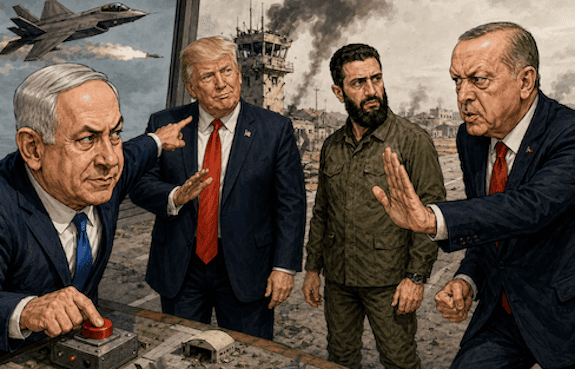
The Levant Files is probably right that neither Ankara nor Jerusalem wants an open Turkish-Israeli war. But “red snow” sets the bar too high. Abu al-Duhur showed that the real danger is not a deliberate declaration of war, but an Israeli strike that kills Turkish personnel, a Turkish response meant to restore deterrence, and an escalation neither government wanted but neither can politically afford to stop.
My dear friend Nikolaos Stelgias has supplied a wonderfully memorable answer to those forecasting an approaching Turkish-Israeli war: expect it when red snow falls. The argument he develops in The Levant Files, however, is considerably more serious than the flourish suggests. Turkiye and Israel may be increasingly bitter regional competitors, their rhetoric may be turning poisonous, their interests in Syria may be colliding and Gaza may have battered what remained of their political relationship, but neither side has a rational interest in crossing the line from rivalry into war.
That is persuasive. What is less persuasive is the implied certainty.
Stelgias’ follow-up, prompted by a private letter from someone he describes as being within the Israeli establishment, actually makes the case for caution stronger. The unidentified correspondent portrays Turkiye as a Hamas patron, Syria as an emerging Turkish satellite and Ankara as an expansionist power challenging Israel from the Eastern Mediterranean to Iran. More ominously, the letter raises the possibility of Israeli counter-pressure through northern Cyprus, obstruction of Turkish air-force modernisation and support for regional actors willing to contain Ankara.
Stelgias is right to warn against opening new fronts over existing disagreements. Yet his own evidence suggests that the problem is no longer whether Turkiye and Israel intend to fight. The problem is whether they can continue raising the stakes indefinitely without eventually miscalculating.
Red snow is the wrong metaphor because wars are not always launched after governments calmly conclude that war is preferable to peace. Quite often they arrive through a chain of limited decisions, each considered manageable, each justified as deterrence and each taken on the assumption that the other side will surely stop first.
History is full of governments discovering that the other side had made precisely the same calculation.
Abu al-Duhur changed the question
The Israeli strike on Syria’s Abu al-Duhur airbase on Aug. 18 should not be filed away as another entry in Israel’s long ledger of strikes on Syrian military infrastructure.
What made this one different was the Turkish dimension. Israel subsequently made clear that its concern was the possible deployment of Turkish forces at the base. Ankara denied that any such deployment had been planned and stressed that its cooperation with Damascus involved training, advice and support conducted with the Syrian government’s consent. Damascus likewise denied plans for a permanent Turkish base.
That distinction is not academic.
Israel was no longer merely targeting an Iranian weapons shipment, Hezbollah infrastructure or the remnants of the Assad military machine. It was signalling that it claimed a say over where and how another sovereign government might cooperate militarily with Turkiye.
Netanyahu’s reported message could scarcely have been more concise: “Don’t.” That one word contained an entire doctrine. Israel’s position is that a Turkish military presence beyond certain limits in Syria could pose an unacceptable security threat. Turkiye’s position is equally basic: Israel has no right to dictate Syria’s defence relationships or enforce its preferences by bombing Syrian territory.
Those positions can be deconflicted. They are much harder to reconcile. That is why Washington’s reaction mattered. U.S. envoy Tom Barrack reportedly described the attack as an “unnecessary escalation,” while the United States moved to strengthen deconfliction and information-sharing arrangements among Turkiye, Israel and Syria. Turkish and Israeli officials had already begun technical contacts in Azerbaijan in 2025 precisely to prevent their operations in Syria from producing an accidental confrontation.
There is a small irony here. If Turkish-Israeli war were genuinely as implausible as red snow, Washington would hardly need engineers to build guardrails around it.
The danger starts with body bags
Abu al-Duhur apparently produced no Turkish casualties. That may be the most important fact of all.
Now change only one variable. Imagine the same strike six months from now, but this time Turkish military technicians, pilots or advisers are at the facility. Israeli intelligence concludes that the site is becoming operational. Aircraft strike it. Turkish soldiers are killed. Then what?
No Turkish government could easily respond with a routine Foreign Ministry statement and move on. Ankara would face enormous pressure to demonstrate that killing Turkish personnel carries a cost. It might retaliate directly, deploy air-defence systems, escort Turkish aircraft in Syrian airspace, restrict Israeli freedom of action indirectly or provide Damascus with capabilities specifically intended to make another strike more expensive.
Israel would then face the mirror-image dilemma. If Turkish forces shot at an Israeli aircraft or imposed an effective military barrier to Israeli operations, could an Israeli government that had publicly defined Turkish deployment as a red line simply shrug? Probably not.
And there lies the danger. Neither side needs to choose war for both to begin climbing toward it.
The weakness in pure rational-deterrence arguments is that rational governments can simultaneously understand that war would be disastrous and believe that one more “limited” response is necessary to prevent the opponent from gaining the upper hand.
Wars have often been built out of limited responses.
The architects usually called them restraint.
Washington is the biggest brake, not a magic wand
Stelgias is right that the United States is perhaps the strongest constraint on escalation.
Washington has no interest in watching two of its most important regional security relationships start exchanging fire. Turkiye is a NATO ally. Israel is a major U.S. security partner. A Turkish-Israeli confrontation would create a strategic migraine for Washington at precisely the moment it is trying to stabilise Syria, contain Iran and shape a new regional order.
Yet NATO should not be romanticised into an automatic insurance policy.
Article 5 does not mean that every clash involving Turkish personnel anywhere in the region instantly becomes a NATO war. Geography matters. Circumstances matter. Political judgment matters. Turkish forces operating in Syria would present a more complicated legal and political problem than an attack on Turkish territory itself.
Ankara could certainly call for consultations under Article 4 if it believed its security threatened. But alliance politics would become complicated long before they became automatic.
Which is precisely why prevention matters.
No Turkish, Israeli or American policymaker should want to discover the finer points of NATO treaty interpretation after Turkish and Israeli aircraft have already started shooting at one another.
Gaza removed one of the old shock absorbers
I am less convinced by the argument that interdependence still provides the kind of restraint it once did.
For years, Turkiye and Israel possessed an extraordinary ability to quarrel politically while continuing to do business underneath the tablecloth. Trade continued. Tourism continued. Intelligence channels survived. Military contacts occasionally survived. Pragmatism repeatedly crawled out from under the wreckage of rhetoric.
Those networks acted as shock absorbers.
Gaza has damaged many of them.
Ankara’s language toward Netanyahu has become ferocious. Israel increasingly describes Erdoğan’s Turkiye not merely as an irritating former partner but as a possible strategic adversary. Turkiye’s move on Aug. 21 to seek an Interpol red notice for Netanyahu in connection with the Gaza flotilla case only added another layer of hostility.
Israel also has legitimate complaints about Ankara’s language on Hamas. That point should not be evaded in any serious Turkish analysis. Oct. 7 profoundly altered Israeli threat perceptions, and Turkiye has at times blurred the distinction between defending Palestinian rights and politically accommodating Hamas more than was either wise or necessary.
But Israeli criticism cannot freeze history on Oct. 7 and pretend everything afterwards is merely a footnote.
The devastation in Gaza, the humanitarian catastrophe and the continuing expansion of settlements in the West Bank have altered international opinion far beyond Ankara. Turkish anger cannot credibly be dismissed as simply Islamist sympathy for Hamas when governments and diplomatic communities across Europe and the Arab world are voicing increasingly severe objections to Israeli policy.
Two propositions can be true at once.
Hamas committed atrocities. Israeli policy does not therefore acquire permanent immunity from scrutiny.
Palestinian rights do not require romanticising Hamas. Israeli security does not justify classifying every critic of Gaza as part of an enemy camp.
Diplomacy usually begins once slogans lose their usefulness.
Syria is not Iran wearing another uniform
There is another mistake creeping into parts of the Israeli debate: treating Turkish influence in Syria as if Iranian influence had simply changed uniforms.
Israeli anxiety is understandable. Assad’s collapse removed Iran and Hezbollah from much of the strategic terrain they once occupied, while Turkiye emerged as the strongest external actor shaping the new Damascus. Israeli planners who spent decades worrying about hostile military infrastructure north of the Golan are not going to relax merely because the insignia have changed.
But Turkiye is not Iran.
It is a NATO member with dense political, economic and institutional ties to Europe and the United States. It has competed with Tehran in Syria, Iraq, the Caucasus and elsewhere. Turkish-Iranian relations contain cooperation, bargaining and tactical accommodation, but also deep geopolitical rivalry.
The claim in the Israeli letter cited by The Levant Files that Ankara and Tehran may be coordinating secretly to undermine Western strategy is, as Stelgias himself notes, unproven.
That does not mean every Turkish move in Syria should be treated as innocent.
Ankara clearly wants significant influence over the reconstruction of the Syrian state and its armed forces. It has security concerns regarding Kurdish armed groups, substantial economic interests and an obvious desire to prevent the post-Assad vacuum from being filled by hostile actors.
But influence is not automatically occupation.
And Israeli insecurity is not automatically sovereignty.
Israel cannot logically argue that Syria is sovereign when sovereignty is useful, but strategically incapacitated whenever Syrian choices become inconvenient.
That contradiction sits at the heart of the dispute.
Keep Cyprus out of this
The most troubling part of the anonymous Israeli letter is therefore not its criticism of Turkish policy in Syria.
It is the suggestion that Cyprus could become another arena for pressure against Ankara.
That would be recklessly shortsighted.
Cyprus already contains enough unresolved history, strategic anxiety and accumulated mistrust to sustain several crises of its own. Importing Turkish-Israeli competition into the island would not solve any problem. It would simply bolt one regional confrontation onto another.
Cyprus must not become a chessboard on which Israel punishes Ankara for Syria, just as Syria should not become a platform from which Turkiye threatens Israel.
The concern cannot be dismissed merely because the letter is anonymous. Israel’s strategic cooperation with Greece and the Republic of Cyprus is real and expanding. Military exercises are intensifying, Greece and Cyprus have acquired Israeli defence systems, and Athens is deepening cooperation with Israel in air defence, missiles and counter-drone capabilities.
There is nothing inherently illegitimate in that cooperation. States are entitled to build defence partnerships.
The danger begins if partnership becomes containment and Cyprus becomes leverage.
The Eastern Mediterranean already contains enough loaded weapons without adding loaded metaphors.
Erdoğan and Netanyahu know the price, which is not always reassuring
Stelgias is persuasive when discussing domestic politics. Erdoğan and Netanyahu are among the region’s most experienced political survivors. Neither is unfamiliar with nationalist mobilisation. Neither enjoys looking weak. Neither is likely to back away easily after publicly drawing a line.
That should reassure us only up to a point.
Economic pressure, electoral uncertainty and war fatigue all discourage a major conflict. Yet exactly the same conditions can encourage leaders to dramatise external threats, perform toughness and convert confrontation into political capital.
Domestic politics therefore cuts both ways.
A leader who wants to avoid war may still feel unable to ignore a challenge.
A government that wants de-escalation may still need a retaliatory gesture.
A retaliatory gesture can easily require another retaliatory gesture.
And suddenly everyone is acting responsibly on the way to disaster.
The same warning applies to Ankara. Turkiye should not answer every Israeli provocation by turning it into evidence of an inevitable civilisational struggle. Erdoğan’s rhetoric may energise domestic audiences, but diplomacy becomes much harder once both sides publicly eliminate their own exits.
Deterrence requires credibility.
Statecraft requires doors.
Unlikely is not the same as unthinkable
A deliberate Turkish decision to wage war against Israel remains extremely unlikely. So does an Israeli decision to launch a general war against Turkiye.
On that central point, Stelgias is right.
The balance of power discourages it. Washington would work furiously to stop it. Neither economy needs it. Neither society wants it. Turkiye has no strategic interest in replacing Iran as Israel’s principal enemy, while Israel has no rational interest in transforming NATO’s second-largest military into a permanent adversary.
But “unlikely” and “impossible” are not synonyms.
The relationship has crossed an important threshold.
Turkish and Israeli military interests now overlap physically in Syria. Israel has shown that it is prepared to use force to enforce its red lines against prospective Turkish deployments. Ankara has made clear that it rejects Israel’s right to draw such lines on Syrian territory. Gaza has hollowed out political trust. Regional alignments are hardening. Both governments have political incentives to look firm rather than flexible.
That is not yet a road to war.
But there is enough fuel beside the road to make smoking inadvisable.
The practical response should be neither hysteria nor complacency. Ankara and Jerusalem need a permanent military hotline, explicit geographic deconfliction arrangements in Syria, advance-notification mechanisms and American-backed understandings covering Turkish training missions, Syrian air-defence reconstruction and Israeli operations.
Azerbaijan can continue providing a discreet channel. Washington must remain directly engaged.
The harder requirement is political.
Israel must accept that post-Assad Syria cannot remain permanently weak simply because a stronger Syrian state might one day limit Israeli freedom of action. Turkiye, meanwhile, must recognise that rebuilding Syrian military capacity without transparency will inevitably trigger Israeli suspicions about what might eventually appear south of Damascus.
Perhaps Stelgias is right. Perhaps red snow will indeed fall before Erdoğan and Netanyahu sit down one morning and consciously decide to wage war against each other.
But that is not the scenario policymakers should fear most.
The more plausible danger is much more mundane: ordinary snow, an Israeli pilot, a target package that includes Turkish personnel, Turkish casualties, a retaliatory response intended to restore deterrence, an Israeli answer intended to preserve it, and two governments discovering rather late that neither side’s original intention matters very much anymore.
Wars do not need red snow.
Sometimes all they need is one badly judged strike and two governments convinced the next move will be the last.