



Satellite imagery reveals for the first time the extent of what Iran destroyed at Naval Support Activity Bahrain
When the Iranian missiles and drones came for the nerve center of America’s naval operations in the Middle East, some of them hit their mark.
The U.S. Navy base in Bahrain was repeatedly targeted between late February and June. Strikes that got through caused extensive damage, according to a Wall Street Journal analysis of satellite imagery, social-media footage and interviews with current and former service members—damage that the Pentagon hasn’t publicly acknowledged. Hit hard were the command headquarters and at least a dozen other buildings, along with two satellite communications terminals.
The military said no one was killed at the base, known as Naval Support Activity Bahrain, and that the strikes didn’t significantly impact operations. The U.S. evacuated most personnel but has kept a small staff on the ground.
Over the course of the war, “Centcom rightfully prioritized the protection of people over buildings, and our strategy of protecting people worked. Iran shot more than 8,000 missiles and drones and only two hits resulted in U.S. fatalities,” said Capt. Tim Hawkins, a spokesman for U.S. Central Command, which oversees U.S. forces in the Middle East. Hawkins also said the U.S. military inflicted far more damage to Iran than it received, with the U.S. striking more than 13,500 targets.
The extensive damage done to America’s sole naval base in the Middle East—along with hits to at least 20 U.S. sites across the region, including military installations and diplomatic facilities—has the U.S. re-evaluating its entire footprint in the region, according to U.S. officials familiar with the deliberations.
Some of the damage to NSA Bahrain


Damaged sites include warehouses, a water tank, two satellite communications terminals and a communications management facility, and the headquarters building for the U.S. Navy in the Middle East. Airbus
The military is now considering revamping the base in Bahrain, reducing the U.S. presence in Kuwait and Saudi Arabia and moving some bases or base functions west, farther from the reach of Iranian missiles and drones, according to the officials familiar with the deliberations.
Structures that were attacked may not be rebuilt. Command and control nodes could be moved underground. And military capabilities could become more spread out across the region, the officials said, though they cautioned that no decisions had been made.
Israel is one of the locations being considered for basing, according to two of the officials. The country hosted dozens of U.S. aircraft, including jet fighters and refueling planes, during the war.
The U.S. government pressed commercial satellite imagery providers in April to restrict access to images showing destruction at American bases as well as the broader conflict zone, making it difficult to see the full scope of the damage. Officials said the move would help protect U.S. forces.
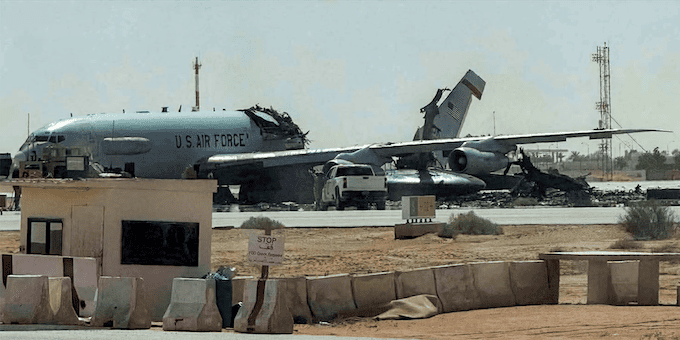
Some of the damage to other bases


Iranian attacks also caused significant structural damage at Ali Al Salem Air Base in Kuwait and Al Dhafra Air Base in the United Arab Emirates. Air Force E-3 Sentry aircraft were also destroyed at Prince Sultan Air Base, in Saudi Arabia. Planet Labs PBC/Reuters, Airbus/AP, UGC/AFP/Getty Images
Pentagon officials have frustrated lawmakers by declining to discuss the cost of the U.S. damage with Congress. In response to a request for comment, the Pentagon pointed to remarks made by Defense Secretary Pete Hegseth on Capitol Hill.
Pressed for an estimate at a May congressional hearing, Hegseth replied: “What is the cost of Iran obtaining a nuclear weapon?”
Pentagon comptroller Jay Hurst told Congress last month that the department’s estimated cost of the war, then at $29 billion, didn’t include damage to U.S. bases.
The Center for Strategic and International Studies estimated in a report published Tuesday that the total cost of the war was about $40 billion. That estimate included their calculus of $2.2 billion to $5.1 billion in damage to U.S. bases, based on structures that CSIS identified as damaged.
The Journal used satellite images and social-media footage to identify which buildings on the Bahrain base were damaged. To estimate what it would cost to construct buildings of the same types today, the Journal reviewed a publicly available Defense Department cost model as well as procurement reports. The estimates only cover construction, and don’t include other costs that could factor into the total if the buildings were to be rebuilt, such as debris removal and reinforcement.
The estimated construction costs at NSA Bahrain totaled about $400 million.
What Iran hit at NSA Bahrain
Less than 150 miles from Iran’s southern coast, NSA Bahrain has been the anchor of American naval power in the Middle East for more than three decades. The base can host every type of ship in the U.S. fleet, and has played a critical role in countering Iranian weapon smuggling, minelaying and tanker attacks.
NSA Bahrain
The base is divided into three sections: a waterfront area focused on ship operations; next to it, the main base, home to administrative and command buildings; and a Navy-leased warehouse and annex complex. Iran hit all three.

Fifth Fleet headquarters
Iran damaged part of the headquarters for the Navy’s Fifth Fleet, which covers the Middle East. The building is no longer usable, according to a U.S. official.
Estimated construction cost: $200 million

Naval Security Forces training building
About 300 feet northwest, the Naval Security Forces training building was destroyed. The NSF provides security for the base and routinely conducts emergency preparedness drills.
Estimated construction cost: $1 million

Emergency management warehouse
Less than a quarter-mile east, the base’s emergency management warehouse, which houses ambulances, sustained damage.
Estimated construction cost: $14 million

Water tank and warehouse
In the waterfront area, a potable water tank and adjacent warehouse were damaged.
Estimated construction cost: $41 million

Galley and barracks
Less than 300 feet southeast, the main dining hall and a barracks that can house roughly 450 personnel sustained damage.
Estimated construction cost: $24 million

Banz Group warehouse complex
On the far side of the base lies a Navy-leased annex operated by a Bahraini company called the Banz Group. Three sections of a warehouse group in that area took some of the heaviest damage.
Task Force 59, the Navy’s first drone and artificial intelligence unit, historically housed drones in one bay of the complex. Established in 2021, Task Force 59 has been charged with using unmanned drones and AI systems to monitor key Middle East waterways.
Estimated construction cost: $34 million

Three additional warehouses
At least three neighboring warehouses were also damaged.
Estimated construction cost: $75 million
In the full accounting of damages, building construction may be the smaller part of the cost, depending on what was inside, said Mark Cancian, a retired Marine Corps colonel and senior adviser at CSIS who co-wrote the think tank’s costs report.
Two AN/GSC-52B satellite communications terminals were destroyed in the opening hours of Iran’s retaliatory strikes, along with a communications management facility. The terminals, which enable near real-time military communication, cost about $20 million each, according to CSIS.
Throughout the base, the damages “exposed weakness and vulnerabilities across the board,” said Mackenzie Eaglen, co-chair of the National Commission on the Future of the Navy, a bipartisan panel created by Congress, and co-author of an April analysis by the American Enterprise Institute on damage to U.S. bases.

NSA Bahrain was built long before Iran possessed the arsenal of precision missiles and drones it has today, and the war revealed its vulnerabilities.
“We’ve been there for more than 50 years, and the base grew up the way the base grew up,” said retired Vice Adm. John “Fozzie” Miller, who commanded U.S. naval forces in the Middle East. “I think there are some things we would do differently.”
As the only U.S. posting in the Middle East where families could live, the base functioned like a small American city, with a softball field, restaurants, a naval exchange and a school. Sailors who spent weeks at sea would pull into Bahrain and head to the base to decompress.
“When I was there last time, they were having a dance party,” said Cancian, who was based at NSA Bahrain twice.

Sailors and Marines dancing at Naval Support Activity Bahrain in 2014. Michael J. Lieberknecht/
Now, retired Navy Vice Adm. Kevin Donegan, who commanded U.S. naval forces in the Middle East, said he expects the U.S. to keep a presence in Bahrain, which is considered a strong ally. “We keep a Fifth Fleet headquarters there, and the question is probably not does that go away, but what does it look like when this is over?” he said.
This week, Secretary of State Marco Rubio met with the King of Bahrain and other leaders in the Middle East to reaffirm the U.S.’s commitment to their security.
“We stand united on regional stability, a free and open Strait of Hormuz, and preventing Iran from acquiring a nuclear weapon,” Rubio said on social media. “Iran’s attacks on Bahrain were unacceptable, and the United States stands with the people and government of Bahrain.”
Rubio also stopped in the United Arab Emirates and Kuwait but skipped Saudi Arabia, which restricted U.S. base and airspace access during the war, deepening a rift that has accelerated Washington’s reassessment of its posture there. Gulf partners have welcomed the ceasefire but remain anxious about Iran’s long-term threat and the durability of American commitments.
Before the war, some military officials warned that bases in the Gulf were exposed. A proposal to move installations farther west was floated in Trump’s first term but never acted on.
“We defended our installations admirably, but the munitions that got through hit infrastructure required for us to conduct operations,” said Dr. Ravi Chaudhary, a former assistant secretary of the Air Force. “This is the byproduct of 10 years of Iran adapting its strike technologies for greater range and accuracy.”
The decisions the U.S. makes now—what to reconstruct, what to abandon, how far to pull back—will define its presence in the Middle East for a generation.

The USS Sioux City transits the bay of Bahrain in 2022. MC3 Nicholas A. Russell/
By Anika Arora Seth,Shelby Holliday, Denise Blostein and Milàn Czerny
WSJ
Excellent summary of early Iran ballistic missile damage to Bahrain now impacting naval supply chain for USS Lincoln and other carrier ops in the Med theater of ops