



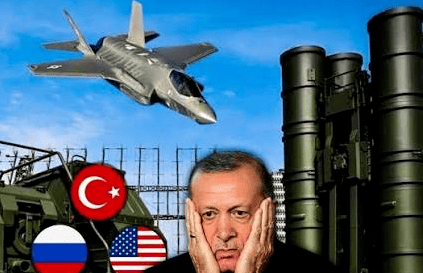
Ankara appeared close to transferring its Russian-made air-defence system to the United Arab Emirates, thereby removing the principal legal obstacle to its return to the F-35 programme. The arrangement has stalled amid reports of Israeli intervention, exposing a striking asymmetry: Israel is working openly to restrict Türkiye’s military capabilities while Azerbaijani oil shipped through Ceyhan continues to provide almost half of Israel’s imported crude.
Türkiye’s S-400 problem has become far more than a disagreement over an air-defence system purchased from Russia nearly a decade ago. It is now the lock on three separate but interconnected doors: the removal of American sanctions, Türkiye’s return to the F-35 programme and the broader restoration of defence-industrial cooperation between Ankara and Washington.
Behind the diplomatic language, the American position is unambiguous. Türkiye cannot regain access to the F-35 while it possesses the Russian-made S-400 system. Nor can the sanctions imposed under the Countering America’s Adversaries Through Sanctions Act simply disappear because President Donald Trump considers President Recep Tayyip Erdoğan a valuable partner.
The obstacle is not merely a presidential policy that Trump can reverse with a signature. Congress has established legal conditions preventing the transfer of F-35 aircraft to Türkiye while Ankara retains the S-400s. Even after Trump publicly promised in Ankara in July that the sanctions would be removed and said he was prepared to consider selling F-35s to Türkiye, the State Department subsequently informed Congress that Türkiye had not yet met the necessary conditions.
The S-400s therefore have to leave Turkish possession in a manner that Washington can verify. Keeping them in storage, leaving them inactive or promising not to integrate them into NATO networks is no longer sufficient. American officials want physical separation, a permanent transfer and guarantees that Türkiye will neither operate nor regain access to the system.
The political will expressed by Trump has opened a door, but American law still blocks the passage through it.
Praise in New York, but no breakthrough
The limits of the Trump-Erdoğan relationship were visible during the United Nations General Assembly meetings in New York. A separate bilateral meeting had been expected and was seen in Ankara as an opportunity to settle the S-400 formula at the highest political level. That meeting did not materialise.
Trump instead met Erdoğan in a broader gathering with Gulf and regional leaders focused primarily on Iran and the spreading Middle Eastern war. He again praised the Turkish president, as he has done repeatedly, but the meeting produced no publicly identifiable breakthrough on CAATSA, the S-400s or the F-35.
Trump’s compliments have political value. They demonstrate that the White House no longer approaches Türkiye through the hostile framework that defined parts of the previous administration. But warm words cannot substitute for a mechanism that satisfies the Pentagon, the State Department and Congress.
This distinction matters because the S-400 issue has already survived several supposed breakthroughs. American Ambassador Tom Barrack said in April that he expected the dispute to be resolved soon. At the NATO summit in Ankara on July 7, Trump went further, saying the time had come to remove the sanctions. Foreign Minister Hakan Fidan subsequently said there was political will in both capitals and expressed confidence that a result could be reached.
Yet in New York this week, Barrack was still saying that talks over both the removal of CAATSA sanctions and the “disposal” of the S-400s were continuing. That single word, disposal, revealed the essence of the American demand. Washington is no longer discussing how the S-400s might coexist with the F-35s. It is discussing how Türkiye can cease possessing them.
The Gulf escape route
Ankara has been searching for a third-country solution because returning the systems directly to Russia would be politically humiliating, while transferring them to the United States would almost certainly be unacceptable to Moscow. A sale to a friendly Gulf country offered a more dignified formula.
Saudi Arabia was mentioned in preliminary speculation. Riyadh requires stronger air and missile defences, particularly after renewed Houthi attacks on Saudi territory and energy infrastructure. But Saudi Arabia is also pursuing a deeper defence relationship with Washington, including access to the F-35. Acquiring a Russian S-400 system would risk creating for Riyadh the very problem that Ankara was trying to escape.
There is no solid public evidence that negotiations with Saudi Arabia reached the stage of a concrete sales agreement. The more serious reporting initially identified either Qatar or the United Arab Emirates as the possible buyer. By mid-July, American and regional officials were telling the Wall Street Journal that the UAE was the country negotiating with Türkiye.
The Emirati option made military sense. The UAE already operates a sophisticated air-defence network built around American and European systems, and the missile threats emerging from Iran and Yemen have reinforced Abu Dhabi’s desire for additional layers of protection. The S-400 could have provided long-range coverage while allowing the UAE to demonstrate that it was not entirely dependent on a single external supplier.
On July 10, Hürriyet columnist Abdulkadir Selvi reported that the S-400s had been sold to an unnamed Gulf country and that an announcement could come that day. He said the final possibilities were the UAE and Qatar. No announcement followed.
The Kremlin did not confirm a sale. Instead, spokesman Dmitry Peskov described the matter as “extremely sensitive” and acknowledged that Moscow remained in contact with Ankara. Because the original end-user conditions prevent Türkiye from transferring the system without Russian consent, Moscow’s position was indispensable.
Reports in pro-government Turkish media later suggested that Ankara and Moscow had nevertheless found common ground. According to this account, Russia was no longer the principal obstacle. Türkiye and the UAE had also reportedly made substantial progress on the commercial terms.
But the agreement still failed to appear.
What Israel wanted, Israel said publicly
The claim that Israel blocked the UAE transaction emerged most clearly in a Sept. 23 column by Mehmet Acet in Haber7. Citing an unnamed source, Acet reported that Israel had urged the Emirati leadership not to purchase the Turkish S-400s because the transfer would clear the way for the removal of CAATSA sanctions and Türkiye’s return to the F-35 programme.
That account cannot yet be independently treated as an established fact. Neither Israel nor the UAE has publicly confirmed such an intervention. No documentary evidence has emerged showing that Abu Dhabi formally abandoned the purchase on Israeli instructions.
Yet the wider claim that Israel is trying to prevent Türkiye from acquiring the F-35 requires no speculation. Prime Minister Benjamin Netanyahu has acknowledged it.
Netanyahu told CNN in July that he opposed the sale and had communicated his position directly to Trump. He argued that providing F-35s to Türkiye would destroy the regional balance because Ankara had what he described as aggressive aspirations. Reuters also reported that a planned meeting between Netanyahu and US Defence Secretary Pete Hegseth was expected to include the Turkish F-35 issue before the meeting was cancelled.
Axios reported that Netanyahu had asked Trump not to approve systems that would modernise the Turkish Air Force, particularly the F-35. Eighteen members of the US Congress simultaneously called for any prospective transfer to be blocked as long as Türkiye possessed the S-400s.
Israel’s opposition is therefore not a theory constructed in Ankara. It is a publicly declared Israeli policy. The only unverified part is whether Israel specifically used its influence in Abu Dhabi to obstruct the S-400 transaction.
The circumstantial case is certainly plausible. Since the Abraham Accords, Israeli security, intelligence, technology and commercial networks have acquired a formidable presence in the Emirates. Israeli officials and specialists are highly visible at defence exhibitions, security conferences and technology gatherings in Abu Dhabi and Dubai. That influence does not mean Israel controls Emirati policy, but it gives Israeli officials direct and frequent access to the circles shaping it.
Israel would not have needed to threaten Abu Dhabi. It could simply have reminded Emirati leaders that taking possession of Russian S-400s could complicate their own access to American military technology, particularly their long-standing ambition to acquire F-35s. The UAE has already seen its prospective F-35 deal become entangled in American concerns about foreign technology, intelligence security and its relationship with China.
In that context, an Israeli warning would reinforce doubts that already existed in Washington and Abu Dhabi.
More than Israel’s qualitative military edge
Israel’s campaign against a Turkish F-35 purchase is frequently explained through the concept of Israel’s qualitative military edge. American law and policy require Washington to assess whether major regional arms sales could undermine Israel’s technological and operational superiority.
But the Israeli objection is no longer simply about maintaining a technological advantage over Arab armies. It reflects a developing strategic rivalry with Türkiye.
An F-35-equipped Turkish Air Force would alter the military equation in Syria and the Eastern Mediterranean. Türkiye would become only the second regional power after Israel to operate the aircraft and, unlike other prospective buyers, would return with its previous experience as a manufacturing partner.
The F-35 would complement Türkiye’s expanding unmanned combat fleet, long-range missiles, electronic-warfare capabilities and the domestically developed KAAN fighter programme. It would also strengthen Türkiye’s ability to shape the airspace surrounding Syria, where Ankara’s and Israel’s strategic objectives increasingly diverge.
Israel wants unrestricted freedom of military action over Syria. It has repeatedly struck targets inside the country and seeks to prevent the emergence of military capabilities that could constrain its operations. Türkiye, meanwhile, wants a stable Syrian central government, the dismantling of separatist structures along its border and a security architecture in which Ankara remains the principal external power.
Israel appears to prefer a weakened and fragmented Syria that cannot challenge Israeli operations. Türkiye’s objective, despite all the complications created by its military presence, is the re-establishment of a functioning Syrian state capable of preserving territorial integrity.
A Türkiye equipped with F-35s would not automatically confront Israel, but it would narrow the enormous air-power imbalance on which Israel currently relies. That is why Netanyahu does not view the matter as an ordinary arms sale between two NATO allies. He sees it as a transfer that could restrict Israel’s strategic freedom.
The Ceyhan paradox
The most glaring contradiction lies not in Washington, Abu Dhabi or Moscow, but at the Mediterranean terminal of Ceyhan.
While Israel attempts to prevent Türkiye from acquiring the F-35, Azerbaijani crude oil continues to reach Israel through the Baku-Tbilisi-Ceyhan pipeline. This is not a marginal commercial relationship. In 2025, Israeli imports of Azerbaijani crude loaded at Ceyhan increased by 31 percent to approximately 94,000 barrels per day, their highest level in three years.
According to Kpler data, Azerbaijani crude accounted for 46.4 percent of Israel’s oil imports in 2025. Russia, the second-largest supplier, provided about 28 percent. In other words, almost one barrel out of every two imported by Israel originated in Azerbaijan and reached the Mediterranean through Türkiye.
The ownership and legal structure require careful explanation. Türkiye does not own the Azerbaijani crude and does not make the commercial decision to sell it to Israel. The BTC pipeline operates under international agreements, and the oil belongs to the producers and traders using it. Türkiye’s state pipeline company BOTAŞ has said it is not involved in the sale.
SOCAR assumed operational control of the BTC pipeline from BP on July 1, 2026. SOCAR holds a 32.97 percent interest, while BP retains 30.1 percent and the remaining shares belong to other partners. Türkiye participates through the Turkish Petroleum Corporation, but it does not unilaterally determine the final destination of every cargo.
That explains the legal defence. It does not eliminate the political problem.
Türkiye officially halted trade with Israel in May 2024 and has maintained that oil is not loaded at Ceyhan with Israel declared as its destination. Maritime data, however, tell a more complicated story. Analysts at Kpler and Vortexa have documented tankers departing Ceyhan while listing offshore Egypt or Cyprus as their destination, switching off their Automatic Identification System signals and subsequently discharging at Israel’s Ashkelon terminal.
One identified tanker, the Valfoglia, loaded about 680,000 barrels of Azerbaijani Light at Ceyhan before delivering the cargo to Israel. Another, the Kimolos, loaded at Ceyhan, disappeared from tracking systems for several days and was then recorded discharging at Ashkelon.
A separate investigation by Palestinian Youth Movement, Energy Embargo for Palestine and Progressive International claimed to have identified 57 crude shipments that left Ceyhan between May 2024 and December 2025, failed to reach their declared destinations and eventually appeared at Ashkelon. The investigation used shipping databases, satellite imagery and tracking records. Its political conclusions may be debated, but the tanker movements it documented deserve an official answer.
The Turkish government can reasonably argue that it cannot confiscate Azerbaijani oil, violate pipeline treaties or control a commercially owned cargo after it enters international waters. Yet Ankara cannot simultaneously claim complete ignorance when a recurring pattern of destination changes and tracking interruptions has been documented by multiple maritime intelligence platforms.
At the very least, Türkiye can demand greater transparency over declared destinations, strengthen scrutiny of shipping companies using Ceyhan and raise the issue directly with Azerbaijan. “One nation, two states” cannot mean that sensitive questions are never asked.
The strategic imbalance
The asymmetry is becoming politically untenable. Israel treats every improvement in Türkiye’s military capabilities as a potential threat and mobilises its influence in Washington and regional capitals accordingly. Türkiye, meanwhile, continues to facilitate, even if indirectly and under binding international agreements, an energy flow crucial to Israel’s economy.
Israel’s position is hard power politics. It is not burdened by sentiment. Israeli leaders oppose Turkish F-35s because they believe Türkiye could become a strategic competitor. They cultivate relations with Greece and the Greek Cypriot administration, challenge Turkish objectives in Syria and seek to shape American policy against Ankara.
Türkiye’s response cannot consist solely of denunciations followed by business as usual. Nor should it involve an impulsive violation of international contracts that would damage Türkiye’s credibility as an energy corridor. It requires a comprehensive review of the leverage Ankara possesses and the consequences of continuing to separate energy, defence and regional security into artificial compartments.
Elections may change the atmosphere, not the interests
Attention is now turning towards the US congressional elections in November and Israel’s general election on Oct. 27. The American vote will determine the balance of power on Capitol Hill and the strength of the congressional groups resisting advanced arms sales to Türkiye.
The Israeli election could be even more consequential. Netanyahu is fighting for political survival, and opinion polls have suggested that his nationalist-religious coalition could lose its majority. A government without Netanyahu and his most extreme partners might lower the temperature in relations with Ankara.
But Türkiye should not confuse Netanyahu’s possible departure with the disappearance of Israel’s strategic objections. The commitment to preserve Israel’s qualitative military edge extends well beyond the current prime minister. An Israeli centrist government may use less inflammatory language while continuing to oppose a Turkish F-35 acquisition.
Similarly, a favourable result for Trump in the congressional elections would not automatically neutralise opposition rooted in concerns over the S-400s, Russia, Syria, Greece, Cyprus and Israel.
Türkiye therefore needs more than patience. It needs a legally credible arrangement that permanently removes the S-400 obstacle, followed by a sustained campaign in Congress explaining why the return of a major NATO ally to the F-35 programme strengthens Western security rather than weakening Israel.
At the same time, Ankara must finally address the Ceyhan contradiction. It cannot watch Israel erect walls against Turkish military power while almost half of Israel’s imported crude continues to arrive through a strategic corridor crossing Turkish territory.
Israel has connected the S-400s, the F-35s, Syria, the UAE and its regional military advantage into a single strategic calculation. Türkiye has treated them as separate files managed by separate bureaucracies.
That is the deeper lesson of Israel’s S-400 gambit. The problem is not simply that Israel plays hard. The problem is that Türkiye has yet to place all its own cards on the same table.