



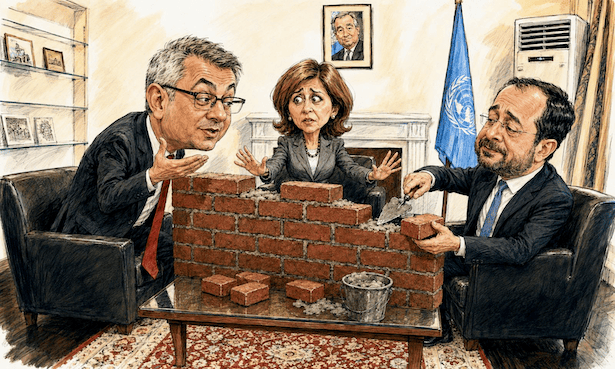
María Ángela Holguín’s interview with ANKA did more than warn that Cyprus’s diplomatic window was closing. By clarifying what happened in New York and rejecting actions that create a hostile environment, the UN envoy challenged President Nikos Christodoulides’ version of events. Greek Cypriot media then used her account to question his policy and examine whether pressure from the far-right ELAM was restricting his room for compromise.
Key Points
The interview given by UN Secretary-General António Guterres’s Personal Envoy María Ángela Holguín Cuéllar to Yusuf Kanlı for ANKA News Agency became more than an assessment of the Cyprus negotiations. Published immediately after the UN General Assembly’s high-level week, it intervened in a contest over why a proposed trilateral meeting failed and whether the diplomatic process retained meaningful momentum.
Holguín’s central warning was stark. The favourable opportunity visible during the previous year and early in 2026 was gradually disappearing. The UN would continue its efforts, and she intended to return to Cyprus in October. Yet the political conditions needed for negotiations were deteriorating amid confrontation, regional instability and insufficient willingness to cooperate, compromise and seek mutual benefit.
Her account of New York was even more consequential. A trilateral involving Guterres, Greek Cypriot leader Nikos Christodoulides and Turkish Cypriot leader Tufan Erhürman had not appeared on the Secretary-General’s programme, which envisaged separate meetings with the two leaders. Christodoulides proposed it during his contacts. When Holguín conveyed the request, Erhürman asked whether there was anything new that could make such a meeting productive. She replied that Christodoulides had reiterated proposals already presented during the leaders’ previous meeting in Cyprus.
According to Holguín, Erhürman concluded that a meeting without the conditions for substantive progress was unlikely to produce a positive result. Her account therefore did not describe an invitation issued by Guterres and rejected outright by the Turkish Cypriot leader. It described a proposal from Christodoulides, relayed through the envoy, that offered no new basis for agreement.
This clarification altered the debate. The initial Nicosia narrative suggested that Christodoulides had presented new ideas that Guterres welcomed, only for Erhürman to block an opportunity for dialogue. Holguín revealed a more complicated sequence and made it difficult to maintain that Erhürman had rejected a scheduled UN initiative.
ANKA changes the island’s political climate
ANKA placed the envoy’s direct account into the public domain while incompatible narratives were still forming. Within hours, the interview was being reported and debated by Kathimerini/KNEWS, Phileleftheros, Politis, Cyprus Mail and SigmaLive. A Turkish news agency’s interview became the principal reference against which Greek Cypriot journalists and political figures tested their own government’s claims.
The discussion consequently shifted. Commentators began asking why Christodoulides proposed a trilateral without sufficient preparation, whether his “new ideas” were actually new and whether he was substituting the appearance of diplomatic activity for measurable progress.
The interview also expanded the dispute beyond New York. Asked whether a conducive environment could be created while the Greek Cypriot side attempted to restrict Turkish Cypriot representatives’ international contacts and pursued other actions considered damaging to trust, Holguín answered: “Absolutely not.” Such conduct, she said, made an already complicated issue more difficult. Negotiations could not emerge from a hostile environment; they required understanding and acceptance of the other side and its existence.
That answer connected conduct outside formal negotiations with prospects inside them. Restrictions on representation, cancelled cultural events and interventions in bicommunal activities could no longer be treated as peripheral controversies. They became evidence in the argument over whether the environment necessary for negotiations existed.
Nicosia’s defence: no deadlock
Christodoulides responded that Cyprus was “under no circumstances” at a deadlock. He acknowledged difficulties but said Guterres remained committed to restarting negotiations. The Greek Cypriot side, he argued, had submitted proposals on methodology, substance and confidence-building measures that were received positively. He also cited Holguín’s return and continuing EU engagement with Turkey as proof that the effort remained active.
Diplomatic contacts have indeed continued. But that does not answer Holguín’s warning. She did not say the UN had stopped working; she said the opportunity was being lost because diplomatic activity had not produced the necessary political decisions.
Government negotiator Menelaos Menelaou accused the Turkish Cypriot side of “delaying tactics” and a “pattern of obstruction.” Yet Holguín’s chronology complicated that charge. A further difficulty arose from the government’s description of Christodoulides’ 19 ideas as new and creative when Holguín said he had repeated proposals Erhürman had already heard. Erhürman argued that adding 19 points before concluding Guterres’s seven measures amounted to moving the goalposts.
Southern media question the government’s policy
Kathimerini’s KNEWS edition placed Holguín’s account at the centre of its coverage. It acknowledged that the trilateral was not on Guterres’s schedule, that Christodoulides proposed it and that Erhürman asked what had changed. KNEWS described a familiar pattern in which one side proposes a meeting, the other questions its purpose and the process stalls. Its conclusion was sobering: Cyprus was being warned that even the opportunity for a serious discussion was fading.
Phileleftheros similarly highlighted Holguín’s chronology, the absence of new substance and her warning about diminishing political will. It also reported her categorical rejection of efforts to restrict Turkish Cypriot international contacts as compatible with a conducive environment. The newspaper did not embrace Erhürman’s position, but its reporting made the government’s first version of New York difficult to sustain.
Politis broadened the scrutiny to Christodoulides’ strategy. One “ViewPoint” article said Erhürman could have attended the trilateral to keep dialogue alive, but argued that Christodoulides had substantial room to act on confidence-building measures. Practical steps such as new crossings and disaster cooperation, it said, should not be reduced to transactional bargaining.
Other Politis commentary accused the administration of creating expectations that repeatedly failed to materialise. It argued that successive governments had attributed stagnation to Turkish intransigence while avoiding sufficient examination of their own choices. An even sharper opinion piece charged that Christodoulides wanted the photograph rather than progress, interpreting the proposed trilateral as an attempt to secure the appearance of initiative without prior agreement on substance.
The Cyprus Mail’s editorial described the week as a “flurry of negativity,” criticised the government’s handling of the controversy involving Turkish Cypriot Nicosia Mayor Mehmet Harmancı and questioned whether Christodoulides sought a meeting partly to obtain international validation for proposals he could promote domestically. It noted that Guterres had already said no trilateral was planned and concluded that insufficient progress had been made to justify one.
Political criticism followed. Former DISY leader Averof Neophytou warned that Christodoulides might become the only president who failed to take Cyprus back into negotiations. Direct Democracy leader Fidias Panayiotou said the president’s years in office had produced “no substantial fruit” and that current policies were not working. AKEL leader Stefanos Stefanou described the climate as pessimistic and called for specific initiatives, while DISY leader Annita Demetriou acknowledged that New York had not produced the hoped-for result and urged “less talk and more work.”
Alithia: has ELAM set the limits?
Alithia offered the most politically explosive interpretation. Under the front-page appeal “Wake Up!”, it argued that the far-right ELAM was moving toward power and had acquired decisive influence over Christodoulides.
According to the newspaper, the president was accepting ELAM’s demands as he prepared for the 2028 election. This was already reversing the prospect of progress on Cyprus. Alithia alleged that ELAM had told Christodoulides not to open new crossings and that the president had accommodated the demand. If accurate, the crossing dispute is being shaped as much by Greek Cypriot electoral calculations as by negotiations between the communities.
Alithia also linked ELAM’s influence to the Cyprus Forum controversy. It said the party could not tolerate Harmancı’s participation and that the Greek Cypriot leadership, following ELAM pressure, attached conditions that effectively prevented him from attending.
ELAM publicly claimed that its intervention caused the “occupation mayor” to withdraw. This does not prove every part of Alithia’s analysis, but it confirms that the party opposed Harmancı’s participation and regarded the outcome as a victory.
Alithia concluded that the crossing and Harmancı episodes were only two of many indications that ELAM had “firmly set foot in power,” ending with the warning: “Wake up!”
The claim that Christodoulides has surrendered control of Cyprus policy to ELAM remains Alithia’s assessment. There is, however, wider evidence of changing political alignments. Philenews has reported a friendlier ELAM tone toward the government and interpreted the reduction in its criticism as a possible sign of cooperation before 2028.
The diplomatic implications are serious. A president increasingly dependent on ELAM may find it difficult to open crossings, facilitate Turkish Cypriot visibility or accept arrangements reflecting political equality. He may continue proposing meetings abroad while losing the domestic freedom needed to make them productive.
Building confidence while eroding it
Guterres’s seven areas cover crossings, demining, joint disaster response, migration, civil-society consultation, sports and citizenship rights for children of mixed marriages. Erhürman says the Turkish Cypriot side accepted six, with crossings unresolved. The Greek Cypriot side disputes aspects of that scorecard and even whether certain items qualify as confidence-building measures.
Yet several steps should be achievable without resolving the constitutional conflict. Disaster cooperation could save lives, demining would remove a shared danger and Mia Milia/Haspolat could improve trade and ease congestion. Holguín’s warning was that even these possibilities remained unrealised because political will was missing.
Erhürman has consequently placed “confidence-eroding actions” alongside the CBM agenda. He cites cancelled festivals and youth events, attempts to discourage diplomatic contacts, property-related arrests, European Parliament initiatives, interventions affecting universities and sports, and the Harmancı affair.
Holguín did not validate every accusation. She did support the underlying proposition that restrictions on contact and denial of the other side’s existence make negotiations more difficult. That distinction is central: adding new confidence-building proposals achieves little if other policies simultaneously consume the remaining trust.
The October test
Holguín’s October return will focus on confidence-building measures, negotiating methodology and sufficient preparation on substance. The UN has also completed its review of the 2015–2017 convergences, but she said the record would be released only when negotiations resumed to avoid a premature dispute over interpretation.
The fact that Holguín is returning proves that UN involvement continues. It does not demonstrate momentum. A credible outcome would require agreement on several implementable measures, clarity over which of the seven points have been accepted and a methodology that preserves earlier convergences while avoiding another open-ended process.
The ANKA interview changed the political climate because it interrupted a one-sided account of New York. It supplied Greek Cypriot media with an authoritative basis for examining their own government and gave Erhürman a UN reference for his argument about confidence-eroding conduct.
Christodoulides can accurately say that diplomacy continues, but he cannot yet show that it is producing progress. Erhürman can insist that high-level meetings require preparation, but must ensure that this principle does not become an obstacle to dialogue. Holguín can facilitate, but she cannot manufacture political courage.
October will reveal whether the interview helped initiate a correction or merely documented another disappearing opportunity. Without practical confidence-building measures and restraint on actions that erode trust, the process may remain active in form while becoming increasingly empty in substance.