



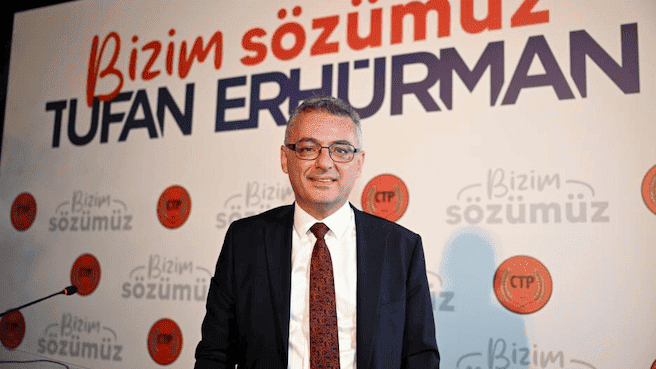
CTP leader’s election victory could give new momentum to the stalled peace process in Cyprus. However, this time the equation in Nicosia is called “conditional dialogue”: 1- Political equality, 2- Timetable, 3- Focus on results, and 4- Preventing a return to the status quo…
According to unofficial results, Tufan Erhürman, leader of the Republican Turkish Party (CTP), has won the presidential election with 62.8 percent of the vote, while incumbent Ersin Tatar trailed at 35.8 percent. Voter turnout stood at 64 percent — about six points higher than the first round of the 2020 election but four points lower than its runoff.
With Erhürman’s victory, the Turkish Republic of Northern Cyprus (TRNC) has entered a new political era defined by cautious optimism and conditional engagement.
In his victory speech, Erhürman emphasized that he had received “almost equal support from all electoral districts,” a result he said demonstrated his campaign’s central pledge: to embrace everyone.
“From the moment I take over presidency, I will resign from my party and will become an independent president at equal closeness to everyone… The Presidency will be a unifying factor — a symbol of unity, togetherness, and cohesion,” he declared. “Rather than working as an individual president, a new era of teamwork begins. Our challenge is to serve this land and its people without discrimination.”
The end of a loud era
The result is now beyond dispute. The Supreme Election Board is expected to certify the outcome in the morning — a mere formality at this stage. Erhürman’s victory closes an era dominated by slogans of “sovereign equality” and “two-state permanence.” His message of solution-oriented realism and institutional normality carried the night.
His campaign avoided theatrical nationalism and instead spoke to fatigue: inflation, bureaucracy, migration, and the quiet despair of an economy adrift. “People wanted seriousness again,” said a young civil servant outside the Nicosia courthouse as the final boxes arrived. “We’re proud of our identity, but pride doesn’t pay the rent.”
Erhürman’s disciplined tone, often dismissed as overly cautious, became his greatest asset. He offered not revolution but restoration — an attempt to steady the institutions and reopen channels of dialogue without compromising dignity.This was the 11th leadership election held by the Turkish Cypriot community and the 9th presidential election since the declaration of the TRNC in 1983. Erhürman becomes the sixth elected Turkish Cypriot leader, following Rauf Raif Denktaş (1976–2005), Mehmet Ali Talat (2005–2010), Derviş Eroğlu (2010–2015), Mustafa Akıncı (2015–2020), and Ersin Tatar (2020–2025).
No one other than Denktaş had ever managed to serve more than one term. The fact that Erhürman, representing the moderate left, succeeded in unseating an incumbent president — and former prime minister — signals a rare political shift in a system often characterized by deep polarization.
With 53.4 percent of the vote, Erhürman’s victory reflected public fatigue with both economic hardship and diplomatic stagnation, as well as a growing appetite for a more pragmatic leadership style.
“This is not a personal victory,” Erhürman told a cheering crowd on election night. “It is the will of the Turkish Cypriot people to speak with their own voice — not in anyone’s shadow, but as subjects of their own history.”
According to the constitution, the president-elect will assume office once sworn in at a special session of Parliament, which will be convened after the Supreme Electoral Council formally certifies the results — expected within the coming week.
The end of endless talks
Erhürman’s campaign slogan, “Dialogue, but not without principles,” encapsulated his approach to the long-stalled Cyprus problem. He does not reject negotiations with the Greek Cypriot side or the United Nations framework, but he insists that any new process must be structured, time-bound, and accountable.
He set out four guiding conditions that he now calls the “foundations of conditional dialogue”:
“These are not demands pulled out of thin air,” Erhürman said in his first post-election interview. “They are principles the UN itself has declared. We are asking only that they be honored. The Turkish Cypriot people cannot live indefinitely in diplomatic limbo.”
His stance is a clear response to the disillusionment that followed the collapse of the Crans-Montana talks in 2017, after which the peace process fell into deep freeze. It also marks a middle path between Ersin Tatar’s hardline two-state policy and the traditional federal model long championed by the CTP.
In Erhürman’s words, “The real issue is not what we call the formula, but whether it works.”
A diplomatic reset — and the Holguín factor
Erhürman’s victory coincides with renewed United Nations efforts to test whether the ground is ready for a return to negotiations on Cyprus.
UN Special Envoy María Angela Holguín Cuéllar is preparing another visit to the island to explore the possibility of re-engagement between the two sides after years of deadlock.
According to diplomatic sources, Holguín plans to meet President-elect Tufan Erhürman and Greek Cypriot leader Nikos Christodoulides separately in the coming weeks. Only after these consultations will she consider whether conditions are suitable for an informal tripartite meeting involving the UN and both Cypriot leaders.
Erhürman has expressed support for Holguín’s initiative — but under clear terms:
“If there is to be progress, it must be based on mutual respect and on the United Nations’ own resolutions. The era of endless patience is over.”
On the Greek Cypriot side, Erhürman’s election was followed closely. While voting was still underway, leading Greek Cypriot daily Politis described his likely victory as “a second chance for the Cyprus peace process.” The paper noted that although his win would not automatically restart negotiations, it could “restore credibility and goodwill” to a process that has long been viewed with skepticism.
Many foreign diplomats share that view. “Erhürman is not a dreamer,” said one Western envoy in Nicosia. “He is a realist — and that alone may help break the stalemate.”
Between Ankara and self-governance
For any Turkish Cypriot leader, relations with Ankara remain the ultimate test of statesmanship. Erhürman’s tone toward Türkiye has been measured — neither confrontational nor submissive.
“I have never been in conflict with Türkiye, and I never will be,” he said during the campaign. “But partnership requires equality. The bond between Ankara and Lefkoşa must be one of respect, not dependency.”
Moments after the unofficial results announced, Erhürman reiterated that he will coordinate with Türkiye and particularly on issues related to foreign policy and the Cyprus problem, every step will be taken in cohesion.”
His first official visit as president, he confirmed, will be to Ankara, in keeping with tradition.
Still, the contrast between Erhürman’s nuanced approach and Tatar’s overt alignment with Ankara is striking.
Tatar had accused him of being “too soft” and even taunted, “Too late, Mr. Tufan — you should not have walked out when Erdoğan addressed our Assembly.”
Erhürman brushed off the attack, saying the focus should be on “shared interests, not symbolic gestures.” His formula of “neither distance nor submission” aims to redefine the relationship as one of coordinated independence — close partnership without political subordination.
The home front: Governance and renewal
Beyond the Cyprus question, Erhürman inherits a troubled economy and a fatigued public sector. Inflation imported from Türkiye has eroded purchasing power, while unemployment and migration continue to sap young talent from the island. In his campaign, he promised to revive production, combat corruption, and restore transparency in governance.
He also vowed to prioritize women’s representation in leadership roles and stem youth emigration through targeted incentives and education reform.
Erhürman plans to reopen dialogue with the European Union, seeking to expand trade under the Green Line Regulation and explore steps to enable direct air connections from Ercan Airport — a long-standing demand of the north.
“The Turkish Cypriot people want to stand on their own feet,” he said. “We will work with Türkiye and the world — but as equals, not dependents.”
Regional ripples and international reaction
International observers note that Erhürman’s win could alter regional calculations in the Eastern Mediterranean.
His pragmatic tone contrasts sharply with the nationalist rhetoric that dominated Tatar’s tenure, particularly amid recent speculation in Turkish, Israeli, and Greek Cypriot media about supposed military coordination against Türkiye — stories widely dismissed as political fabrications.
Erhürman’s team avoided exploiting such narratives, focusing instead on domestic renewal and diplomacy grounded in institutional legitimacy. The shift was noted even in foreign capitals. A European diplomat in Ankara described the election as “a small but significant correction — not a break, but a recalibration.”
A new chapter, conditional hope
Erhürman’s victory has lifted expectations both inside and outside the TRNC. But expectations can be fragile. Many Turkish Cypriots still remember the disillusionment of past peace efforts, and few are prepared to believe in miracles.
As leading private Kanal-T channel’s editor in chief Rasıh Reşat remarked, “The people no longer want big promises — they want small, measurable results.”
Erhürman seems aware of this reality. When asked what would happen if another round of UN talks collapses, he replied: “If negotiations fail again, it will not be the side that walks away that is questioned — it will be the one that keeps the table empty. We will no longer be spectators of our destiny.”
The TRNC now stands at a crossroads where patience has expired but hope endures — cautiously, conditionally, and for now, intact.
A new page is indeed turning in Northern Cyprus. And this time, as Erhürman reminded his supporters on election night, “the pen is finally in the people’s hands.”
***
Carefully Choreographed Symphony of Conflicting Emotions from Ankara
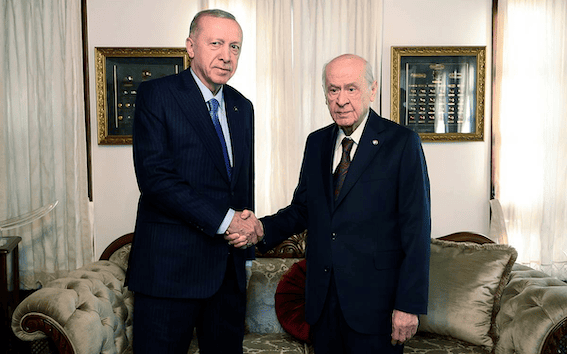 President Recep Tayyip Erdoğan led with diplomacy, congratulating the Turkish Cypriot people, pledging “respect for their democratic will,” and expressing hope to “work together in the new period.”
The brevity and balance of the message were deliberate — the sound of a government that knows it must tread carefully.
But the harmony did not last. Devlet Bahçeli, leader of the Nationalist Movement Party and Türkiye’s self-appointed custodian of “Turkishness,” thundered that “the TRNC should vote to join Türkiye.” He dismissed the result as illegitimate and the turnout as unrepresentative.
It was an outburst that betrayed deep anxiety: Turkish Cypriots, by electing a man who speaks softly and thinks independently, had reminded Ankara that fraternity does not mean obedience.
By contrast, Vice President Cevdet Yılmaz praised the Turkish Cypriot electorate’s “maturity” and affirmed Türkiye’s “continued solidarity.” His words carried the calm of institutional pragmatism — a reminder that Ankara still houses more than one school of thought on Cyprus.