



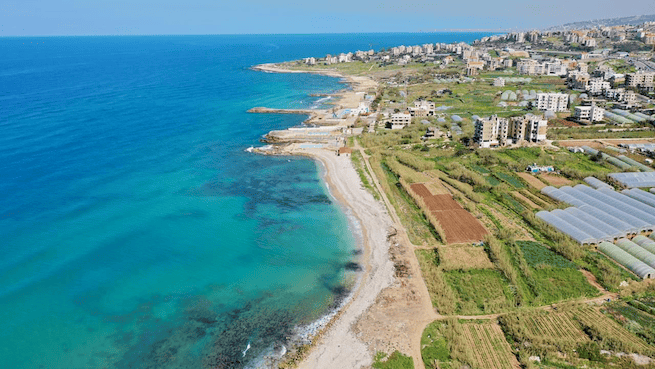
Jieh, a seaside town south of Beirut, was once known for its beach resorts, long sandy shoreline and summer crowds. For decades, Beirutis escaped the city’s heat by heading south to spend weekends swimming, sunbathing and enjoying one of Lebanon’s most popular coastal destinations.
Today, Jieh finds itself on a different front line.
Before the war in southern Lebanon, the town’s population stood at roughly 10,000 residents. Since the conflict escalated, an estimated 40,000 additional people have arrived, transforming a quiet coastal community into a congested urban centre almost overnight. Municipal officials and residents say the town’s infrastructure has reached a breaking point.
The pressure is visible everywhere. Apartments designed for a single family now accommodate as many as five families, with households of five to seven people sharing increasingly crowded living spaces. Roads that once served a beach resort town are clogged with traffic from dawn until late evening. Residents complain that finding a parking space near their homes has become nearly impossible.
Local businesses are struggling to keep pace. Waiting times at supermarkets during peak hours now rival those of much larger cities. Shopkeepers displaced from southern villages have relocated their businesses to Jieh, often selling goods directly from vehicles parked along the roadside. While these informal markets provide livelihoods and access to essential goods, they have also become a source of chronic congestion as motorists stop to make purchases along already overcrowded roads.
Yet the most serious challenge may be the least visible.
Waste management systems designed for a population of 10,000 are now expected to serve nearly 50,000 people.
Rubbish collection, traditionally carried out several times a week, is no longer sufficient. Collection contractors cite limited disposal capacity, a shortage of workers and growing difficulty finding available dumping space as waste volumes surge. In some areas, overflowing bins force residents to leave rubbish on roadsides, where it accumulates under the heat of the Mediterranean summer.
At night, stray dogs tear through garbage bags searching for food, scattering waste across streets and public spaces. By morning, residents are greeted by the smell of decomposing rubbish while municipal cleaning crews struggle to catch up. In neighbourhoods where rubbish collection once occurred twice a week, authorities now face the challenge of servicing what is effectively a city of 50,000 people on a daily basis to prevent a public health emergency.
The risks are becoming increasingly apparent.
Summer temperatures create ideal conditions for disease transmission, insect infestations and deteriorating sanitary conditions. What was once a manageable municipal service has become a daily emergency requiring continuous intervention. Yet many municipalities simply do not possess the financial resources, equipment or manpower needed to respond.
The situation in Jieh is far from unique.
Across Mount Lebanon and the coastal belt south of Beirut, small towns are attempting to absorb population increases that would challenge even major cities. Municipalities operating on limited budgets suddenly find themselves responsible for tens of thousands of additional residents without corresponding support from central government institutions.
In some communities, local authorities have resorted to asking residents to volunteer as traffic wardens and municipal police officers simply to maintain basic order. Such measures illustrate the widening gap between the responsibilities municipalities face and the resources available to them.
Most concerning is the apparent absence of a coordinated national response.
Municipal leaders increasingly complain that they have been left to manage the crisis alone. While local authorities scramble to address housing shortages, traffic congestion, sanitation challenges and public health risks, no comprehensive strategy appears to exist to support communities absorbing the largest share of displaced populations. The burden has fallen on municipalities already struggling with the consequences of Lebanon’s prolonged economic collapse.
For now, social cohesion remains intact.
Jieh’s predominantly Christian community understands displacement. Many families remember periods during Lebanon’s civil war when they themselves were forced from their homes. Sympathy for those fleeing violence remains strong, and most residents recognise that the displaced have little choice but to seek refuge wherever shelter can be found.
But goodwill alone cannot replace functioning infrastructure.
Every overloaded rubbish truck, every overcrowded apartment building and every kilometre of traffic adds another layer of pressure to a town already operating beyond its intended capacity. Residents increasingly speak not of resentment but of exhaustion. Yet history shows that when public services begin to fail, exhaustion can quickly evolve into tension.
This is why the refugee crisis in Lebanon can no longer be viewed solely as a humanitarian challenge. It is increasingly becoming an infrastructure challenge, a governance challenge and, ultimately, a national security challenge.
The United States, the European Union and international donors should urgently focus on strengthening the operational capacity of local government institutions. Funding additional waste collection, sanitation services, traffic management, public health programmes and municipal policing may lack the visibility of larger geopolitical initiatives, but these services form the foundation of social stability.
Preserving Lebanon requires more than providing assistance to displaced families. It requires ensuring that the communities hosting them do not collapse under the strain.
If municipal systems fail, the consequences will extend far beyond overflowing rubbish bins. Public health risks will rise, tensions between communities may deepen and the fragile social contract holding together many parts of Lebanon could begin to fray. In a country already burdened by economic crisis and political paralysis, that is a risk policymakers cannot afford to ignore.
The first line of defence against instability in Lebanon is not found at a military checkpoint or diplomatic conference table. It is found in the daily functioning of local government: the rubbish truck that arrives on time, the street that remains clean, the traffic that keeps moving and the municipality that still has the capacity to serve its people.
In towns like Jieh, that first line of defence is now under severe strain.