




Shaffaf Exclusive
The Answer is “Yes, unequivocally”, If we, Arabs and Gulf citizens, are to call things by their proper names and commit ourselves to candor in describing facts and actions.
Since Khomeini’s arrival to power in Iran, in 1979, and Iran’s transformation from an ally of the West into a theocratic (religious) state, regional conflicts have intensified. The slogan of “exporting the revolution” emerged, and the region has suffered from the growing influence of Iranian power and interference in the internal affairs of other countries through the establishment and support of armed militias and movements loyal to Tehran. This led to a state of chronic instability in Lebanon, Iraq, Syria, and Yemen.
Introductory Explanation:
Twelver Shiites constitute approximately 8% of the world’s Muslims. Remaining Shiite groups, such as the Zaydis and their branches, and the Ismailis, make up about 5% of the world’s Muslims. They are peaceful, embrace a culture of coexistence and cooperation, and reject conflict.
Our discussion, here, concerns Ja’fari Twelver Shiism, which is the official state religion of the Islamic Republic of Iran according to the 1979 Iranian Constitution. At the apex of Iran’s administrative hierarchy stands the Supreme Leader (or Wilayat al-Faqih—the Guardianship of the Islamic Jurist), who embodies a Shiite political theory established by Khomeini. This doctrine regards him as the general deputy of the Twelfth Imam, the Awaited Mehdi, who is in occultation (“absent”), and grants him the highest political and religious authority. He serves as the Commander-in-Chief of the Armed Forces and possesses absolute authority over judicial and financial oversight, the implementation of rulings, the declaration of war and peace, and is regarded as the holder of the final binding decision for all those who are religiously obligated.
He possesses all of these absolute powers because he represents the Awaited Mehdi, who in turn represents God’s rule on Earth.
Thus, the legendary mythical being—that is, the Twelfth Imam, the Awaited Mehdi, who is in occultation and is now 1192 years old (having been born in 255 AH)—is the fundamental pillar of Twelver Shi’a doctrine, indeed its principle, foundation, and cornerstone. Twelver Shi’as believe that he will reappear in the “End Times” to fill the earth with justice and fairness. They regard him as the “Proof (Hujjah) of God” and the one who completes the chain of the “Twelve Imams,” which began with the succession of Ali ibn Abi Talib 1,400 years ago. According to their belief, he entered “occultation” in 260 AH after the death of his father, the Eleventh Imam, Hasan al-Askari.
The articles of the Constitution of the Islamic Republic were formulated on the basis of the “End (of) Times doctrine”—that is, the belief that humanity is currently living in the era of the End Times, during which the Awaited Mehdi will reappear in order to take control and rule the world from his state in Iran. Therefore, the conditions for his appearance must be prepared and facilitated.
The scenario of the Mehdi’s appearance in the Shi’a cultural and popular tradition is portrayed as bloody, expansionist, and destructive to the utmost degree, and it is described in detail in Twelver Shi’a books and literature.
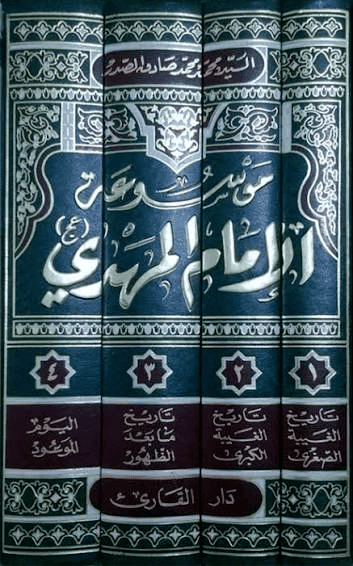
See the four-volume work The Encyclopedia of Imam al-Mehdi by Iraqi Shi’a religious authority Muhammad Sadiq al-Sadr, the father of Muqtada, the leader of the Sadrist Movement, as well as A Study of the Mehdi by the Shi’a religious authority Muhammad Baqir al-Sadr, the founder of the Islamic Da’wa Party. You will be surprised by the enormous quantity of myths, fantastical stories, falsehoods, and irrational beliefs.
In this context, it must be said that myths exist among all peoples and in every human society, including those in which no known religions or belief systems originated. They are an inseparable part of every culture around the world. However, myths and epics often possess humanistic and moral qualities and are filled with values such as the idea that love is the center of life and with expressions of human emotion, as is the case with the myths of ancient Mesopotamia, the Sumerians, the Greeks, the ancient Indian epics, and the epics of the Iliad, the Odyssey, and Gilgamesh.
However, Twelver Shiite myths are based on the ideas of extremism, domination, the spread of chaos and hatred, and a sense of superiority over others.
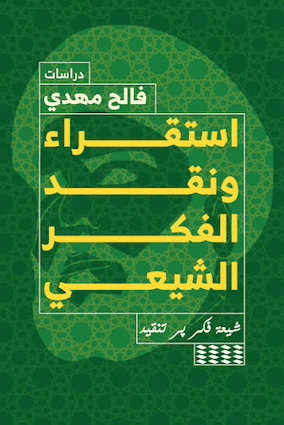
The Iraqi researcher Faleh Mahdi, in his book Critique of Shiite Thought (in arabic), says that Shiite myths were constructed in light of a “cancerous” and defeated Persian identity, characterized by disappointment, an inferiority complex, defeat, and frustration, which shaped the entire Persian history after the fall of the Sasanian Empire that had ruled the world for more than four centuries. Their myths, he argues, reflected a state of hopelessness and psychological brokenness. According to him, Persians still suffer from feelings of inferiority and victimhood until this day.
Kufan vs Kulayni Shiism
The same author explains that “Kufan Shiism” in its early stages was peaceful. It arose in the city of Kufa in Iraq during the first Islamic century after the death of Ali ibn Abi Talib, and not immediately after the Prophet’s death as it is claimed. Kufa’s inhabitants were Arabs, and Caliph Umar ibn al-Khattab is claimed to have described them as “the brains of the Arabs and the treasure of men,” for they were a people of strength, leadership, values, and thought.
As for the Persian “Kulayni Shiism,” which emerged in the early fourth Islamic century and was founded by Abu Ja’far al-Kulayni from the town of Kulayn near Tehran, who spent the last years of his life in Baghdad and authored Al-Kafi—the principal Shiite reference for Prophetic traditions and regarded among Shiites as comparable to Sahih al-Bukhari among Sunnis. According to the author, he pursued a project of appropriating Islam and its leading figures.

The author claims that al-Kulayni had a narcissistic tendency and glorified the Persian identity. He “Zoroastrianized” Ali ibn Abi Talib—that is, he turned him into a Zoroastrian-style hero based on the Iranian cultural and epic heritage (Shahnameh), whose heroes, such as Rustam, Esfandiyar, and Bahram, were warriors and leaders who defended the faith and the kingdom. He also detached the role of the Messenger of Islam (Mohamed) from the Caliphate and marginalized the status of the prophets, whom the Qur’an praised and venerated.
The author adds that al-Kulayni narrates a tradition from Imam Ja’far al-Sadiq in Al-Kafi stating: “We and our Shi’a are (created) from a special clay.” He argues that this hadith is not found in Sahih al-Bukhari and looks like a complete fabrication, noting that any human group, regardless of its religion, includes the righteous and the wicked, the learned and the ignorant, the intelligent and the foolish, the bad and the good.
He also reports a narration attributed to Ali ibn Abi Talib stating that, on the Day of Resurrection, at the Sirat (the bridge over Hell), Ali will choose his followers and admit them into Paradise.
He further cites another narration claiming that, when he appears, Christ will walk behind the Awaited Mehdi rather than beside him, despite the high status and esteem accorded to Christ in the Qur’anic texts, which, according to the author, do not mention the Mehdi at all.
The Safavid Persian Shi’ism that emerged at the beginning of the 10th century AH was an extension of the Kulaynian Shi’ism and continued for 250 years.
As for the current Islamic Republic of Iran, it is the latest stage of Kulaynian Shi’ism. Khomeini reformulated and further developed it, making it more comprehensive while placing particular emphasis on the “End Times doctrine,” according to which the Mehdi will appear and rule the entire world from Iran.
For the record, the issue of the appearance or emergence of the Mahdi is not a dominant cultural concept among Sunnis. Simply, because Sunnis constitute the majority—making up 85% of Muslims—and govern almost the entire Islamic world, thus not suffering from a minority complex. Among Shi’as, however, it is a dominant culture, a fundamental pillar, and carries significant weight in religious rituals. In general, the idea of the awaited Mehdi’s emergence is seen as an expression of defeat and helplessness. Shi’as have always been a minority living in a state of desperate hopelessness, searching for a savior. They found what they were looking for in the idea of the Mehdi, then mythologized him and transformed him into an enduring symbol.
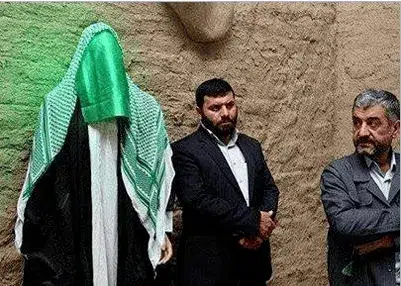
Mehdist Delusion:
Now, in the 21st century, “Mehdist delusion” has become an overwhelmingly dominant culture in the Islamic Republic at every level and across all social classes, in a way that goes beyond the bounds of reality and is unacceptable to the reasoning of any researcher of Iranian affairs.
Imagine, dear reader: there is a clock in Palestine Square, in central Tehran, known as the “Countdown Clock to the Destruction of Israel.”

According to official Iranian statements, this is supposed to occur in the year 2040. It is an electronic display installed by the Islamic Revolutionary Guard Corps on “International Quds Day” in June 2017, based on the belief that the awaited Mehdi whispered in the ear of the late Supreme Leader Ali Khamenei and informed him of the date of Israel’s demise. The question that arises here is: why did he not also tell him the date when his own headquarters would be targeted by an attack involving thirty Israeli aircraft, allegedly resulting in the deaths of him, his wife, his grandson, and his advisers, and leaving his son Mojtaba either seriously injured or dead? Meanwhile, Israel reportedly struck the clock and destroyed Palestine Square during the 12-Day War!
Former Iranian President Mahmoud Ahmadinejad delivered eight speeches before the United Nations General Assembly in New York during his presidency (2005 – 2013). Ahmadinejad believed that his speeches were under Mehdist guidance. He stated in some instances that he felt an “aura” surrounding him while speaking and that the Mehdi was dictating the speech to him. This formed part of Ahmadinejad’s “Mehdist” ideology, which he promoted throughout his presidency, asserting that his addresses at international forums were paving the way for the Mehdi’s appearance. At the time, religious authority (marja‘) Mohammad-Taqi Mesbah Yazdi—regarded by his supporters as a “philosopher,” a member of the Assembly of Experts, and one of Iran’s leading clerics—declared in Friday sermons that obedience to Ahmadinejad was obedience to God.
At present, those leading Iran’s security and military institutions are described as belonging to the “Hojjatieh” movement, whose members are said to hold a firm belief in what the author characterizes as the “Mahdist delusion.”
This, the author argues, should not be underestimated or dismissed as merely an internal matter, because it has serious implications for Iran’s foreign policy and its relations with the Gulf states and the wider world—namely, mobilizing Shiites all over the globe around the idea of salvation and the emergence of the promised Mehdist empire.
According to certain traditions, among the signs of the Mehdi’s appearance are “al-harj,” meaning intense and widespread killing, and “al-marj,” meaning confusion, disorder in people’s affairs, widespread strife, and the ruin of Basra.
The author contends that everything Iran does in the Gulf region—from coercion and instability to disrupting regional security and targeting neighboring countries with missiles and suicide drones—is part of this “Mehdist delusion.”
The world today, the author concludes, is not dealing with a political structure or a governing system that seeks negotiation or even dialogue, but rather with ideological figures who embrace uncompromising, zero-sum Mehdist beliefs.
According to the author, engaging in dialogue with them is therefore futile, and Iran is employing all of its capabilities and resources to pursue its national ambitions in ways that align with its ideological objectives.
Unfortunately, the Arab world lacks think tanks dedicated to studying the nature of the Iranian mindset and the dangers it poses in light of Twelver Shiism. We hear from Iranian officials and their followers that the Mehdi was fighting alongside the militias of Hezbollah, Harakat al-Nujaba, the Zaynabiyoun Brigade, and the Fatemiyoun Brigade in Iraq, Lebanon, Syria, Iraq, and Yemen. They also claim that “he” will “liberate” the countries on the opposite shore of the Arabian Gulf and annex them to the “Mother of Villages” (Umm al-Qura), which they identify as the Islamic Republic of Iran.
The “Umm al-Qura” theory
The “Umm al-Qura” theory was formulated by the Iranian theorist Mohammad Javad Larijani (brother of the late Ali Larijani, the former Speaker of Parliament, who also served as a senior foreign policy adviser to Supreme Leader Ali Khamenei) in his book Propositions on National Strategy, which is still taught in Iranian universities.
Mojtaba Khamenei belongs to the ideological current that believes in this theory and acts according to it.
This fixation on expansion and on spreading global disorder is not confined to university studies. It is also taught to schoolchildren, whose textbooks include maps of the Gulf states bearing the flag of the Islamic Republic.
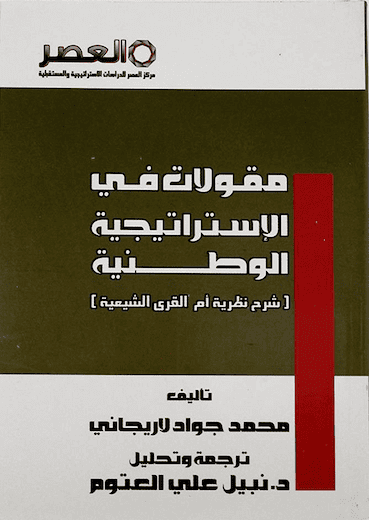
Based on the “Umm al-Qura” theory, the concept of “buffers” or proxies was developed with the aim of keeping any future war away from Iran by assigning that role to its armed proxies. The first buffer consisted of Iraq, Syria, Lebanon, and Yemen. The second buffer comprised Shiite armed movements across the region. The third buffer consisted of Shiite minorities in the region or dormant cells. These buffers or proxies constitute imported security designed to protect Iran by keeping confrontation away from its own borders.
The Failure of Tehran’s Bet on Its Proxies
However, Iran disastrously miscalculated, and the strategy backfired. The billions of dollars Tehran spent over the years on its proxies to purchase imported security evaporated in the first real test. The war that Tehran sought to wage remotely through its proxies was transformed by the combined American-Israeli offensive into a direct, open, and high-intensity confrontation.
After years of investing in collective deterrence through Hezbollah in Lebanon, Hamas in Gaza, and the Houthis in Yemen, Iran had counted on overwhelming Israel with missile attacks to overload its defenses and force Washington to back down. Reality, however, turned out very differently from what Tehran had anticipated.
These groups suffered severe blows beginning with the October 7, 2023 attack, significantly reducing their ability to play their intended role in defending Iran. As the war shifted onto Iranian territory, Tehran found itself without the protective umbrella of its proxies. The very forces that had been expected to shield Iran became little more than witnesses to the unraveling of Tehran’s regional project.
In conclusion, I would say that Iran hates the very idea of development and prosperity, and it hates the Gulf states even more than it hates Israel and the United States. This became unmistakably clear during the last March war. The level of bullying and the madness of the mullahs’ government in Iran has reached a point where it can no longer be contained. It exploits the mythical Mehdist belief to pursue dangerous expansionist political objectives and embraces an ideology of extremism and self-destruction.
The question that reality poses is this: Is there currently any genuine, comprehensive, and immediate alternative to the United States—the world’s foremost military power—for protecting the Gulf states?
The author, Mohammad Al-Hashemi M.D., is a physician at one of the Gulf region’s largest hospitals and comes from a mixed Arab and Iranian Shiite background.
ليس المذهب الإثنا عشري
الأصح القول التشيع الفارسي
او تحديدا ما يعرف بولاية الفقيه
. The article is excellent, very very informative and interesting. Although, we knew that the policy of Iran was driven by their religious beliefs in a Mahdi and the chaos that will ensue, however, this article delves deeply into their religious psyche, the details of their religio-psychological state. The information is vast and comprehensive. It is something that the West should be very informed about it; especially the Europeans who seem to be very ignorant of it. As to the peace with Egypt and I would add Jordan, it is indeed a “cold peace”, notwithstanding the government to government deals… Read more »