



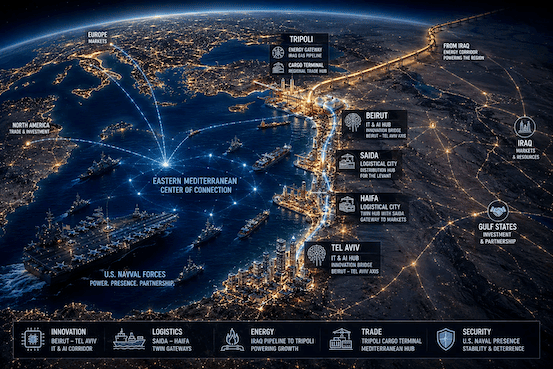
The recent Washington Institute article on proposed U.S. foreign assistance cuts should be read in Beirut with alarm.
At the very moment when Washington is trying to shape a new Israel-Lebanon security arrangement, and when the Lebanese Armed Forces are expected to carry a heavier burden in restoring sovereignty and containing Hezbollah, the FY2027 request would reportedly cut U.S. support for the LAF to just $36 million. That is not strategy. It is contradiction. If America wants Lebanon to become sovereign again, it cannot weaken the only national institution capable of enforcing sovereignty. And if Washington wants to move from aid to trade, it must first understand the obvious: capital does not flow into a militia state. Investment begins where sovereignty begins. Lebanon should not be treated as a charity case. It should be treated as a strategic investment in the future of the Eastern Mediterranean. The old aid model failed because it managed collapse without changing the balance of power. It helped Lebanon survive without helping it recover command over its territory, borders, ports, airport, economy, and decision of war and peace. The answer is not abandonment, but a hard sovereignty-and-prosperity compact.
The real question is what Lebanon could become if it were no longer held hostage by the IRGC: a Mediterranean hub, a gateway to Europe, a services platform for Iraq and Syria, a reconstruction base for the Levant, and a bridge between Gulf capital, European markets, and the Arab interior. The deeper Lebanon is entrepreneurial, diasporic, multilingual, commercial, educated, Mediterranean, plural, argumentative, and outward-facing: a country of universities, hospitals, banks, lawyers, doctors, engineers, traders, designers, hoteliers, journalists, and emigrants whose networks span the Gulf, Europe, Africa, and the Americas. Hezbollah’s domination is therefore not merely a security problem. It is a civilizational distortion. It turned a society built for commerce and exchange into a forward operating platform for the Iranian Revolutionary Guard Corps. It converted Lebanon into a border trench for Tehran and made the Lebanese people pay the price.
America’s support for Egypt after peace with Israel was not charity. It was the financial architecture of a new strategic order. Peace needed a budget. Lebanon now needs a modern version of that logic: not blank checks, not subsidies to a failed political class, but a conditional package tying sovereignty, security, reform, and investment. Rubio’s April promise to empower vetted LAF units belongs at the center of this compact. If Lebanon is expected to restore state authority, it needs more than speeches. It needs vetted units, reliable salaries, secure communications, mobility, intelligence support, border control, counter-smuggling tools, logistics, and political backing. That cannot be done inside a shrinking aid envelope. If Washington speaks of empowering the LAF while cutting it to symbolic levels, Hezbollah will read weakness, Israel will read unreliability, and Lebanese reformers will read abandonment. The answer is not to recreate the South Lebanon Army. A Lebanese force funded by Israel would be dead on arrival politically. It would be seen as collaboration and would hand Hezbollah the propaganda gift of a lifetime. The viable model is different: Lebanese-commanded, Lebanese-flagged, internationally funded, externally verified. Israel’s role should be reciprocal, not managerial: reduce strikes as verified Lebanese deployments occur, accept credible state control, share intelligence through American or French channels, and withdraw from contested points when sovereignty is restored. Lebanon does not need a buffer militia. It needs a state.
AIPAC and the pro-Israel community should draw the same conclusion. If they support direct Lebanon-Israel talks, they should support the instrument that makes those talks meaningful: a dedicated American program for Lebanese sovereignty. This is not a concession to Lebanon. It is an Israeli security interest. A weak Lebanon is Hezbollah’s ecosystem. A ruined Lebanon is Iran’s recruiting ground. A sovereign and prosperous Lebanon is Hezbollah’s defeat. The cheapest way to secure Israel’s northern border is not endless air operations. It is a Lebanese state strong enough to control its territory and an economy strong enough to make Hezbollah’s war economy obsolete.
The compact should have three wallets: a security wallet for vetted LAF units, southern deployment, border control, port and airport sovereignty, communications, drones, engineering and logistics; a stabilization wallet for southern reconstruction, municipal services, schools, clinics, roads, electricity, and the return of displaced families; and an investment wallet for ports, power, telecoms, digital infrastructure, logistics zones, tourism, education, hospitals, and Levant reconstruction platforms. This is not aid to a failed state. It is investment in a post-Hezbollah Lebanon.
The regional map demands it. Iraq needs Mediterranean access. Syria, one day, will need reconstruction channels. Gulf capital needs credible Levantine platforms. Europe needs Eastern Mediterranean connectivity. India-to-Europe corridors need redundancy beyond the Red Sea and Suez. Lebanon fits naturally into that architecture, but only if it is sovereign. There can be no investment corridor through a militia state. The greatest mistake is to assume that Israelis and Lebanese are natural foes. They are not. The hostility was sustained by war, occupation, trauma, ideology, and above all by Iran’s strategic use of Lebanon. Remove the IRGC structure, and the underlying logic changes. In a post-IRGC Levant, there may be no two societies more naturally aligned with the United States than Israel and Lebanon. Both are small, educated, diaspora-connected, human-capital driven, entrepreneurial, globally networked, and Western-facing. Israel is a technology and security powerhouse. Lebanon, freed from Hezbollah, would be its natural Mediterranean counterpart: commercial, cultural, financial, educational, and logistical.
Lebanon should stop going to Washington as a supplicant. It should go with a bargain: help us restore sovereignty, and Lebanon becomes the Eastern Mediterranean partner America always needed — a liberal economy, a plural society, a gateway to the Levant, a platform for reconstruction, a neighbor capable of peace with Israel, and a strategic alternative to Iranian domination. But the bargain must be strict: money for sovereignty, not corruption; investment for reform, not oligarchy; security support for vetted units, not captured institutions; reconstruction under state authority, not militia patronage.
For too long, Lebanon has been treated as a buffer zone: between Israel and Syria, Iran and the West, war and ceasefire, collapse and rescue. That era must end. The strategic horizon is larger: from buffer zone to business corridor, from militia frontier to Mediterranean hub, from Iranian proxy platform to American-aligned liberal economy. A sovereign Lebanon is not a threat to Israel. It is Israel’s best northern security guarantee. A prosperous Lebanon is not a burden for America. It is America’s missing partner in the Levant. In a post-IRGC Middle East, Israel and Lebanon are not natural enemies. They are America’s natural twin anchors on the Eastern Mediterranean: one a technology and security powerhouse, the other a commercial, cultural, financial, and logistics gateway to the Levant.
U.S. policy should be designed to make that future irreversible.