



Lebanon’s political class should stop confusing regional patronage with national interest. The country’s economic collapse has exposed a reality that many factions in Beirut still refuse to acknowledge: the states exercising the loudest political influence over Lebanon are not the ones carrying the burden of keeping it afloat.
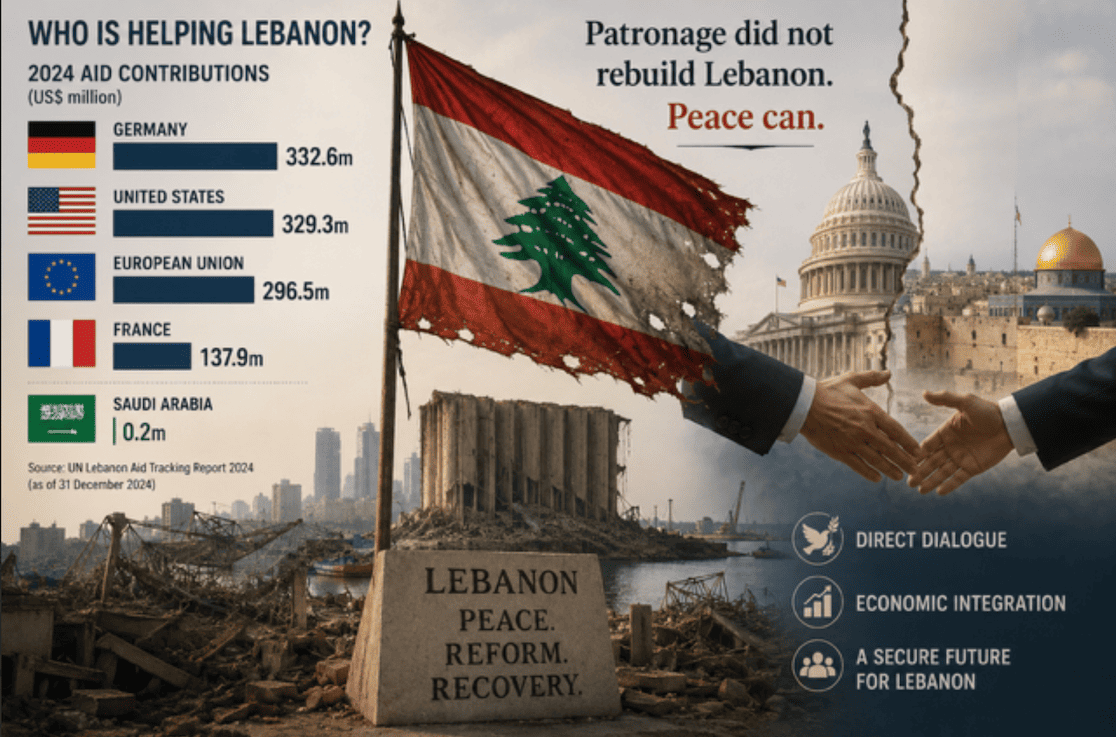
The figures are stark. According to the United Nations’ 2024 Lebanon Aid Tracking report, Germany contributed $332.6m in aid to Lebanon, the United States $329.3m, the European Union $296.5m and France $137.9m. Saudi Arabia’s contribution stood at just $200,000 through tracked humanitarian and development channels. Germany alone contributed more than 1,600 times as much.
Even broader Saudi aid figures tell a similar story. Saudi Arabia’s own KSrelief platform shows total projects in Lebanon since 2019 amounting to roughly $60m — a modest sum for a country suffering one of the worst financial collapses in modern history. Lebanon’s banking system imploded in 2019, the sovereign defaulted in 2020, the currency lost almost all its value and depositors remain locked out of more than $80 bn in savings. Yet throughout the years of collapse, Riyadh largely disengaged from Beirut politically and economically.
The withdrawal mattered. Lebanon did not simply lose a traditional Gulf ally; it lost a major source of tourism, investment, remittances and confidence at the precise moment its state institutions were weakening under the expanding influence of Hezbollah. At the same time, Saudi Arabia’s labour nationalisation policies reduced opportunities for many Lebanese expatriates who had long relied on Gulf employment as an economic lifeline.
Iran, meanwhile, pursued the opposite model: deep investment in Hezbollah and its surrounding ecosystem rather than in the Lebanese state itself. Tehran’s backing strengthened a military structure but hollowed out national institutions and further isolated Lebanon from international capital. The ultimate victims were the Lebanese themselves, including the Shia communities of southern Lebanon that bore the cost of repeated wars and devastation.
The conclusion should now be unavoidable. Neither Saudi Arabia nor Iran built a sustainable Lebanese state. One disengaged from Lebanon as it collapsed; the other invested in a parallel power structure that accelerated the state’s erosion.
This is why Lebanon’s political parties, particularly those still calibrating their positions according to Saudi preferences, should reassess the direction in which the region is moving. Meetings with Saudi envoys may still carry symbolic weight in Beirut salons, but symbolism does not recapitalise banks, stabilise currencies or rebuild economies.
Instead, Lebanon’s factions should fall behind Joseph Aoun and support the diplomatic opening being encouraged by President Donald Trump toward direct dialogue and eventual peace negotiations with Israel. However controversial such a path may appear today, the economic logic is becoming increasingly difficult to ignore.
Lebanon will not recover its financial losses through austerity alone. Nor will it recover through another cycle of regional confrontation. The country requires a geopolitical reset capable of unlocking a large-scale international rescue package, restoring investor confidence and reintegrating Lebanon into the economic transformation under way across the eastern Mediterranean and Gulf.
Peace, in this context, is not merely a diplomatic aspiration. It is increasingly becoming Lebanon’s only viable economic strategy.
A normalised regional environment would open access to foreign direct investment, energy co-operation, tourism flows and technology partnerships at a scale impossible under permanent instability. It would strengthen the Lebanese state against armed non-state actors while giving international financial institutions and western governments stronger grounds to support a meaningful bailout and reconstruction programme.
For years Lebanon’s factions justified paralysis in the name of regional alliances. But alliances that neither protected the Lebanese economy nor rescued the Lebanese state deserve re-examination. The question facing Beirut now is no longer ideological. It is brutally practical: which path offers Lebanon a chance to survive?
The answer may ultimately lie not in Tehran or Riyadh, but in a Lebanon-first strategy that prioritises economic recovery, sovereignty and peace over the exhausted rivalries of the past.