



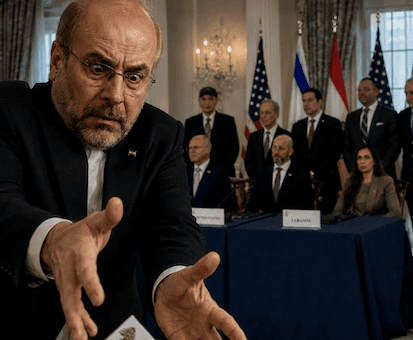
Diplomacy is often called the art of the possible. In the Middle East, it is more often the art of confronting the unacceptable rather than surrendering to it.
The framework agreement signed between Lebanon and Israel under American sponsorship marks a rare inflection point. Not because it resolves decades of hostility, nor because it announces some sudden convergence of interests, but because it alters the strategic environment in which those hostilities unfold. By formalizing even a narrow channel between Beirut and Jerusalem, it weakens one of Iran’s central objectives: the monopolization of Lebanon’s strategic posture through permanent confrontation.
The timing is not incidental. As Tehran probes the limits of maritime pressure in the Strait of Hormuz, testing once again the elasticity of Western commitments to freedom of navigation, it also sees its Levantine lever slipping. The logic is simple: a Lebanon partially reintegrated into a framework of state-to-state engagement is a Lebanon less available for indefinite instrumentalization.
Washington’s posture reflects this dual theatre. The Trump administration’s approach — transactional, coercive, and unapologetically asymmetric — rests on a brutal premise: negotiation is effective only when backed by credible disruption. This is not détente. It is structured confrontation — closer to Reagan’s pressure strategy than to the old diplomatic reflex of engagement for engagement’s sake. Reagan captured the logic plainly:
“Strength is the most persuasive argument we have to convince our adversaries to negotiate seriously and to cease bullying other nations.”
The principle is that adversaries do not moderate because they are invited into a process; they moderate when the cost of obstruction exceeds the benefit of delay.
The readiness to resume targeted strikes against threats to maritime flows, coupled with overt political alignment with both Israel and the Lebanese state, signals that engagement with Tehran will not be conducted from ambiguity, but from imposed clarity.
Iran remains both a necessary interlocutor and a systemic spoiler. Any durable regional arrangement requires engaging it; any naïve engagement empowers it. The challenge, therefore, is not to normalize relations, but to compartmentalize them: to extract concessions in one domain while constraining expansion in another.
The Lebanon–Israel framework embodies this logic. It does not resolve the Iranian question yet; it sidelines it. It creates facts on the ground that limit the range of Iranian escalation without requiring Iranian consent. In doing so, it restores a measure of agency to Lebanese institutions long overshadowed by parallel structures of power.
What emerges is a model of diplomacy that rejects both maximalist confrontation and illusory reconciliation. It accepts kinetic friction but as a means to pressure. It does not confuse dialogue with trust, nor negotiation with weakness.
In that sense, the real “deal” is not merely between Lebanon and Israel, nor even between Washington and Tehran. It is a recalibration of how power is exercised in a region where legitimacy is often contested, sovereignty often porous, and time horizons are asymmetrical.
Reagan deal with what he coined the Evil Empire. In dealing with the fanatical republic of Iran, Trump is dealing with the devil itself, in this context, is not just about faith. It is about leverage, sequencing, and the controlled use of force to define the boundaries within which diplomacy can operate.
Anything less is not diplomacy.
It is abdication.