



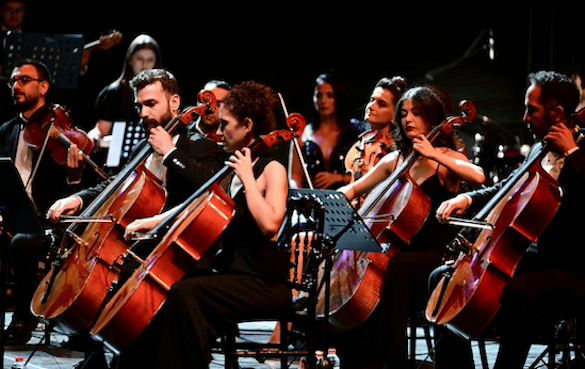
As the Hatay Academy Symphony Orchestra carried Fairuz’s songs from wounded Antakya to an Ankara open-air stage, the music evoked another battered Mediterranean city that has repeatedly refused to disappear. Beyond the concert grounds, however, Beirut, Gaza and Damascus are again being reordered by war, diplomatic blocs and competing security projects, with Turkiye increasingly at their centre.
On a warm Ankara evening, the voice of Beirut travelled north without crossing a checkpoint. It came through the strings, woodwinds, kanun, oud and percussion of the Hatay Academy Symphony Orchestra, whose musicians gathered at the Oran Open-Air Stage on Aug. 23 for “Beirut’s Echo: A Fairuz Symphony.” The orchestra that survived the destruction of Antakya was performing the songs of a woman whose voice has survived every destruction of Lebanon.
There was Habbaitak Be El Saif, “I Loved You in Summer,” which conductor Ali Uğur has transformed from a serenade into a declaration of fidelity to Hatay. Summer represents the city’s generous days; winter, its devastation and long wait for recovery. Bektoub Ismak Ya Habibi carried the compulsion to preserve the beloved’s name, while Bent El Shalabeya recalled the streets, courtyards and village life of a Levant repeatedly scattered by migration and war but stubbornly retained in song.
Then came Li Beirut, “To Beirut,” Fairuz’s elegy of love, grief and belonging. Performed by musicians from earthquake-stricken Hatay, it became more than a Lebanese song. It sounded like an exchange between two cities that understand how buildings, people and familiar streets can disappear while memory refuses to surrender.
The allegory extends across the contemporary Levant. Fairuz’s music imagines an emotional geography connected by culture, language and loss. Today, that geography is being divided by settlement corridors, buffer zones, airstrikes and air-defence calculations. Gaza is negotiating survival between cease-fire clauses and renewed bombardment. Lebanon is being pressed to restore the state’s monopoly over arms while seeking an Israeli withdrawal. Syria is rebuilding a national military as Israel attacks infrastructure it fears may become part of a Turkish-supported security system.
Turkiye is attempting the geopolitical equivalent of the orchestra’s arrangement: combining Eastern instruments with a Western structure. Ankara wants greater strategic autonomy in the Muslim world without abandoning NATO, closer alignment with Arab powers without entering an irreversible anti-Iranian alliance, and accommodation with Russia without permanently forfeiting America’s F-35.
The difference is that geopolitics has no conductor capable of keeping every section in time.
Gaza diplomacy becomes a regional bloc
The clearest structure is the mediation partnership among Turkiye, Egypt and Qatar. Cairo contributes geographical leverage, control of the principal Arab gateway to Gaza and long-standing security channels with Israel. Doha retains access to Hamas’ political leadership. Ankara adds influence with Palestinian actors, weight in Washington and connections across Syria, Pakistan and the Gulf.
On Aug. 20, the three mediators condemned renewed Israeli attacks in Gaza, warning that civilian deaths and repeated cease-fire violations threatened negotiations at a particularly sensitive stage. Israel continued to demand Hamas’ disarmament before completing withdrawal, while Hamas insisted that Israel must first withdraw and demonstrate full compliance. It was reported that the mediators called for effective international pressure to prevent the process from unravelling.
The following day, the diplomatic formation widened. Turkiye joined Egypt, Indonesia, Jordan, Pakistan, Qatar, Saudi Arabia and the UAE in condemning Israeli settlement expansion and categorically rejecting the E1 plan east of East Jerusalem. The eight foreign ministers warned that E1 would separate the northern and southern West Bank, further isolate East Jerusalem and make a contiguous Palestinian state increasingly impossible.
The joint statement went beyond condemnation by supporting international accountability measures, including sanctions against individuals and entities responsible for implementing or facilitating settlement expansion.
Its significance lies in the diversity of its authors. Egypt and Jordan have peace treaties with Israel. The UAE normalised relations under the Abraham Accords. Qatar and Turkiye maintain channels to Hamas. Saudi Arabia continues to balance Palestinian statehood against strategic relations with Washington. Their convergence establishes a diplomatic threshold: regional normalisation cannot be interpreted as consent to annexation or the permanent fragmentation of Palestinian territory.
For Ankara, the bloc also reconciles two apparently competing policies. Turkiye can deepen relations with Cairo, Riyadh and Abu Dhabi without diluting its Palestinian position. It can simultaneously demonstrate that criticism of Israel is no longer a largely Turkish-Qatari undertaking but part of a broader regional platform.
Mecca adds collective deterrence
The second layer is military. On Aug. 7, Turkiye, Saudi Arabia and Pakistan signed the Mecca Joint Defence Agreement, expanding the Saudi-Pakistani defence relationship into a trilateral framework. Its most striking provision declares that an armed attack against one party will be regarded as an attack against all.
The formulation resembles NATO’s collective-defence principle, but the Mecca framework should not yet be called an “Islamic NATO.” It has no publicly identified integrated command, standing multinational force, common budget or automatic procedure for determining a response. News agencies described the agreement as a significant deterrent message but noted the absence of detailed military commitments.
The pact nevertheless combines complementary capabilities. Turkiye contributes NATO experience, a large conventional military and an expanding defence industry. Saudi Arabia provides capital, strategic geography and access to Gulf markets. Pakistan brings military manpower, operational experience and nuclear status, although nothing publicly released confirms that Islamabad’s nuclear deterrent has been extended to its partners.
Its first practical results may emerge in defence-industrial cooperation rather than battlefield planning. Saudi investment could support Turkish drones, missiles and eventually the KAAN fighter programme. Existing cooperation involving Baykar’s AKINCI unmanned combat aircraft offers a foundation for local production and technology partnerships. Pakistan can contribute testing, operational experience and access to South Asian markets.
Russian newspaper Kommersant characterised the agreement as a powerful signal rather than an ironclad alliance. That distinction is important. The pact offers insurance against uncertainty surrounding the American security umbrella and Israeli or Iranian military action, but it does not prove that the three countries would enter every conflict together.
Nor is it necessarily an anti-Iranian coalition. Turkiye and Saudi Arabia remain wary of Iranian power, yet both have reasons to avoid permanent confrontation. President Recep Tayyip Erdoğan has urged U.S. President Donald Trump to resume diplomacy with Tehran. The Mecca pact is better understood as a third pole intended to deter threats without forcing its members to choose exclusively between Washington, Tehran and increasingly assertive Israeli power.
Abu al-Duhur brings the Israeli-Turkish rivalry to the runway
The risks of that assertiveness became visible on Aug. 18 when Israel struck the Abu al-Duhur airbase in Syria’s Idlib province, near the intersection of Idlib, Aleppo and Hama. Eight strikes reportedly damaged the runway, hangars and storage facilities. The base had been largely inactive for years but was being rehabilitated with Turkish assistance.
Israel said it acted on intelligence suggesting that Turkish personnel, radar or air-defence systems were about to be deployed there. Israeli planners feared a Turkish-supported Syrian air-defence network could restrict the Israeli air force’s freedom to attack targets in Syria and disrupt routes associated with Iran and Hezbollah.
Ankara rejected the allegation as a pretext for an unlawful attack on Syrian sovereignty. Damascus reportedly informed intermediaries that Abu al-Duhur would remain under Syrian control and that no permanent Turkish base was planned. Syrian Foreign Minister Asaad al-Shaibani said Israel attacked despite receiving those assurances.
The incident transformed the nature of the rivalry. Israel was not attacking an Iranian or Hezbollah installation that happened to be inside Syria. It struck Syrian infrastructure because of its prospective association with Turkiye. No Turkish personnel were killed, but a future attack producing Turkish casualties could compel Ankara to retaliate to preserve deterrence.
Syria nevertheless says it remains prepared to resume security negotiations. Previous discussions had produced a nearly completed arrangement involving security zones, a UN-supervised buffer and an eventual Israeli withdrawal from territory occupied after Bashar al-Assad’s fall.
Egypt, Qatar and Saudi Arabia condemned the Abu al-Duhur strike. Cairo sees Israeli military operations in Syria through the same sovereignty lens it applies to Gaza and the Philadelphi Corridor. Egypt may not share every element of Turkiye’s Syrian policy, but both oppose a regional order in which Israel unilaterally determines the military capacity permitted to neighbouring Arab states.
Lebanon reflects the same struggle
Lebanon presents a parallel but more complicated sovereignty crisis. Beirut wants Israeli strikes to end and Israeli forces to withdraw from positions in the south. Israel and the United States insist that Hezbollah must disarm and that all military authority must return to the Lebanese state.
U.S.-mediated discussions have centred on “pilot zones” from which Israeli forces would withdraw as the Lebanese army assumed control and removed Hezbollah’s military infrastructure. The formula attempts to make Israeli withdrawal and Hezbollah’s disarmament mutually reinforcing rather than leaving either side to act first without guarantees.
The dilemma resembles Syria’s. Israel argues that weak state institutions cannot prevent hostile forces from rebuilding. Damascus and Beirut respond that Israeli attacks further weaken the same governments Washington claims to support. Turkiye’s preference is for stronger Syrian and Lebanese state authority, reduced militia autonomy and limits on Israel’s preventive-strike doctrine. This provides common ground with Egypt and Saudi Arabia without requiring agreement on Hamas, Hezbollah or Iran.
Barrack plays an increasingly difficult go-between
The United States is now the principal barrier against an accidental Turkish-Israeli clash. Tom Barrack, U.S. ambassador to Turkiye and special envoy for Syria, has emerged as the central intermediary. Contrary to some accounts, he is not formally the special envoy for both Syria and Iraq.
Barrack said Israel had warned Washington of an impending Turkish deployment at Abu al-Duhur, but that American verification found the intelligence incorrect. He also criticised the absence of adequate notification before the attack, warning that Turkish aircraft could have been scrambled and brought two major U.S. partners into direct combat. Israel disputed elements of his account.
Washington is consequently working to strengthen a deconfliction mechanism linking Turkiye, Israel and Syria. According to Reuters, the proposed channel would provide rapid communication over deployments, intelligence warnings and prospective military operations.
Barrack’s criticisms have provoked Israeli ministers and commentators, particularly after his remarks on the Golan Heights and Lebanon. He later clarified that U.S. recognition of Israeli sovereignty over the Golan had not changed and that Washington was not proposing negotiations with Hezbollah. The controversy demonstrates the limits of America’s role. Washington is attempting to restrain Israel without abandoning it, reassure Turkiye without endorsing its entire Syrian agenda and strengthen Arab governments without legitimising armed non-state actors.
The S-400 search for an exit
Parallel to the Levant crisis, Ankara is negotiating over the Russian-made S-400 systems that led to its removal from the F-35 programme and U.S. sanctions under CAATSA. Turkiye is exploring whether the batteries could be transferred to a third country, reportedly Qatar or the UAE, with Moscow’s consent.
No Turkish, Russian, Qatari or Emirati authority has confirmed a sale. Russia’s approval is necessary under the end-user restrictions governing the original transaction. The negotiations therefore amount to a three-sided bargain among Ankara, Moscow and Washington, with a prospective Gulf recipient forming a fourth party.
Russian media have treated reports of a completed deal sceptically. Kommersant reported that Kremlin spokesperson Dmitry Peskov confirmed contacts with Turkiye but called the subject “extremely sensitive.” The newspaper highlighted conflicting reports that a sale had already been agreed and that Ankara was still awaiting Russian permission. Moscow has not publicly approved a transfer.
Russia has little reason to facilitate Turkiye’s return to the F-35 programme without compensation. The S-400 dispute creates friction within NATO and preserves Russian leverage over Ankara. Moscow could demand economic concessions, continued defence cooperation or Turkish flexibility on other bilateral files.
Russian approval would still not guarantee an American green light. U.S. legislators worry that transferring the batteries to a Gulf state hosting American aircraft might simply relocate the security problem. Washington would require guarantees covering the radar, data storage, Russian maintenance access and permanent removal of the system from Turkish control.
Ankara’s proposed solution captures the logic of its wider strategy. Turkiye wants to preserve a functional relationship with Russia, restore access to advanced American aircraft and strengthen its Gulf partnerships without admitting that the S-400 purchase was a strategic error.
From Fairuz’s Beirut to Abu al-Duhur’s bombed runway, the region is searching for an arrangement that allows incompatible forces to coexist. Turkiye has placed itself at the intersection of nearly every emerging framework: Gaza mediator, Arab-Islamic diplomatic partner, Mecca defence signatory, Syrian security sponsor, NATO member and Russian arms customer.
That positioning gives Ankara reach, leverage and multiple options. It also exposes Turkiye to every fault line it is trying to manage. In the orchestra, Eastern and Western instruments could share one composition because they listened to one another and followed a common score. In the new Levant, the players are armed, the score remains contested and too many conductors are competing for the same stage.
The father of Your Fairuz is from Mardin, did you know?
Mother Lebanese, father Mardini
Great piece Yusuf, I had no idea you were an expert on OUR Fairouz.