



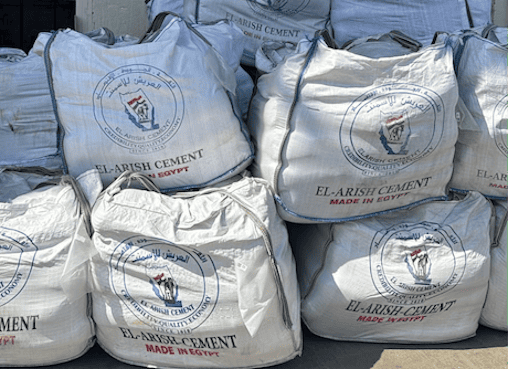
The strange economics of Lebanon’s cement imports raise an urgent question: who will profit from the country’s multibillion-dollar reconstruction?
Lebanon’s reconstruction should be an opportunity to rebuild homes, infrastructure and confidence in the state. Unless the government acts quickly, however, it could also become an opportunity for Hezbollah and politically connected business networks to rebuild their finances.
The warning signs are beginning to appear in the markets for cement and steel—the two basic commodities upon which any reconstruction programme will depend.
Lebanon’s cement industry has traditionally been dominated by three producers: Holcim Liban, now under new Lebanese ownership following the sale of Holcim’s 52.07 per cent stake in January 2026; Cimenterie Nationale, producer of Al Sabeh cement; and Ciments de Sibline, historically associated with interests close to Druze leader Walid Jumblatt. The first two operate in and around Chekka in northern Lebanon, while Sibline is based in the Chouf.
Together, the three producers have an estimated combined capacity of 6mn tonnes a year. Even at the post-civil-war peak, Lebanese cement demand reached about 5.5mn tonnes. In capacity terms, therefore, Lebanon does not need to import cement. The recent tight market was not caused by an absence of domestic production capacity, but by interruptions linked to the long-running dispute between environmental campaigners and quarry operators, which led to quarry shutdowns and constrained the supply of locally produced cement.
Production interruptions and shortages recently drove market prices to as much as three times the official level of 82 dollars, according to people working in the industry. This prompted Industry Minister Joe Issa El Khoury to intervene.
On July 1, 2026, the minister issued Decision 52/1, raising the maximum factory-gate price of black cement from approximately $82 to $96 per tonne, excluding VAT. On the same day, Circular 53/1 opened the market to imports of black and white cement, subject to prior approval from the Ministry of Industry.
Opening the market was defensible. Lebanon urgently needed more supply, competition and relief from artificial shortages. But the way some newly created importers appear to be operating raises questions that cannot be ignored.
Cement that is cheaper than its apparent cost
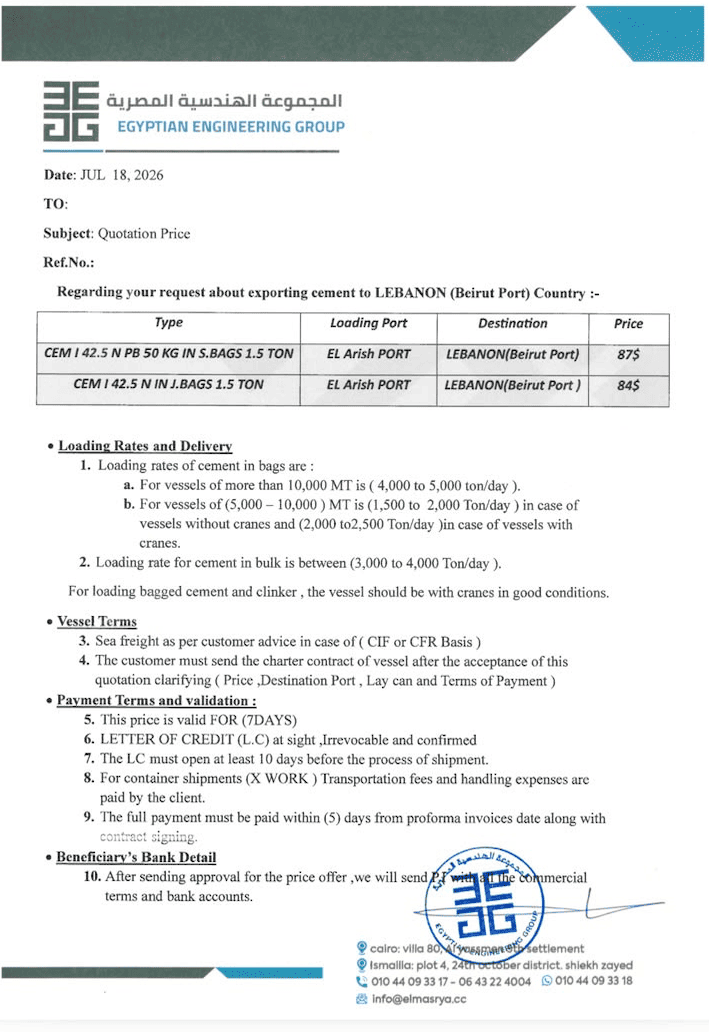
Industry sources say a newly established company called RJ Holding, reportedly registered in Baalbek, ordered approximately 20,000 tonnes of cement from Egypt. I was unable to find sufficient public corporate information to independently establish the company’s ownership, financing or ultimate beneficial owners. That absence of transparency is precisely why the authorities should disclose the information collected when granting its import permit.
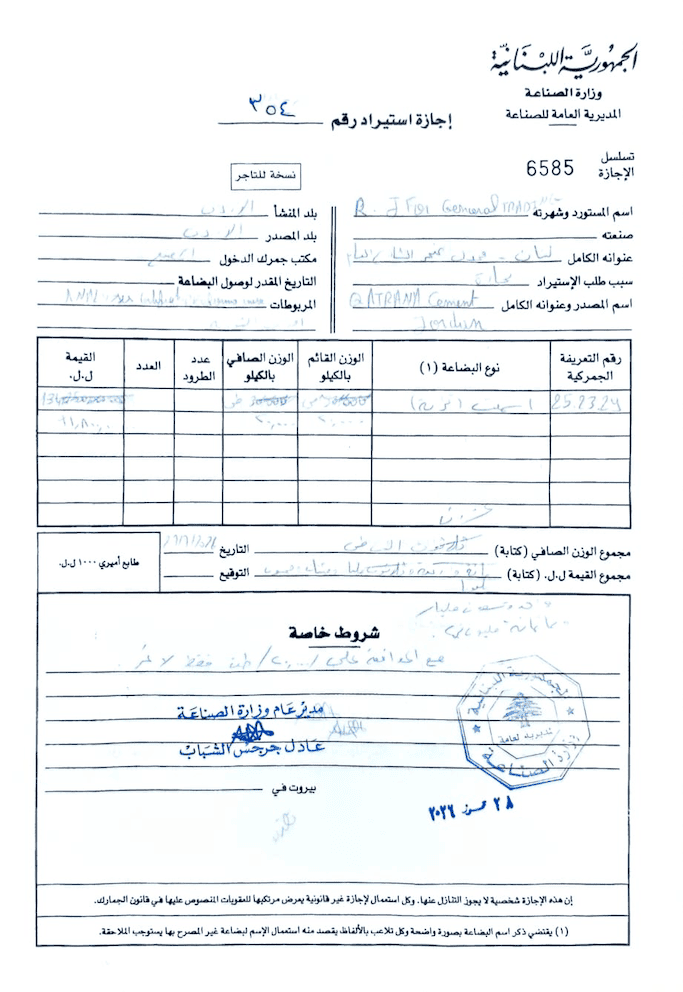
According to industry estimates, the Egyptian cement has a purchase price of approximately $87 per tonne. On the figures provided by market participants, the indicative landed cost would be:
|
Cost component |
Approximate amount per tonne |
|
Egyptian purchase price |
$87.00 |
|
VAT at 11% |
$9.57 |
|
Customs at approximately 3% |
$2.61–$3.00 |
|
Port handling and related charges |
$5.00 |
|
Indicative total |
Approximately $104.18–$104.57 |
Transport, financing, insurance, storage and inland delivery could push the effective cost higher.
Yet industry sources say some of this cement is being offered in Lebanon at approximately $92 per tonne. If both figures are being quoted on the same tax and delivery basis, the importer would be losing more than $12 on every tonne before accounting for overheads.
Across a 20,000-tonne shipment, that implies an apparent loss of roughly $240,000 or more.
Several possibilities should be examined to warrant such a price level: under-declaration at customs, unpaid taxes, hidden subsidies, misrepresented invoices, cross-subsidisation by an undisclosed financier, or the conversion of unexplained cash into legitimate Lebanese commercial revenues.
This is a pricing anomaly significant enough to justify an immediate investigation.
Who is entering the market?
The concern extends beyond one shipment.
Industry sources report that several newly established companies with little publicly visible history are applying for permits or importing large quantities. They also say that Al Moussawi Industry and Trade—or an affiliated Moussawi business group—has sought permission to import cement. Al Moussawi is known for its links to Hezbollah.
The Moussawi group has long had ambitions in the sector. As early as 2015, Moussawi Industry and Trade was reported to be planning a $200mn cement factory in Jenta, in the Baalbek region near the Syrian border. Where industry sources allege links to Hezbollah, the government has an obligation to conduct enhanced beneficial-ownership and sanctions screening before issuing a permit, not after the money has moved.
The Ministry of Industry should therefore publish:
- The names of every company granted a cement-import permit since July 1.
- Each company’s shareholders, directors and ultimate beneficial owners.
- The approved quantity, country of origin and declared purchase price.
- The source and method of payment used for each shipment.
- Customs, VAT and port payments made per tonne.
- The laboratory certificates and quality inspections completed before release.
Without those disclosures, Lebanon risks replacing an old and politically connected domestic oligopoly with a new, opaque import cartel.
The quality-control question
There is also a physical safety issue. Local producers allege that some imported cement entering through the Port of Tripoli is not undergoing adequate independent quality testing.
That claim must be verified urgently.
Cement is not an ordinary consumer good. Its chemical composition, strength development, storage conditions and conformity with technical standards determine whether homes, schools, hospitals and bridges remain standing. A certificate supplied by the exporter should not substitute for independent sampling and testing in Lebanon.
Every shipment should be sealed on arrival, sampled under customs supervision and tested by an accredited laboratory against applicable Lebanese standards before entering the market. The results should be published against the shipment number and importer.
A reconstruction boom conducted with untested or improperly stored cement could create the foundations of Lebanon’s next disaster.
The steel warning
Similar distortions may be emerging in steel.
Industry participants say Lebanese steel prices have increased by approximately 15 per cent to around $620 per tonne. They attribute part of the shift to the disappearance or reduction of cheaper Iranian steel that had flooded the Lebanese market before and its replacement by material from Egypt, Ukraine, China and Turkey.
Lebanon’s 2024 trade data already show China, Turkey and Egypt among its principal iron and steel suppliers. Current international benchmarks also indicate that Turkish rebar was trading at approximately $584–$586 per tonne FOB in June 2026, before freight and Lebanese import costs.
The government must establish whether the increase reflects legitimate international costs or the positioning of intermediaries ahead of reconstruction contracts.
The lesson from 2006
Lebanon has seen this model before.
After the 2006 war, Hezbollah did not treat reconstruction merely as humanitarian relief. Its construction and social-service networks helped it control access to compensation, select contractors, distribute materials and reinforce political loyalty in the southern suburbs and the south.
Jihad al-Bina, Hezbollah’s reconstruction arm, became central to this effort. The US Treasury designated it in February 2007, describing it as a construction organisation formed, operated and directly financed by Hezbollah and Iran.
The risk today is not necessarily that the identical companies will reappear under the same names. Modern networks are more likely to operate through newly incorporated importers, nominally independent traders, intermediaries and subcontractors whose beneficial ownership is difficult to establish.
Control over reconstruction inputs would offer several advantages. It could generate commercial margins, provide a mechanism for placing cash into the formal economy, direct contracts towards allied businesses, and force local builders to depend on politically connected suppliers. Even selling initially at a loss could make strategic sense if the objective were to undermine existing producers, capture market share and dominate supply once reconstruction accelerates.
The scale of the opportunity is enormous. The World Bank estimated Lebanon’s post-2023 conflict recovery and reconstruction needs at $11bn, including between $3bn and $5bn requiring public financing. Housing and private-sector reconstruction account for much of the remainder. The World Bank assessment was released in March 2025.
In a market of that size, control over cement, steel, transport and contracting could refinance an entire political-commercial ecosystem.
Reconstruction must not become recapitalisation
Lebanon needs imports. It needs competition, affordable building materials and reconstruction without further delay. The answer is not to close the market again to protect the three established cement producers.
The answer is transparency.
Every importer participating in reconstruction should be subject to verified beneficial-ownership disclosure, enhanced sanctions screening, traceable banking records, customs reconciliation and independent quality testing. Cash purchases above a defined threshold should trigger enhanced scrutiny. Internationally financed projects should require suppliers and subcontractors to disclose ownership and politically exposed persons, with third-party audits extending all the way down the procurement chain.
These safeguards should apply equally to established cement producers, new importers and politically connected companies of every sect.
The central question is simple: how can a newly created company buy cement for an apparent landed cost above $104 and sell it for $92?
Until the importer, the Ministry of Industry and Lebanese Customs provide a documented answer, this is not merely a story about competition or cheap cement. It is a warning about who may be positioning themselves to control Lebanon’s reconstruction—and whether the money intended to rebuild the country could instead be used to rebuild Hezbollah.