



CHP’s crisis is no longer only about party leadership. It is about whether Turkish democracy itself can still rely on legitimacy, predictability, and peaceful political competition.
There are moments in political history when a crisis ceases to belong solely to the institution at its center and begins to reflect the condition of an entire democratic system. The events that unfolded on May 24 in Ankara were precisely such a moment.
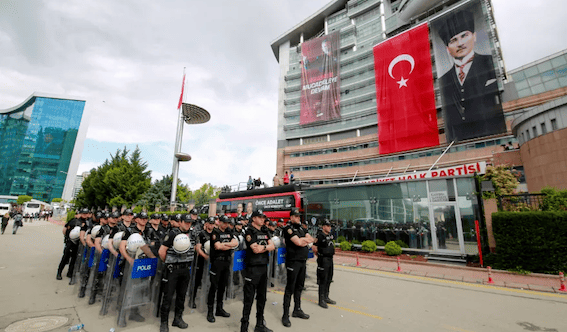
The Republican People’s Party (CHP), not merely Türkiye’s main opposition movement but also the founding party of the republic itself, saw its headquarters stormed by riot police following a controversial judicial intervention that retroactively annulled the party’s 2023 congress under the doctrine of mutlak butlan, or “absolute nullity.” What followed was more than an internal party confrontation. It was a deeply symbolic rupture in Türkiye’s already fragile democratic culture.
The images alone were extraordinary. Riot police cutting chains at the gates of CHP headquarters. Tear gas filling the corridors of the building long referred to by party members as the Baba Ocağı, the “Father’s Home.” MPs forming human barricades. Rubber bullets fired into enclosed spaces. Journalists pushed away from the scene. And finally, a drenched Özgür Özel, removed from his office yet marching seven kilometers toward Parliament alongside tens of thousands of supporters under heavy rain.
One did not need to support CHP politically to understand the historical gravity of the day. Because what suffered damage was not only the CHP. What suffered damage was the collective belief that political legitimacy in Türkiye still primarily derives from voters, delegates, elections, and democratic procedures.
A dangerous threshold
Democracies do not survive because societies always remain calm or politically harmonious. They survive because citizens continue believing that political competition remains legitimate, reversible through elections, and protected by accepted democratic rules.
This is why the current CHP crisis matters far beyond opposition politics. At first glance, the dispute may appear procedural: a contested congress, judicial review, competing legal interpretations regarding party administration, and a leadership struggle between Özgür Özel and former chairman Kemal Kılıçdaroğlu.
But beneath the legal terminology lies a far more dangerous question: What happens when democratic legitimacy itself becomes unstable?
For years, Türkiye has already struggled with polarization. Yet elections still functioned as one of the few remaining mechanisms preserving democratic legitimacy. Citizens voted, parties competed, winners governed, losers reorganized, and political life moved forward.
The present crisis risks moving the country into something qualitatively different.
Once party congresses, electoral mandates, and internal democratic processes become vulnerable to retroactive nullification through extraordinary interventions, politics gradually stops functioning as democratic competition and begins resembling institutional survival warfare.
And survival politics rarely produces societal peace.
The symbolism of the raid
The police operation itself carried enormous symbolic weight.
The CHP is not an ordinary political party in Turkish political memory. It is the party that led the War of Independence, established the republic, and shaped much of modern Türkiye’s institutional architecture. Whether one supports or opposes its ideology is secondary to that historical reality.
Seeing riot police forcefully entering the headquarters of the republic’s founding party inevitably triggered deeper anxieties inside Turkish society regarding democratic continuity, institutional legitimacy, and the shrinking boundaries of political normality.
The operation also transformed Özgür Özel politically.
Until now, Özel had largely been viewed as a party chairman navigating internal opposition tensions after unexpectedly defeating Kemal Kılıçdaroğlu in the November 2023 congress. The raid changed the optics dramatically. Forced into the street by police intervention, Özel immediately reframed the crisis not as a leadership dispute but as a broader democratic struggle.
“The CHP is now in the streets,” he declared before initiating the march toward Parliament.
The symbolism was deliberate. Parliament itself became the destination not merely in geographical terms but politically: an assertion that legitimacy belongs to elected politics, not institutional engineering.
The Kılıçdaroğlu dilemma
Kemal Kılıçdaroğlu’s role in this crisis has become increasingly controversial and historically consequential.
Legally, his supporters argue that court decisions must be respected to avoid institutional chaos and deeper illegitimacy. Politically, however, many opposition voters increasingly view the entire process less as an ordinary legal dispute and more as an externally enabled operation that risks fracturing the opposition at one of the most sensitive moments in Türkiye’s political trajectory.
That perception matters enormously. Because democratic legitimacy is sustained not only through legal texts but through societal trust in fairness and political neutrality.
The central issue is therefore no longer whether Kılıçdaroğlu possesses a theoretical legal route back to party leadership. The real question is whether such a process strengthens or further weakens public confidence in democratic opposition politics.
Ironically, a tactical attempt to restore institutional order may ultimately deepen public distrust toward institutions themselves.
A broader democratic erosion
Türkiye has experienced institutional interventions before. From military tutelage to party closures, constitutional crises, and extraordinary judicial mechanisms, the republic carries a long memory of tensions between elected legitimacy and institutional power.
Each intervention was often justified through exceptional circumstances. Yet cumulatively, those cycles weakened democratic trust rather than strengthening political stability.
That historical memory explains why the current moment feels so heavy.
Many democracies that later experienced democratic erosion did not collapse suddenly through dramatic coups. More commonly, democratic weakening unfolded gradually through the normalization of extraordinary interventions, institutional uncertainty, and declining public confidence in democratic procedures.
The current CHP crisis risks accelerating precisely that process. The danger is not simply that opposition voters feel anger.
The greater danger is that large segments of society begin losing confidence that political competition itself remains secure, protected, and meaningful.
Once citizens start believing that congresses, elections, and mandates can all become permanently contestable through extraordinary institutional mechanisms, politics increasingly transforms into an existential struggle rather than democratic coexistence.
And existential politics radicalizes everyone.
The İmamoğlu factor
The timing of the crisis has intensified those anxieties even further.
The judicial intervention targeting CHP’s leadership structure unfolded simultaneously with mounting legal pressure against Istanbul Mayor Ekrem İmamoğlu, widely viewed as one of the opposition’s strongest future presidential contenders.
This overlap has reinforced the opposition narrative that the broader goal is not merely internal party correction but systematic fragmentation of the opposition itself before the next electoral cycle.
Özel’s increasingly aggressive defense of İmamoğlu reflects this understanding. Alongside Ankara Mayor Mansur Yavaş, CHP’s visible leadership has attempted to project unity and institutional continuity despite the chaos surrounding the party headquarters.
Yet the deeper damage may already extend beyond individuals.
Because the more Turkish politics becomes dominated by legal uncertainty and institutional confrontation, the harder it becomes to preserve democratic normality itself.
The test facing CHP supporters
There is, however, another side to this crisis.
Moments of democratic strain also become tests of democratic maturity.
If democratic legitimacy is perceived to be under pressure, the response cannot simply be rage, uncontrolled escalation, or destructive confrontation. That would only accelerate the instability already threatening Türkiye’s political culture.
The real challenge for CHP supporters is whether they can transform this moment into disciplined democratic resistance rather than uncontrolled polarization.
That distinction matters historically.
If opposition supporters respond through peaceful mobilization, civic engagement, institutional discipline, legal struggle, and continued commitment to democratic norms, this crisis may yet become not only a story of democratic erosion but also one of democratic resilience.
Because ultimately, the question facing Türkiye today is larger than who controls CHP headquarters.
The real question is whether Turkish democracy can still preserve a political culture in which legitimacy derives primarily from citizens, party members, delegates, elections, and democratic processes themselves.
If that confidence erodes permanently, polarization will no longer remain merely political.
It will become a crisis of coexistence itself.