



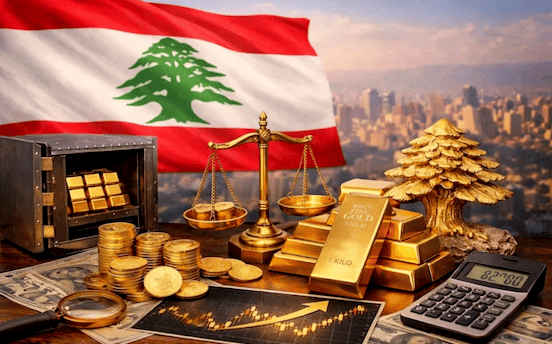
Selling part of the gold and investing the money could help repay depositors and get the economy moving again.
Lebanon has gold worth almost $40 billion, yet people still cannot freely withdraw their own savings. Banks cannot repay their customers. The government cannot afford the recovery the country needs. And the central bank, which holds the gold, owes billions to the banks.
We keep hearing that the gold must be protected for the future. But what happens to that future if families become poorer, businesses close and another generation leaves?
The World Bank expects Lebanon’s economy to shrink by 6.4 per cent in 2026, after growing by an estimated 4.2 per cent in 2025. War has interrupted that recovery, hurting tourism, spending and investment.
Lebanon urgently needs money to reach the people who will use it. Families need to buy food, pay school fees, repair their homes and cover medical bills. Their spending helps shops, service providers and businesses stay open and pay their workers.
One way to support that spending is to return more of the money trapped in bank accounts.
The problem is that the three institutions expected to help—the banks, the government and Banque du Liban—are all financially constrained. The problem is not lack of assets but a lack of Liquidity.
Banks placed much of their customers’ money at the central bank and cannot get it back. The government has unpaid debts and cannot borrow normally from international markets. The central bank can print Lebanese pounds, but it cannot print dollars. Printing more pounds does not solve a dollar shortage and could make prices rise and the currency fall again.
There are dollars circulating in Lebanon. People receive money from relatives abroad, businesses take cash payments and some sectors continue to do well. But this cash does not make frozen bank deposits available or restore normal business lending. It is circulating in a cash economy. To create liquidity banks have to start issuing loans again.
That is why the gold deserves a serious discussion.
As I explained in my previous article, “Lebanon’s Gold Has Many Owners Until the Bill Arrives”, the gold appears among the central bank’s assets. The government owns the central bank, but that does not mean it can take the institution’s assets for any purpose while its debts remain unpaid.
Owning a business does not give you an unlimited right to empty its safe while leaving the people it owes waiting outside.
This does not mean depositors personally own the gold bars. It means that any decision about the gold must take the central bank’s unpaid obligations seriously.
A 1986 law prevents the gold from being sold without legislation approved by Parliament. Using it therefore requires a public decision, clear rules and a binding explanation of where the money will go.
The scale of the unpaid debts makes continued delay difficult to defend. The governor put the central bank’s obligations to banks and depositors at around $79 billion.
The government also has about $31.3 billion in unpaid Eurobond borrowing, with interest accumulating since the 2020 default making it close $46.7 billion as of 6 November 2026.Eurobonds are the dollar bonds through which the state borrowed money. This is only part of the government’s debt, a further 50 bln USD is owed to the central bank and some of it is held within Lebanon’s financial system.
Against this background, leaving all the gold untouched is a choice with a cost.
Consider a simple example.
Lebanon holds approximately 286.8 tonnes of gold. At the gold price quoted on the morning of 5 November, the total would be worth about $38 billion. Selling half would raise roughly $19 billion before costs, while leaving the other half in gold.
That $19 billion could be invested in short-term US government debt, known as Treasury bills. These investments earn a return and can be sold for cash if needed.
Using the latest available one-year Treasury bill rate of 4.39 per cent, the investment could earn approximately $835 million over a year, before costs. That is equivalent to about $70 million a month, although the bills themselves do not pay monthly.
To make that figure more meaningful: spread across 200,000 eligible depositors, it would provide about $348 extra per person each month. Spread across 100,000, it would provide about $696 each. These are examples of how the income could be shared, not promises about how many people would qualify.
The $19 billion originally invested would remain in place if only the earnings were used for repayments. Spending some of that $19 billion as well would allow bigger payments now, but leave less invested and reduce future earnings.
There is no magic here. Selling gold does not erase the financial losses. It changes the form of the central bank’s wealth: some gold becomes dollar investments that earn income and can be turned into cash creating liquidity.
Gold can rise in value, but it does not pay interest. The question is whether Lebanon should keep every bar while passing up income that could help people today.
Returning savings would serve two purposes. It would repay part of what depositors are owed and put a much needed spending power back into the economy.
Some of the money would buy imported goods. Some people would save it. It would therefore be wrong to claim that every dollar repaid creates an extra dollar of Lebanese economic activity. But families paying a local mechanic, buying from a local producer or repairing their homes would support jobs and businesses.
The government could try to achieve a similar result through a large spending programme. But it has limited resources, unpaid debts and growing demands for reconstruction and public services. Even the cash budget surplus reported by the World Bank does not mean all those bills can be met.
A peace agreement could eventually bring investment and outside support. A US-backed agreement involving Lebanon and Israel might offer substantial economic benefits. In the current political climate, however, that possibility is too uncertain to pay anyone’s bills today.
Lebanon needs a plan based on resources it already has.
Any sale must be transparent. The public should know how much gold is sold, at what price, where the money is invested and who receives the earnings. Independent auditors must check the accounts. The sale must accompany efforts to recover stolen funds, make banks financially sound and agree on how the state will repay its debts.
There are risks. Gold could rise after a sale. Interest rates could fall, reducing future earnings. Keeping half the reserves in gold would preserve some protection against those risks.
But doing nothing also carries risks: deeper poverty, more business closures and more years of savings that exist on statements but cannot be spent.
Lebanon’s gold should help protect Lebanon’s future. That future includes the people struggling to survive today.
Ultimately, the battle over Lebanon’s gold pits the deep state’s grip on the country’s wealth against depositors’ right to recover their savings.
Calculation
Market snapshot, not a firm sale quotation.
|
Item |
Assumption or calculated result |
|
Gold reserves used in illustration |
286.8 metric tonnes |
|
Half the reserves |
143.4 metric tonnes |
|
Troy ounces per metric tonne |
32,150.7466 |
|
Half-reserve volume |
4,610,417 troy ounces |
|
Spot gold, 5 November 2026, 07:52 GMT |
$4,124.89/oz |
|
Estimated gross proceeds |
$19.017 billion |
|
52-week Treasury bill annualised yield, 4 November 2026 |
4.39% |
|
Approximate annual gross income |
$834.9 million |
|
Monthly equivalent, not actual monthly bill payments |
$69.6 million |
|
Monthly equivalent across 200,000 recipients |
$348 each |
|
Monthly equivalent across 100,000 recipients |
$696 each |