



Cheap weapons and vulnerable trade routes are reshaping the investment case for oil and gas, argue David Asher and Scott Modell. What are the implications for Lebanon?
The next upheaval in energy markets may depend less on how much oil the world can produce than on whether it can deliver that oil safely. A drone, a damaged pipeline or a threatened shipping lane can unsettle supplies far beyond the battlefield, forcing consumers and investors to put a higher value on reliability.
That is the central argument of The New World Disorder, a security presentation by David Asher, a senior fellow at the Hudson Institute and adviser to Rapidan Energy and BCA Research, and Scott Modell, Rapidan Energy’s chief executive. Their assessment describes an international system in which military superiority offers diminishing assurance that commerce will continue uninterrupted.
For financial markets, the implication is uncomfortable. Energy disruption could become a recurring feature of the investment landscape, keeping pressure on inflation while directing capital towards producers and infrastructure less exposed to conflict.
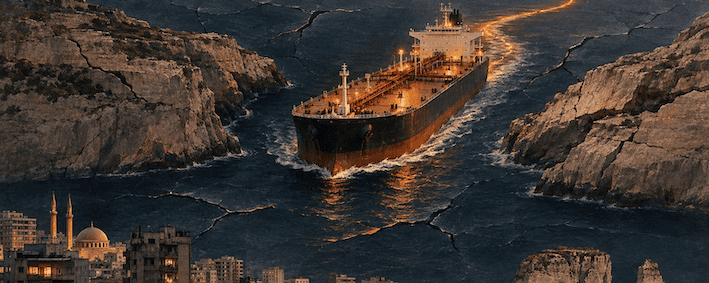
At the centre of the analysis is the Strait of Hormuz. Asher and Modell argue that restoring some tanker traffic through the waterway would fall short of resolving the confrontation between Washington and Tehran. Ships can move while the political conditions for another disruption remain intact.
Their presentation describes a dangerous divergence in perceptions. Washington may interpret restored flows as evidence that pressure is working. Tehran may regard the survival of its leadership and its continuing ability to interfere with shipping as proof that it retains leverage. Both sides can believe they are gaining ground, reducing the incentive to compromise.
The authors attach a 60 per cent probability to a continuation of this uneasy arrangement through the remainder of 2026, with no comprehensive US–Iran agreement, partial flows through Hormuz and crude below $100 a barrel. They assign a 25 per cent probability to regional war and major disruption, with crude above $100. A full peace agreement, restoring prewar flows and leaving oil in a $60–$80 range, receives a 15 per cent probability.
These are scenario judgements rather than measured probabilities. Their significance lies in the authors’ conviction that a durable settlement is the least likely outcome. Even their central case leaves energy buyers operating under persistent uncertainty.
The wider concern is that the cost of inflicting disruption has fallen. Drones, fast boats, mines and cyberattacks give comparatively small actors the capacity to threaten expensive infrastructure. Defending a port or refinery can require resources far beyond those needed to attack it.
That imbalance changes the economics of security. More production capacity provides limited comfort if export terminals remain vulnerable or ships cannot secure passage on acceptable terms. Buyers must consider the resilience of the entire delivery route alongside the price of the commodity.
The presentation extends this logic to Taiwan, where the authors warn that a Chinese blockade could have consequences exceeding those of disruption at Hormuz. The threat would reach beyond energy into manufacturing and trade, linking a regional confrontation to the functioning of the wider world economy.
Cyber operations add another dimension. The authors discuss the Chinese groups known as Salt Typhoon and Volt Typhoon to illustrate the exposure of communications networks and critical infrastructure. In their assessment, a confrontation abroad could be accompanied by disruption to the systems supporting economic activity at home.
Russia presents a different version of the same problem. Asher and Modell argue that Europe’s reduced reliance on Russian energy, combined with Ukrainian attacks on supply infrastructure, is weakening Moscow’s energy leverage. Yet they see little prospect of a decisive end to the war in 2026, assigning a 75 per cent probability to continued stalemate, 20 per cent to a ceasefire and just 5 per cent to outright victory by either side.
For investors, the presentation’s clearest conclusion concerns North America. Oil and gas supplies that avoid Hormuz, comply with sanctions and originate in politically stable jurisdictions should command greater buyer interest, the authors argue. Pipelines, processing facilities and export terminals could benefit as customers seek more dependable sources.
They are particularly positive about US infrastructure handling natural gas liquids and liquefied petroleum gas. Asian buyers seeking alternatives to Gulf supplies and European customers moving away from Russian energy could increase the strategic value of American export capacity.
The thesis nevertheless contains a tension. Land-based infrastructure may reduce exposure to maritime chokepoints, but exports still depend on ports, vessels and overseas demand. A reliability premium is a relative advantage, rather than a guarantee of immunity from disruption. Nor does geopolitical insecurity establish that every energy project will earn an attractive return.
There is a broader economic risk. Repeated supply interruptions can raise costs while weakening activity, complicating central banks’ response. Higher interest rates cannot reopen a shipping lane. Easier monetary policy cannot repair a refinery. Governments could face demands to cushion consumers while simultaneously spending more on defence and infrastructure protection.
For Lebanon, this global repricing of energy security would carry a particularly heavy cost. Dependence on imported petroleum for transport and electricity exposes households and businesses to a shock they have little capacity to absorb. The World Bank warns that higher oil prices would increase the country’s external financing needs, while more expensive freight would add to inflation.
Lebanon need not import its fuel through Hormuz to suffer the consequences of disruption there. Oil and refined products trade in interconnected markets. A shortage elsewhere can raise the cost of replacement cargoes in the Mediterranean, while regional insecurity can increase transport and insurance costs. Distance from the chokepoint offers only partial protection.
The financial transmission would be especially difficult in an economy still struggling with a damaged banking system. A larger fuel bill requires more dollars to maintain the same volume of imports. Dollar pricing cannot shield consumers from that increase: it simply means the loss of purchasing power arrives through higher dollar bills. Businesses buying fuel would have less working capital available for wages, inventories and investment.
Electricity adds a second layer of exposure. The World Bank has documented how unreliable public supply pushed households and businesses towards expensive diesel generators. A sustained rise in diesel prices would therefore reach well beyond the petrol station, raising the cost of refrigeration, water pumping and manufacturing. Households unable to afford solar panels and batteries would have fewer ways to reduce their exposure.
There is also a potential squeeze on the dollars entering the country. Regional escalation could deter tourists and diaspora visitors just as import costs rise. The resulting pressure would depend on the duration of disruption and the resilience of remittances, rather than following automatically from a higher oil price. But the combination of a larger external bill and weaker service receipts would leave Lebanon more vulnerable.
These risks strengthen the economic case for reliable public electricity and investment that reduces fuel consumption. Better grid performance, renewable generation and storage could lower exposure to imported energy. Affordable financing matters: the World Bank notes that the upfront cost of private solar systems has restricted access in a country with severe banking constraints.
The Lebanon implication is a further inference from the presentation’s global thesis. Energy security requires credible import financing and institutions capable of sustaining essential services. Without them, households and businesses must absorb each new external shock through higher bills, reduced consumption or interrupted activity. For Lebanon, the premium on reliability is already a cost of daily life.
Asher and Modell offer a deliberately pessimistic reading of the international order. Their more sweeping warnings about nuclear proliferation and wider war remain forecasts, not inevitable outcomes. But the financial question they raise is concrete: how much should markets pay for energy that can reliably reach its customer?
In a world of vulnerable trade routes and inexpensive weapons, that assurance may account for a growing share of the price of a barrel.
Sources for the Lebanon analysis: World Bank Lebanon overview, economic outlook; World Bank Lebanon Rapid Damage and Needs Assessment, energy sector assessment.
David Asher is a senior fellow at Hudson Institute. His work focuses on US foreign policy in Asia, global macro strategy, economic and financial policy toward US state adversaries, strategic law enforcement, and high technology development. Dr. Asher has advised the US government on countering money laundering, terrorism financing, and sanctions evasion schemes as well as campaigns to undermine nation-state and terrorist adversaries. He has developed and conducted whole of government investigations into international issues involving nuclear, chemical, and biological weapons development and proliferation. Over the last 25 years, he has played a senior role in economic and financial pressure campaigns involving terrorist organizations, drug cartels, and weapons proliferation networks.
Scott Modell is Rapidan Energy Group Chief Executive Officer. He is a seasoned expert on Iran and the broader Middle East as well as Latin America and Europe. He is a decorated former CIA officer who served for 13 years in the Directorate of Operations with five tours conducting operations in Latin America, Western Europe and the Middle East. He is a non- resident fellow at the centre for strategic and international studies focusing on security issues related to Iran and the middle east and a senior advisor to US special operations on counter threat finance operations. He is an Adjunct Professor at Georgetown University.