



A Guide for Arab Voters in Israel
The upcoming election is often described as pivotal. But the truth that must be presented to every Israeli, whatever religion, race or nationality, is that elections in Israel have been pivotal since November 4, 1995.
Why are these nights, and why are these elections different from those held since Prime Minister Yitzhak Rabin was murdered by a Jewish assassin, armed with explosive messianic materials supplied by rabbis, politicians and others who prostrate themselves upon the graves of the patriarchs?
Then as now, it is the same mantra resurfacing. The murderer famously justified his act on the grounds that the prime minister did not have a Jewish majority in support of peace agreements with the Palestinians, simply because his government relied on the Arab parties to ensure a blocking Knesset majority.
Today, it is the same Benjamin Netanyahu, who in the mid-1990s stood on a balcony over Zion Square in Jerusalem and sprayed those arguments which led to Rabin’s murder into the air; it is the same rabbis and the same messianists, but the old wine is in a newer bottle. The racist “Jewish majority” argument used back in the day had a solely cosmetic upgrade, and transformed into “Zionist majority.”
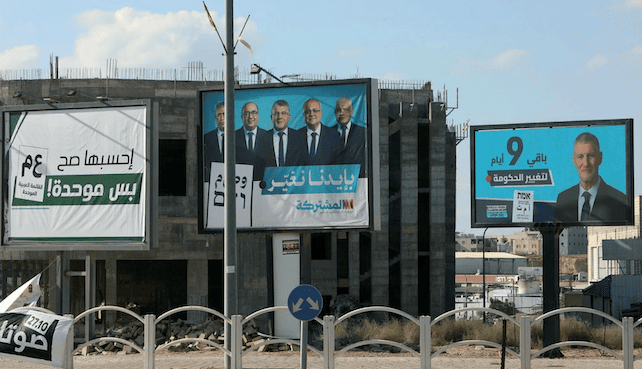
Today, what people call the “bloc of change,” which says it wants to replace the current government, has taken “Zionist majority” to heart and to the billboards. To paraphrase another prime minister, Yitzhak Shamir, who said “the Arabs are Arabs… the sea is the same sea”: For a bloc that prides itself on “change,” it deserves to be lambasted for the racism being the same racism and the Zionists being the same Zionists.
In this atmosphere, Arab citizens are left in a difficult position. The question they face is what to do in this election, and what to do in the election’s aftermath, whatever the results may be. It is not an easy question to answer. Hearing “Jewish-Zionist majority” fuels a growing sense of despair among many from Israeli politics, which is saturated with exclusionary racist discourse. Moreover, the history of Arab elected officials in the Knesset leaves little room for optimism.
I must admit I once felt such a sense of despair, leading me to abstain from voting. At another time, it prompted me to stick to universal principles and cast a ballot for a party I knew would not cross the electoral threshold.
Despite all of the above, Arab citizens of Israel deserve the possibility of taking their fate into their own hands through democratic elections. That is a civil right that does not exist anywhere in the Arab world around them. They should not relinquish this privilege.
Therefore, they must seize the opportunity that has come their way now, before it is too late. Because if a “fully right-wing” government returns to power for the coming years, it might pass laws that prevent Arab citizens from voting at all. As far-fetched as that may sound, they could justify it by claiming that only those who have served in the military are entitled to vote or by employing various other notorious Zionist tricks, such as the Basic Law on the nation-state and the like.
The principles for choosing a party should be as follows: a ticket that does not use the racist argument of a Zionist majority that wants to replace the current government, that gives women a good chance of making it into the Knesset and that wants to be part of a future coalition to change the national discourse, promote peace and accept responsibility for the fate of all the citizens of the country.
This is an opportunity for change before disaster strikes.
IN PLACE
Haaretz, 25.10.2026
For Hebrew, press here