



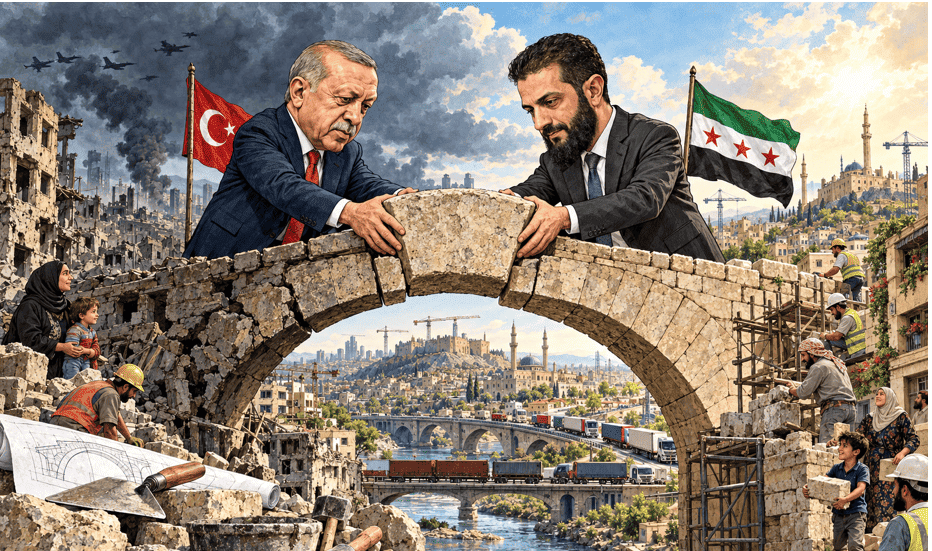
Türkiye’s engagement in Syria reflects immediate security concerns and a substantial interest in its neighbour’s recovery. Treating Turkish influence as a problem to be contained, while accepting other powers’ military freedom as a condition of stability, applies an unequal standard to regional security.
Key Points
- Türkiye’s border security and Syria’s recovery can reinforce each other through accountable institutions, negotiated military integration and protection of Kurdish rights.
- Saudi investment and Turkish cooperation can complement one another, strengthening reconstruction while reducing Syria’s dependence on any single foreign partner.
- Regional stability requires consistent respect for Syrian sovereignty, with Turkish engagement and Israeli military actions judged by the same standards.
Syria’s reconstruction will depend partly on whether outside powers support the restoration of a functioning state or continue treating the country as an arena for competing strategic projects. For Türkiye, that distinction has immediate consequences. A stable neighbour can help secure its southern border, restore trade and create conditions for voluntary refugee returns. A fragmented Syria would perpetuate insecurity, armed networks and displacement.
Ankara undoubtedly seeks influence, commercial opportunities and a favourable regional balance. Those interests deserve scrutiny, but their existence does not establish that Türkiye intends to subordinate Syria. The more useful questions concern Syrian consent, control over national institutions and whether foreign partnerships strengthen the country’s ability to govern independently.
Border security and Kurdish rights can coexist
Describing Türkiye’s policy simply as an effort to suppress Kurdish influence conflates an entire community with particular armed organisations. Ankara’s stated security concerns centre on structures it associates with the PKK. Those assessments can be debated, but they must be addressed directly rather than treated as evidence that Kurdish political participation itself constitutes a threat.
The Syrian Democratic Forces’ contribution to the struggle against Islamic State deserves recognition. That contribution does not settle the subsequent questions of military command, territorial administration or relations with neighbouring countries. Nor can Turkish security concerns justify denying Syrian Kurds citizenship, cultural rights or meaningful representation in national institutions.
A durable settlement must accommodate both requirements. Kurdish citizens need enforceable guarantees of equality, while Syria needs an agreed framework for bringing armed formations under accountable national authority. Integration should provide a political settlement in which communities can trust state institutions.
Türkiye’s support for negotiated integration is relevant here. Its Foreign Ministry welcomed the ceasefire and full integration agreement announced in January 2026, endorsing an inclusive approach to reconstruction based on popular consent. That position provides a basis for both defending Ankara’s policy and judging whether its actions meet its declared objectives.
Syrian defence capacity is part of sovereignty
The rebuilding of Syrian military institutions should be assessed through their contribution to national stability and accountability. Training officers, supplying equipment and restoring infrastructure can create dependence on foreign partners, but they can also help replace competing armed groups with a functioning national security system.
The decisive issue is who exercises authority. Defence cooperation should preserve Syrian control over deployment, command and strategic decisions. Transparent agreements, professional standards and civilian oversight would strengthen the case that Turkish assistance serves Syrian recovery. Arrangements that undermine those conditions would weaken it.
A country emerging from prolonged conflict cannot be expected to remain indefinitely incapable of defending its territory. Syrian sovereignty requires institutions that can secure borders, protect civilians and prevent armed organisations from exercising authority beyond public control. Assistance towards those objectives is not inherently expansionist because it comes from Türkiye.
Israel’s security concerns also warrant consideration, particularly regarding hostile armed groups and weapons transfers. But legitimate concerns do not establish an unrestricted entitlement to determine Syria’s defence capabilities. Regional stability cannot depend on one state retaining permanent military freedom over another.
Türkiye’s objection to Israeli attacks therefore has a defensible foundation: recovery becomes harder when Syrian territory and infrastructure remain exposed to repeated intervention. Ankara has publicly framed its support for Damascus around Syria’s unity, sovereignty and territorial integrity. Its own policies should be measured against those principles.
Saudi investment can reinforce Turkish cooperation
Saudi involvement in reconstruction need not constitute a strategy for displacing Türkiye. Gulf financing, Turkish industry, regional transport networks and Syrian labour can contribute to the same recovery. Their combination could give Damascus access to resources that no single partner can provide.
Competition over contracts and political influence is inevitable. Yet competition does not make cooperation impossible, nor does every new investment require Syria to move from one strategic camp into another. A diversified network of partners could increase Syrian bargaining power and reduce dependence on any individual sponsor.
Ankara and Riyadh have already demonstrated overlapping diplomatic positions. Both joined regional governments in July 2025 in supporting Syrian reconstruction and condemning Israeli attacks. They participated together again in an August 2026 statement warning that violations of Syrian sovereignty threatened regional stability. These positions do not erase differences, but they challenge the assumption that Turkish and Saudi interests must collide.
The practical priority should be restoring electricity, housing, transport, employment and public services. Such improvements would strengthen Syrian institutions while helping create conditions for safe and voluntary refugee returns. Türkiye has a direct interest in that outcome, as do Syria’s Arab partners.
Washington needs cooperation with Ankara
An American strategy organised primarily around limiting Turkish influence would risk placing geopolitical competition ahead of Syrian stabilisation. Washington has legitimate reasons to oppose exclusive control by any outside power. That principle, however, should apply consistently to every actor.
The more useful tests concern results. Does a partnership reduce the threat from Islamic State and other armed organisations? Does it protect minorities, strengthen accountable institutions and lower the risk of regional war? Does it leave Syrians with greater control over their future?
Turkish cooperation that advances those objectives should be encouraged. Policies that undermine them should be challenged with specific evidence. Treating Ankara’s involvement as inherently destabilising would obscure opportunities for coordination over border security, institutional reconstruction and economic recovery.
Consistency also matters beyond Syria. Defence cooperation involving Israel, Greece or Gulf states is frequently presented as a contribution to regional security. Türkiye’s partnerships deserve evaluation through the same criteria: consent, accountability, proportionality and their consequences for neighbouring countries. Strategic autonomy does not become illegitimate simply because Ankara’s preferences sometimes differ from Washington’s.
A stronger defence of Turkish interests
Türkiye’s most persuasive case rests on the relationship between its security and Syria’s recovery. A functioning Syrian state could reduce cross-border threats, revive commerce and ease displacement pressures. Those benefits give Ankara substantial reasons to support institutional reconstruction rather than permanent fragmentation.
Making that case credible requires respect for Syrian decision-making, protection of Kurdish rights, accountable defence cooperation and arrangements that prevent a prolonged military presence from becoming permanent dependency. These commitments would strengthen Turkish influence by grounding it in a partnership Syrians have reasons to sustain.
Other powers should face the same expectations. Syria’s sovereignty cannot be invoked to constrain Türkiye while being set aside to accommodate another country’s military preferences. The purpose of reconstruction should be to give Syrians the institutions, resources and security needed to determine their own future. A responsible partnership with Türkiye can help make that possible.
*A former editor-in-chief of Turkish Daily News, Hurriyet Daily News, Yusus Kanli writes on geopolitics and press freedom. He is also the author of The Anatolian Fire, on Eurasian myths and legends.