



Nearly seven years after Lebanon’s banking collapse, the damage extends beyond frozen deposits. The prolonged shortage of accessible credit has left businesses struggling to finance their operations and households searching for money wherever they can find it. Accounts emerging from this financial vacuum describe a predatory lending market in which urgent cash comes at extraordinary interest rates—and default can put a family’s home or property at risk.
Bank lending has begun to recover, but remains limited. Banque du Liban’s December 2025 Macroeconomic Review recorded $794 million in fresh loans and advances, up from $418 million a year earlier. Despite that increase, fresh lending represented less than 2.5% of nominal GDP. The central bank concluded that bank credit continued to play only a limited role in financing economic activity.
Some banks have resumed small personal loans, including car financing, and short-term lending to merchants. These services remain far removed from the scale of lending available before the collapse.
In a report published in June 2025 Banque du Liban describes the stark contrast of where the credit market was pre crisis of 2019 and where it was in June 2025, “Outstanding bank credit to the private sector fell from approximately $56 billion in June 2019 to $5.5 billion in June 2025—a contraction of roughly 90%. This illustrates the enormous financing gap facing businesses and households.”
For businesses, the consequences are immediate. Suppliers demand payment, wages fall due and inventory must be replenished. A company can have customers and orders yet lack the working capital needed to continue operating. When transactions depend on cash already in hand, a temporary liquidity shortage can become a threat to survival.
That desperation creates an opening for loan sharks.
A loan shark is a predatory lender who advances money at exceptionally high rates, often outside effective regulatory oversight, and may enforce repayment through intimidation or coercion. The danger lies in the combination of punishing borrowing costs, opaque terms and collection practices that leave borrowers afraid to challenge the lender.
From the exchange counter to the lender
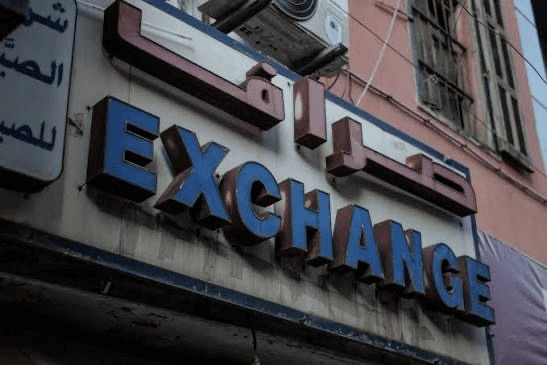
Accounts gathered for this investigation identify some foreign currency exchange offices as an entry point into this market. A person seeking money is referred to a private lender by a foreign exchange house. Other accounts interviewed for this article confirm that certain exchange operators lend directly, charging rates as high as 1% a day.
These allegations concern particular operators; they do not establish that all exchange businesses participate in predatory lending. But they raise a pressing supervisory question: are some cash intermediaries also acting as credit brokers or lenders, and under whose oversight?
The accounts interviewed identify lending operations linked to three main individuals. Abou Jaoudi trading in Daoura, two individuals from the Zaaiter family in Dahieh, and an individual from Al Masri family, originally from Tripoli and operating in Beirut. These identifications remain incomplete as individuals were too afraid to speak face to face.
The same accounts suggest that some lenders cooperate, transferring troubled debts to collectors believed to have greater capacity to intimidate borrowers using arms and physical threats. One party supplies the cash, another introduces the customer, and a third enforces collection.
If corroborated, this would reveal an interconnected lending and collection network rather than isolated transactions between private individuals.
The arithmetic of a debt trap
Borrowing at 10% a month can turn a short-term financial problem into an impossible repayment burden.
On a $500,000 loan, monthly interest alone is $50,000. If interest is paid each month and the principal remains unchanged, the borrower pays $600,000 in interest over twelve months—more than the amount originally borrowed—and still owes the full $500,000.
If unpaid interest is added to the debt and compounded monthly, the balance reaches approximately $1.57 million after a year. Of that amount, approximately $1.07 million is accumulated interest. This calculation assumes no repayments, no additional charges and monthly compounding; the actual liability depends on the agreement.
The reported daily rate is more severe still. At 1% a day, calculated on an unchanged principal without compounding, thirty days generates interest equal to 30% of the loan. On $500,000, that would mean $150,000 in interest in one month.
For a business already short of cash, these terms can consume the money needed to pay suppliers and employees. Borrowing to keep the doors open can instead accelerate closure.
When repayment becomes a claim on the family home
The most troubling accounts concern what happens after default.
Borrowers reportedly face threats against themselves or their families and pressure to provide a house or land as security. Some accounts describe the eventual loss of those properties. Establishing precisely how this is happening required further examination of loan agreements, guarantees, property records and any documents signed under alleged pressure that the accounts were too scared to provide.
The accounts also confirm that a lender in Daoura can transfer or sell an unpaid debt to collectors in Dahieh, where individuals are armed.
The social cost extends beyond the borrower. A business owner’s liquidity crisis can put a family residence at risk. Relatives may become guarantors or face pressure to settle a debt they did not incur. Fear of retaliation then discourages complaints, leaving the scale of the problem difficult to measure.
As accounts begin to emerge, they warrant urgent investigation by the relevant authorities. the practice is spreading and is spreading fast.
Who supplies the money?
The origin of the lending capital remains unresolved.
Sources suspect that some funds may come from drug trafficking or other illicit activities. Tracing the cash needed more investigative work in a dangerous zone.
If criminal proceeds are financing these loans, the implications extend beyond predatory lending. Illicit capital could be converted into interest income and property holdings, giving its owners both financial returns and greater influence over vulnerable businesses and families.
A cash economy developing its own credit market
Lebanon’s financial collapse pushed economic activity toward cash. But demand for credit did not disappear when banks stopped meeting it.
Businesses still need financing between purchasing stock and receiving payment. Households still face emergencies that exceed their available savings. Where regulated lenders cannot provide an answer, other actors can enter—with terms dictated by desperation.
This is the next challenge in Lebanon’s cash economy: informal cash circulation is developing an accompanying credit market. Where that market relies on coercion, borrowers may exchange immediate financial relief for a longer-term loss of income, property and security.
Containing it requires more than restricting cash transactions. Authorities need to investigate alleged threats and coerced property transfers, provide a credible route for borrowers to report abuse, and examine exchange businesses implicated in lending or referrals. Financial investigators must trace the capital behind the loans and distinguish legitimate private financing from predatory or criminal operations.
At the same time, Lebanon needs functioning, adequately capitalised banks capable of financing viable businesses and households. Restoring lending must be part of a credible banking recovery that addresses losses and depositors’ claims.
A modern economy cannot sustain investment, employment and growth when businesses must finance every transaction from cash already in hand. The longer legitimate credit remains inaccessible, the stronger the position of lenders willing to exploit desperation.
Lebanon’s banking collapse has already deprived people of access to their savings. It must not also leave them dependent on creditors who can turn a cash shortage into the loss of a family property home.