



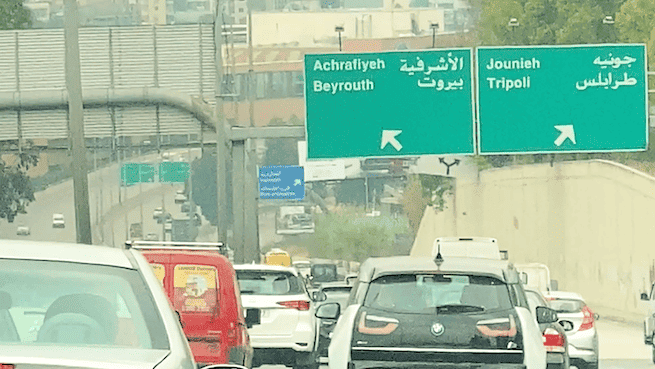
A video clip that circulated this year on social media in Lebanon shows a man in a car, playing two roles: a driving instructor and a student. It’s a deadpan sketch aimed at Lebanon’s traffic chaos — or, read another way, a satirical portrait of a people shaped by collapse.
“How do you drive on the highway?” the instructor asks. “Slowly,” the student answers. “Bravo,” the instructor says and checks a box.
“If someone is driving behind you?” “I slam on the brakes.” The instructor nods approvingly.
“If someone pulls up next to you?” “I swerve into them.”“Very good.”
“Someone tries to merge into your lane?” “I block them.”“Love it,” the instructor answers.
“Shall we begin?” the student finally asks. “We are done,” the instructor replies and hands him the key. “Congratulations.”
The sketch rings true to anyone who has ever driven in Beirut, where the streets are like a nest of bees you’ve just disturbed. Everyone swerves and stings, rushing in all directions. As a native Beiruti now living in Cambridge, Mass., I try to resist when I visit Lebanon, but I become part of the swarm because the road demands it. Traffic rules are rewritten minute by minute. A taxi driver stops to haggle with a passenger mid-lane while the cars behind wait; a roundabout turns into a duel of bumpers; pedestrians step off the sidewalk to cross a street only to be sped at.
Driving in Beirut is one mundane example of how we Lebanese have stopped believing we owe each other or our unraveling country anything. The road’s swarm logic governs our politics, where elected officials all seem to be rushing ahead randomly. We have no faith in the system, only in our own maneuvering. Heartbreak has become muscle memory.
Driving is an expression of our society’s permanent gridlock, and even a deeper rot: It reveals that we have lost the thread that connects us to one another and that the only way forward is to cut someone else off.
How did we get this way?
Policy failures and broken institutions are partly to blame. Lebanon’s institutions have struggled to recover since the civil war, which raged from 1975 to 1990, leaving an estimated 150,000 dead. More recently, banks froze deposits in the 2019 economic crash, wiping out people’s savings and plunging much of the country into poverty. Months later, the Beirut port blast, one of the largest nonnuclear explosions in history, killed at least 235 people, injured thousands and destroyed a large swath of the capital.
Alongside those disasters, we have experienced a slow, grinding erosion of trust, accountability and basic function. Public services have all but disappeared. ATMs are moody, courts are backlogged for years and government offices operate with little budget or oversight. What remains is a country where dysfunction is the norm and survival depends on workarounds.
A relative visiting from the United States asked me during a recent stay why there were water trucks parked in front of some buildings in Beirut. I looked, then shrugged. “They’re delivering water,” I said, matter of fact. He looked confused. That’s when I realized he needed context. In Lebanon, water often doesn’t come out of the taps unless you pay private suppliers to bring it. Delivery men haul hoses up the staircases and fill cisterns on the roof. It’s the same with electricity: Most people who can afford it rely on private generators.
For a while, there seemed to be the possibility of change. After the Hamas attack on Israel on Oct. 7, Hezbollah, the Lebanese militant group that wields enormous power in Lebanon, joined the war. Israel struck devastating blows against the organization and its patron, Iran, and suddenly the region seemed to tilt. Syria turned toward the West, Iran was weakened, Lebanon had a respected new president and prime minister, and diplomats talked of disarming Hezbollah altogether. For a moment, it felt like change might finally come.
But many months later, little has shifted. Hezbollah is still armed, Israel still occupies our land in the south and continues to bomb parts of the country, killing more than 100 civilians since a cease-fire with Lebanon 10 months ago, according to the United Nations. International donors continue to tie meaningful aid for Lebanon’s reconstruction and recovery to the disarmament of Hezbollah and the restoration of full state authority — conditions that Lebanese leaders have failed to meet — and we are still too practiced in survival to believe change could belong to us.
We’re no longer in free fall, but much remains broken. The corrupt are still in place. We are stuck in the rubble, but pretending we’re not. Collapse here doesn’t mean change. It just means adjusting to worse terms. We call it resilience, but at what point does resilience become resignation? When does adapting stop being a strength and start being a trap?
Absurdity flourishes in a country where a few thrive and the rest survive. If you want to see what that looks like, step into Em Sherif Deli. The restaurant sits in Beirut’s glitzy new downtown, with its wide boulevards, manicured medians and luxury high-rises. It feels almost like a different city.
Em Sherif doesn’t look anything like a deli in the American sense — no Formica counters, no workers in aprons slicing meat, no urns filled with weak coffee. It’s less a sandwich shop and more an experience designed for those who can afford it. French and English float through the air. Waiters in crisp white shirts deliver $20 mini sandwiches. Designer handbags rest casually on tables. Outside, valet drivers wheel away S.U.V.s worth years of their wages. Children, barefoot and dust-covered, as young as 3, weave through traffic asking for change.
Two countries are living on top of each other, one buffered by generators, drivers and imported everything, the other left to negotiate survival in the margins. What’s most unsettling isn’t how shocking it feels, but how routine it is. Just like we speed through intersections without looking.
On a recent summer drive to the beach with my 15-year-old son, the road wound past the site of the port explosion — the debris has mostly been cleared, but nothing here has been rebuilt — and then past another scar we have stopped seeing: the site where former Prime Minister Rafik Hariri was assassinated by a truck bomb in 2005.
My son asked quietly, “Are the people who did it in jail?”
I wasn’t sure which tragedy he was referring to. I let out a short laugh, not because the question was funny, but because it felt so absurd to even ask such a question. Then it hit me: The real absurdity was my reaction. When you stop seeking answers, adaptation becomes a trap. That’s when you realize that nothing ever changes, except how far we’ve lowered our expectations.
Nada Bakri is a journalist and essayist based in Cambridge, Mass., and a former reporter for The New York Times.