



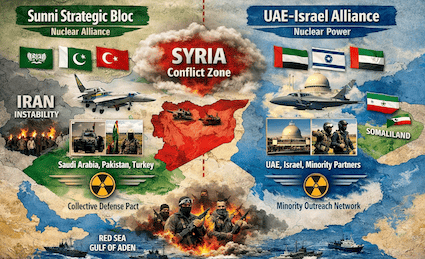
The Middle East is reorganizing itself in real time—and Syria is once again the proving ground.
This week’s developments leave little room for illusion: forces loyal to Ahmed al-Sharaa have pushed decisively into Kurdish-held areas, extinguishing any remaining hope for a negotiated, federal Syria. The message is unmistakable: unity will be imposed by force, or pluralism will be eliminated.
For the Kurds, reports of abuses and coercion revive an old, brutal calculus: when rights are denied internally, protection is sought externally. The same applies to Syria’s Druze, who increasingly survive under an Israeli security shadow. Syria is once again teaching the region its harshest lesson—and that lesson now unfolds in a nuclearized strategic environment.
⸻
Two Nuclear Blocs, Two Visions of Order
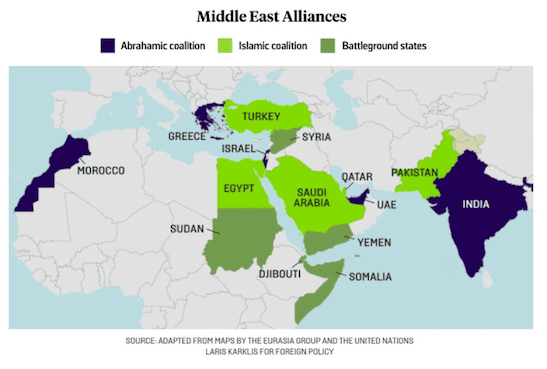
What is emerging in the Middle East today is not merely a diplomatic reshuffle, but the consolidation of two rival security blocs—both backed by nuclear deterrence, both shaping outcomes from Syria to the Red Sea.
Bloc One: Treaty-Based, Nuclear-Backed State Deterrence
The first bloc is coalescing around Saudi Arabia, Pakistan, and increasingly Turkey.
Its defining feature is explicit, delegated nuclear deterrence. Pakistan’s declared nuclear arsenal anchors this architecture, much as the U.S. nuclear umbrella underpins NATO. Saudi Arabia provides financial depth and strategic geography; Turkey contributes conventional military power and defense industry capacity. Together, they form a state-centric, treaty-based security bloc designed to preserve borders, suppress secessionist spirals, and deter regional collapse as Iran weakens.
This bloc fears not diversity—but fragmentation. It understands that forced centralization, as now attempted in Syria, produces endless insurgency under nuclear shadow.
Bloc Two: Unilateral Nuclear Power and Minority Shields
Opposite it stands a looser but no less consequential bloc centered on Israel—a de facto nuclear power—and the United Arab Emirates.
Israel’s undeclared but widely acknowledged nuclear capability gives this bloc independent escalation control, without treaties or collective-defense clauses. Its strategy is node-based rather than territorial: protecting minorities, securing ports and corridors, and bypassing broken capitals. Druze and Kurdish outreach in the Levant mirrors Emirati-Israeli positioning in the Red Sea and Horn of Africa.
This bloc does not advocate federalism—but it thrives where federalism is denied. When central states crush pluralism, minorities inevitably seek nuclear-backed patrons.
⸻
Syria’s Warning Under Nuclear Shadow
Syria today is not simply repressing its periphery; it is doing so in a region where both sides of the emerging order rest on nuclear deterrence. That reality raises the stakes dramatically. Kurds pushed out of Damascus’s reach will look elsewhere. Druze will deepen reliance on Israel. What emerges is not sovereignty, but permanent proxy exposure under nuclear risk.
This is the future awaiting other fragile states that mistake coercive unity for stability.
⸻
Lebanon and Iraq: Reform or Become Terrain
For Lebanon, hyper-centralized confessionalism has become a liability. Every regional shock becomes existential because all power is trapped at a paralyzed center. Federalism would not divide Lebanon; it would remove the incentive for any community to seize the state for survival—and prevent minorities from seeking nuclear-backed protection abroad.
For Iraq, the federal framework already exists, but enforcement does not. Revenue-sharing, security command, and constitutional arbitration must become rules, not negotiations. In a nuclearized region, improvisation is not flexibility—it is danger.
⸻
The Choice Before the Next Shock
The Middle East is no longer drifting toward polarization; it is settling into nuclear-backed symmetry without shared rules. In such an environment, weak centralized states are not neutral. They are battlegrounds.
Lebanon and Iraq still have agency. They can build internal shock absorbers through federal governance—or wait until competing nuclear blocs organize their diversity for them.
Federalism is not fragmentation.
It is preemptive stability.
And in the Middle East that is now emerging, states that fail to organize pluralism internally will find it enforced externally—under nuclear shadow.