



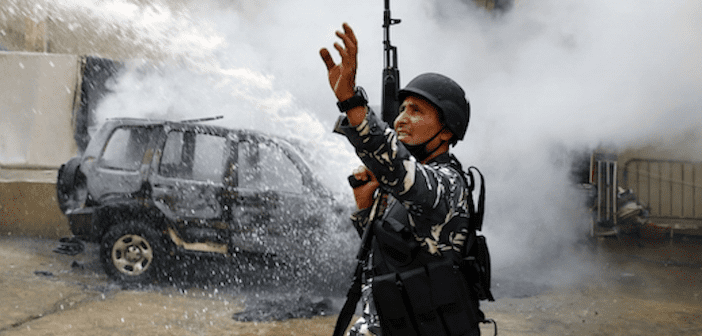
Rioting has rocked Lebanon’s second city of Tripoli for four straight nights, with protesters torching the provincial government headquarters and targeting the homes of leading politicians
Beirut (AFP)
More than 400 people have been wounded in northern Lebanon this week in clashes between security forces and protesters angered by a coronavirus lockdown they say is starving them.
What is behind the escalating tensions in the main northern city of Tripoli, and is Lebanon heading towards mass social unrest as anger mounts over government mismanagement of the country’s many crises?
– Cocktail of crises –
Since 2019, Lebanon has grappled with its worst economic crisis since the 1975-1990 civil war.
More than half the population now lives below the poverty line, according to the United Nations, while the Lebanese pound has lost more than 80 percent of its value against the dollar on the black market.
According to the International Monetary Fund, gross domestic product (GDP) fell by 25 percent last year while prices jumped by 144 percent over the same period.
Compounding the situation, Lebanese banks have prevented depositors from fully accessing their foreign currency savings, only allowing them to convert them into the local currency at half the black market rate, incurring a substantial loss.
This amounts to a “de-facto haircut” on deposits, affecting mostly small and medium-sized depositors, said economist Jad Chabaan of the American University of Beirut.
The coronavirus pandemic finished off businesses already struggling to survive the financial downturn.
By June last year, Covid and related measures had already pushed nearly one in three Lebanese into unemployment, the UN food agency said.
An August 4 explosion at Beirut port piled new misery onto an already desperate situation.
The country’s worst peace-time tragedy killed more than 200 people and ravaged entire swathes of the capital, costing the government billions of dollars in blast damages.
Authorities opened an investigation into the blast but its slow progress has added to widespread public anger against political leaders widely blamed for the disaster.
Outgoing premier Hassan Diab, who resigned in the aftermath of the explosion, said it was caused by a highly explosive shipment of ammonium nitrate fertiliser left to languish for years in the port.
Nearly six months on, political leaders have yet to form a new government despite international pressure.
Foreign donors have pressed for a government committed to long-awaited reforms, including restructuring of the national debt.
Lebanon defaulted on its foreign debt for the first time last year and bailout talks with the IMF hit a wall just months later.
– Lockdown woes –
Lebanon has recorded 293,157 coronavirus cases and 2,621 deaths since February last year.
This month it recorded one of the world’s steepest per-capita surges in infections, forcing authorities to impose a full lockdown until February 8.
The restrictions include a round-the-clock curfew, with grocery shopping only allowed through deliveries.
With day labourers making up around half of Lebanon’s workforce, the restrictions have prompted alarm.
“We are very concerned that vulnerable families and their children will be left to deal with a catastrophe on their own,” the Save the Children charity has said.
To ease the burden, the World Bank has approved emergency aid worth $246 million to help 786,000 Lebanese.
Local authorities say they have started disbursing monthly payments of 400,000 Lebanese pounds (around $50 at the market rate) to some 230,000 families.
But caretaker social affairs minister Ramzi Musharrafieh acknowledged Tuesday that three quarters of the population of more than six million need assistance.
– ‘Worst to come’ –
Angered by the lockdown, residents of Lebanon’s poorest city of Tripoli have rioted for four nights in a row, prompting the heavy deployment of troops and riot police.
Protesters have lobbed molotov cocktails, fireworks and stones. The security forces have responded with tear gas and rubber bullets.
Clashes since Monday night have injured more than 400 people, according to an AFP tally.
Mohamed al-Beiruti, an anti-poverty activist in Tripoli, said earlier this week that living conditions were “bringing popular anger to a boil”, and the worst was likely still to come.
Chaaban, the economist, warned popular discontent was unlikely to abate any time soon.
If the political deadlock over forming a new government persists and protests continue, the exchange rate to the dollar on the black market could rise further, and prices increase even more, he said.
This all comes as the government has been mulling lifting subsidies on fuel or medicines, which would further stoke inflation, he said.
As for the big picture, Lebanon cannot unlock billions of dollars in international aid until it has a new government, and there is no political breakthrough on the horizon.