



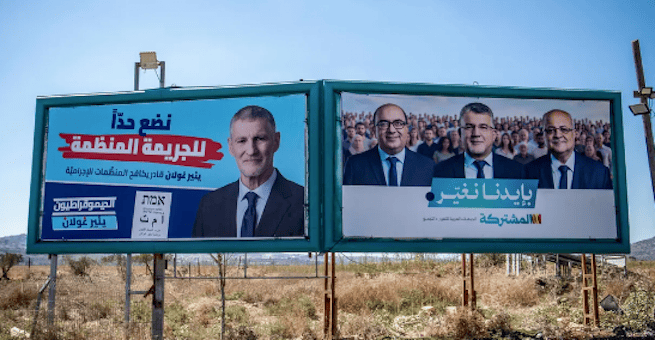
The Arab world, from the Atlantic to the Gulf, has been watching the recent Israeli elections with bated breath. This Israeli situation is capturing the attention of Arab citizens in their own countries—countries that, for the most part, lack this kind of freedom of political and parliamentary activity, save in rare instances—due to the regimes that oppress their citizens and silence their voices from the moment they are born until they leave this world.
At this juncture, there is no doubt that Arab citizens from the east to the west of the Arab world envy this Arab minority that remained in its homeland, which came to be known as Israel in 1948. People in the countries of the Arab world have long seen Arab political parties and movements in Israel fighting among themselves—sometimes at odds, other times uniting—with some merging into Jewish-Zionist parties and others boycotting elections for political reasons, personal whims, or other such fancies and convictions. Now they are seeing Arab citizens in Israel flocking to the polls to elect their representatives to the Israeli Knesset, parliament of the “so-called entity,” as Israel is habitually described in their media that beat the drum day and night for their tormentors in their own delusional entities.
Despite everything that is said about internal Jewish conflicts in Israel, and despite the ongoing struggle with the nature of the state and its place within this problematic reality, this Arab minority knows its own people best. It has no need for guidance or advice from those who observe it from outside its homeland, while remaining in their own countries—which are both in crisis and defeated at the same time. Nor does it need guidance from those who were exiled or displaced from their homelands—homelands of faith—to settle in the lands of the “infidels.”
It is true that the situation of this minority, which has remained in its homeland since the establishment of Israel as a Jewish state recognized by the international community, is by no means ideal. Furthermore, their struggle with this nature of the state is no easy matter, particularly given the persistence of the Israel’s conflict—in various forms and for many years since then—with the Arab world, which has used the name “Palestine” as a scapegoat to blame for the failure of its own regimes to build nations that guarantee a dignified life for their people.
Against the backdrop of the Arab-Israeli conflict, this minority has been frequently accused by demagogic Arab nationalist rhetoric—both abroad and at home—of leaning toward “Israelization.” However, the Arabism these figures boast about has been exposing its flaws in recent decades, as it has failed to build a single Arab country based on equal citizenship for its inhabitants of diverse ethnic and religious backgrounds. See, for example, Syria. On the contrary, all the societal fissures have come to the surface, along with the bloodshed perpetrated by regimes and militias that is fueled by deep-seated grudges and hatreds rooted in the mentality of their sects and factions over hundreds of years.
Thus, it would be wiser for all those who level accusations against this Arab minority in Israel to leave them alone and redirect their efforts toward repairing the foundations of their own countries, which are crumbling or on the verge of collapse. All of them would do well to learn from the lessons of this minority and its strategies for survival in a homeland with diverse ethnic and religious backgrounds.
It might also be useful to present to readers—regardless of their intellectual leanings or geographic locations—the facts regarding Israeli political parties, including Arab ones—facts that cannot be swept under the rug or concealed behind hackneyed slogans.
Political Parties Law:
To ensure that Arab readers are well-informed when discussing the situation of Israeli political parties—including Arab parties in particular— it must be noted that there are legal requirements for the participation of individuals and parties, and only those parties that do not violate these requirements are permitted to participate in elections. These requirements are stipulated in the Basic Law: The Knesset, which is a binding constitutional law.
The Political Parties Law stipulates the following:
“A list of candidates shall not be permitted to participate in Knesset elections, nor shall a person be permitted to stand as a candidate in Knesset elections, if the list’s objectives or activities—or the person’s actions, as the case may be—contain, either explicitly or in a manner that may be inferred, any of the following:
(1) Rejection of Israel’s existence as a Jewish and democratic state;
(2) Incitement to racism;
(3) Support for armed struggle by a state or a terrorist organization against the State of Israel.”
So what does this mean? It means that the Arab parties participating in the Israeli elections do not violate any provision of this law. For this reason, the Supreme Court unanimously ruled to allow these parties to participate.
Oath of Allegiance:
There is another mandatory step for every member elected to the Knesset. This is the “Oath of Allegiance” taken during the Knesset’s first session following the elections. Every elected member must take this oath; without doing so, they are not considered a member of parliament.
The oath of allegiance reads as follows: “I pledge to remain loyal to the State of Israel and to faithfully carry out the duties of my office in the Knesset.”
There are some populists who, in order to stir up emotions among certain groups both abroad and at home, raise trite slogans opposing the ongoing process of Israelization among Israeli Arabs. However, the Political Parties Law and the oath of allegiance leaves no room for doubt that these parties participating in the Israeli democratic process are, in every sense of the term, part of the Israeli society.

It has also become clear in this election hat this “Israelization” has expanded and spread to two regions outside the Arab minority areas. Firstly, a radical transformation has taken place as Arab residents of the Golan have rushed to obtain Israeli citizenship and participate heavily in the elections. Second, in the occupied Arab area of Jerusalem, the number of Palestinians acquiring Israeli citizenship has increased in recent years, and more Palestinian schools have adopted chosen to adopt the Israeli rather than the Palestinian Authority curriculum. In the most recent elections, there was a very significant increase in Arab Jerusalemites’ participation in the Knesset elections.
This means that the process of “Israelization” has extended from the “Arabs of Israel,” or “Arabs of the Interior,” or “Palestinians of the Interior”—or whatever other terms tanyone wishes to use—to occupied Arab Jerusalem and the Golan Heights. This is a reality that cannot be ignored or obscured by nationalist or Islamist slogans spewed by professional demagogues.
In fact, this “Israelization” is not a recent phenomenon; rather, it began the moment Israel was established on this patch of land. To ensure that these words are not without foundation, it suffices to cite here the statement issued by the Israeli Communist Party in November 1948, upon Israel’s establishment.

Statement by the Communist Party:
“It is a crime to turn the just war against the aggressors from the Arab League and their colonial masters into a racist war aimed at plundering and oppressing the Arab masses in Palestine. The Palestinian Arab masses have resisted the war imposed on the State of Israel… And while our Jewish comrades are fighting bravely on the front lines of the Israeli army, our Arab comrades face the gravest dangers in their heroic clandestine struggle behind enemy lines against the colonizers and their accomplices themselves.” (Source: Al-Ittihad, November 1, 1948).
Moreover, at that time the leaders of this party called, from the Knesset podium, for the enlistment of Arabs in the Israeli army. In the early 1950s, Arabs in Israel—in the Triangle and the Galilee—rushed to enlist for military service in the Israeli army, as revealed by documents in the Israeli National Archive. Perhaps I will address this topic and disclose these documents on another occasion.
In short, non-Arab as well as Arab readers—and Palestinians in particular— should arm themselves with the facts before addressing issues about which they are unaware of the hidden details, which have been kept from them both by the Arab media that consistently foster ignorance, and by the Western media that seem to be insufficiently informed about the Arab population – or more accurately, populations – of the state of Israel.