



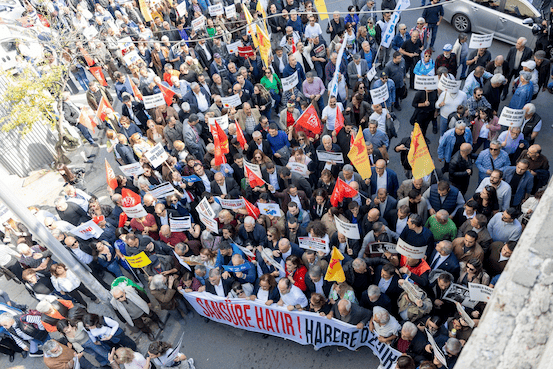
Journalists marched in cities across Türkiye on Saturday against arrests, censorship, access restrictions and state-appointed control of media outlets. Supported by opposition leader Özgür Özel and representatives of nearly the entire opposition spectrum, the coordinated protests appeared to be the largest street mobilization by Turkish journalists since the Ergenekon-era press freedom rallies.
Turkish journalists left their newsrooms and took their struggle for press freedom to the streets on Saturday, staging coordinated demonstrations across the country under the slogan “No to Censorship, Freedom for News.”
Marches and public statements were organized in Istanbul, Ankara, İzmir, Bursa, Eskişehir, Antalya, Adana, Kocaeli, Van and Diyarbakır. Events were also reported in several other locations, giving the campaign a reach rarely seen in professional protests by Turkish journalists.
The date, October 24, was deliberately chosen to mark the first anniversary of the appointment of a trustee to opposition-aligned broadcaster TELE1. The demonstrations also followed the police raid and state takeover of Halk TV, the blocking of news websites and social media accounts, and a succession of arrests and house arrest orders involving journalists.
The organizers argued that these measures could no longer be treated as unrelated legal cases. Taken together, they said, arrests, trusteeships, suspended broadcasts and digital restrictions were reducing the number of independent institutions capable of scrutinizing power and informing the public.
Thousands march in Istanbul and Ankara
In Istanbul, journalists and supporters gathered near the Bull Statue in Kadıköy before marching toward the waterfront. They carried photographs of jailed journalists and banners declaring “Journalism is not a crime,” “Freedom for news” and “We will not be silenced.”
Agence France-Presse reported that police estimated the Istanbul crowd at no fewer than 3,000. A similar police estimate was reported for Ankara, where journalists marched from Kolej Junction to Sakarya Street. Participants included reporters, editors, photographers, trade unionists, lawyers, academics, human rights advocates and ordinary citizens.
The nationwide character of the mobilization distinguished it from the smaller courthouse protests and newsroom solidarity gatherings that have become familiar responses to journalists’ arrests. Saturday’s action was planned as a simultaneous public demonstration, linking local journalism organizations with national unions and professional associations.
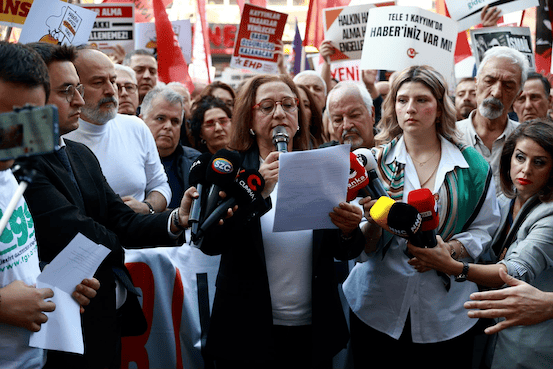
Özgür Özel joins journalists in İzmir
Yeni Party leader Özgür Özel joined the İzmir march to demonstrate his support for journalists and the public’s right to information.
The procession began outside the Türkan Saylan Cultural Centre in Alsancak and continued along Kıbrıs Şehitleri Street to Gündoğdu Square. Özel walked behind the journalists’ front ranks rather than leading the procession, a positioning that underlined the organizers’ insistence that it remain a professional press freedom action rather than a party rally.
The march ended with participants leaving pens at the Zübeyde Hanım Monument. The gesture represented journalists prevented from writing through imprisonment, censorship or economic and administrative pressure. A message from imprisoned BirGün reporter İsmail Arı was also read to the crowd.
Özel was accompanied by İzmir deputies, local officials and mayors. Reports identified a sizeable parliamentary delegation, including Deniz Yücel, Murat Bakan, Ednan Arslan, Seda Kaya Ösen, Tuncay Özkan, Salih Uzun, Yüksel Taşkın, Ümit Özlale and Gökçe Gökçen. Several politicians and lawmakers participating across the country had previously worked in journalism or maintained close professional ties with the media.
Özel’s participation gave the İzmir demonstration additional political weight. Yet the decision to walk behind the journalists helped preserve a distinction between political support for the demands and political ownership of the event.
Support across the opposition spectrum
The marches attracted senior politicians and representatives from almost every opposition party.
In Ankara, reports listed participants from the Yeni Party, Republican People’s Party, Peoples’ Equality and Democracy Party, İYİ Party, Democracy and Progress Party, Felicity Party, Workers’ Party of Türkiye, Communist Party of Türkiye and Labour Party. Trade unions, bar associations, medical organizations, professional chambers and civil society groups also joined the procession.
The presence of politicians with journalism backgrounds was particularly significant. They joined the demonstrations as elected representatives but also as people familiar with the professional consequences of political pressure, prosecution and restrictions on access to information.
Families seeking justice for major disasters and attacks also marched in Ankara. Relatives of victims of the October 10 Ankara bombing, the Çorlu train disaster, the February 6 earthquakes, the İliç mining disaster and other tragedies stood beside journalists. Their presence reinforced the organizers’ central argument: restricting journalism also restricts the ability of victims and citizens to demand accountability.
Political support had begun before Saturday. The Workers’ Party of Türkiye called on its supporters to attend, while the İYİ Party announced that it would stand with journalists. Özel had previously urged participation during a solidarity gathering for Halk TV.
From individual cases to a common crisis
The marches were prompted by a wide range of grievances. Professional organizations protested journalists being detained or imprisoned because of their reporting, questions or commentary. They condemned house arrest orders enforced with electronic monitoring, prosecutions under the disinformation law and restrictions on news websites and social media accounts.
The government’s strongest response is that journalists and media owners cannot claim immunity from legitimate criminal investigations. Prosecutors investigating Halk TV chairman Cafer Mahiroğlu have alleged bribery, tender manipulation and money laundering. Mahiroğlu denies wrongdoing and describes the investigation as politically motivated.
The press freedom dispute concerns both the allegations and the measures adopted before a final judgment. Installing a trustee changes corporate and editorial control while a case is still being investigated. Journalists therefore ask whether evidence could be protected through less intrusive measures that would preserve editorial independence.
The largest journalists’ marches since the Ergenekon era
Street marches by journalists are relatively rare in Türkiye. Professional organizations regularly issue statements, hold courthouse vigils and organize limited solidarity gatherings, but simultaneous demonstrations in numerous cities require an unusual level of agreement among organizations with different traditions and political outlooks.
By their geographic spread, political breadth and combined turnout, Saturday’s demonstrations appeared to be the largest coordinated street mobilization by Turkish journalists since the Ergenekon-era press freedom rallies.
In March 2011, close to 3,000 journalists and supporters marched in Istanbul after the detention of journalists including Ahmet Şık and Nedim Şener during the Ergenekon investigations. Prominent editors, columnists, broadcasters and politicians joined that protest, which became a defining moment in the profession’s resistance to the criminalization of journalism.
Saturday’s demonstrations were more geographically dispersed. Police estimates cited by AFP indicated approximately 3,000 participants in Istanbul and another 3,000 in Ankara, before attendance in İzmir and the other cities was counted. The comparison is therefore based on scale and nationwide coordination rather than a single consolidated turnout figure.
International attention remains uneven
AFP provided the principal international written report, and its dispatch was republished by outlets including the Times of Israel and Barron’s. Reuters documented the Istanbul demonstration through its photographic service, showing journalists, union members and opposition supporters carrying cameras and press freedom placards.
Al Jazeera published a video report connecting the marches with journalists’ arrests, the Halk TV takeover and restrictions on independent news websites. It also included the government’s denial that journalists were being targeted because of their work.
The International and European Federations of Journalists had endorsed the mobilization in advance, calling for an end to judicial harassment and political interference in the media. Their support helped place the protests within a wider European press freedom debate.
A struggle over the public’s right to know
Saturday’s marches did not determine the merits of any criminal case, nor could they resolve Türkiye’s wider press freedom crisis. Their importance lay in transforming a succession of individual interventions into a common national question.
The journalists’ message was that freedom of the press cannot be reduced to the personal liberty of reporters or the commercial rights of media owners. When journalists cannot investigate, question and publish without fear of imprisonment, closure or administrative takeover, citizens lose the means to examine how public power is exercised.
The unusually large turnout, the involvement of nearly the entire opposition spectrum and the participation of citizens seeking justice showed that the issue had moved beyond professional solidarity. For the first time since the Ergenekon-era rallies, Turkish journalists demonstrated on such a scale that pressure on the media was also pressure on society’s right to know.