



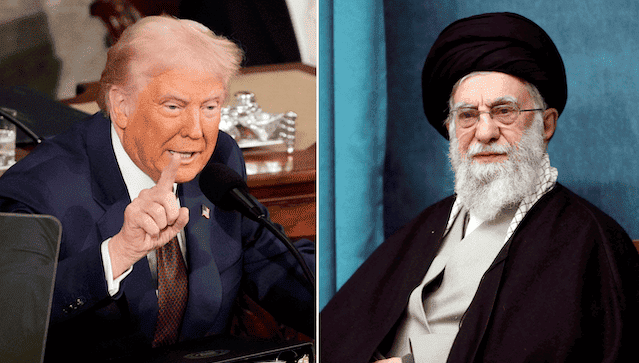
Neither side seems to want a war, but they fear the costs of backing down and are apparently convinced the other side will blink first.
Before President Donald Trump launched his strikes against the Fordow, Natanz and Isfahan nuclear sites—the most important Iranian nuclear infrastructure—I predicted that if he attacked only in a limited way, the conflict would be contained. But if the attack was wider and seen as being about regime change, it would escalate and not be containable. Though we attacked all three sites, Trump’s intent was limited to the nuclear program, and the Iranians responded much the way they had to the killing of Qassem Soleimani: They signaled what they would do in advance of attacking al Udeid base, letting us limit the damage and conveying they had no interest in escalation. So, is that the lesson that President Trump has learned: You can use force in a limited way for a limited objective and Iran will respond in kind?
The fact that the president is apparently now speaking about a more limited strike to try to produce a deal—and only if that fails might he then consider a much larger one intended to produce regime collapse—suggests the following: First, he thinks that he can use limited force for coercive purposes to achieve a deal and that the Iranians have an interest in keeping the conflict limited. Second, that if he cannot achieve a nuclear deal—which seems to be his preoccupation even if others talk about ballistic missiles, support for proxies and treatment of Iran’s citizens—he will raise the ante, but much later.
The problem is that the Iranians now seem to feel that Trump can be deterred by their threats to attack U.S. forces, interests and friends throughout the region. They read him as wanting only a limited conflict and they are threatening a much wider one. Apart from the mismatch in perceptions, there is an irony: Neither side actually wants a wider war. Trump doesn’t want a war that escalates, could be hard to stop and could produce a huge leap in oil prices when he already has to deal with the affordability crisis in this country. But the Iranians, for all their bluster, know they are profoundly vulnerable with little or no air defense, and with the risk that their forces, including the Islamic Revolutionary Guard Corps, and related control mechanisms of their public, could be dramatically weakened by a war that escalates. With a public they know is extremely angry, this is not the time to weaken the regime further. So neither may want a wider war with escalation that can take on a life of its own, but each reads the other as willing to back down on their red-lines, believe it is very costly for them to back down on their own, and are effectively playing a game of chicken.
For President Trump it comes back to understanding his objective. I may be wrong, but I still think he defines it more narrowly: Iran doesn’t rebuild its nuclear infrastructure and program and effectively gives up its pursuit of nuclear weapons in a way that is unmistakable. For Ayatollah Ali Khamenei et al., is that outcome seen as such a sign of regime weakness that it is a threat to the regime? Or is it possible that there are those around the Supreme Leader who can prevail upon him to look for a way out, given the danger of a war with the U.S. to the survival of the regime? That happened in 1988 with Ayatollah Ruhollah Khomeini when Mir Hossein Mousavi and Akbar Hashemi Rafsanjani persuaded him that the risk of escalation with the U.S. threatened the survival of the regime, and he needed to end the war with Iraq. The real question now is whether, as in 1988, regime survival will once again trump revolutionary defiance.
Dennis Ross is the William Davidson Distinguished Fellow at The Washington Institute and former U.S. special envoy to the Middle East. This article was originally published on the Politico website.