



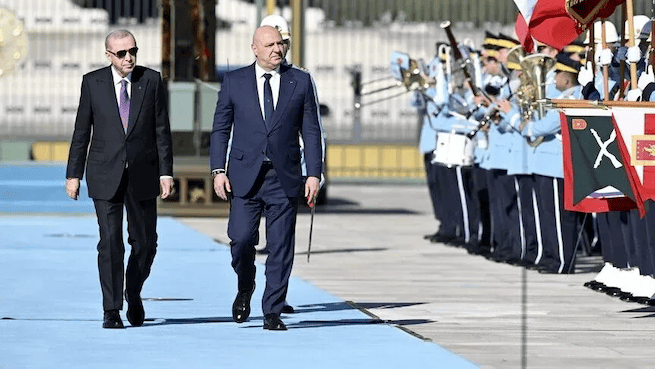
Türkiye’s offer to participate in security arrangements for southern Lebanon marks Ankara’s attempt to become a central actor in the transition from U.N. peacekeeping to Lebanese state control. The proposal also appears to form part of a wider diplomatic process involving Washington, although there is no public confirmation that a Turkish role was formally discussed at the White House.
Türkiye is positioning itself for a role in a new security framework for southern Lebanon as the United Nations prepares to end nearly five decades of peacekeeping operations, raising concerns over a possible security vacuum along the Israeli-Lebanese frontier.
President Tayyip Erdoğan said after talks with Lebanese President Joseph Aoun in Ankara that Türkiye was ready to participate in initiatives aimed at supporting Lebanon’s sovereignty and regional security following the withdrawal of the United Nations Interim Force in Lebanon, or UNIFIL.
Aoun’s visit came only nine days after he met U.S. President Donald Trump at the White House on July 21, the first visit by a Lebanese head of state to Washington in nearly two decades. Public accounts of those talks focused on Hezbollah’s disarmament, the withdrawal of Israeli forces from southern Lebanon and stronger international support for the Lebanese Armed Forces.
Diplomatic sources have said Türkiye’s possible participation in post-UNIFIL arrangements was also raised in discussions linked to the Washington visit. The claim has not, however, been confirmed in public U.S. or Lebanese accounts. It should therefore be treated as evidence that consultations are under way around the emerging framework, rather than as proof that Washington has endorsed a Turkish deployment.
From Washington to Ankara
The sequence of Aoun’s visits is nevertheless significant. In Washington, he sought U.S. leverage to secure an Israeli withdrawal and support his effort to bring all weapons under state authority. In Ankara, he explored how Türkiye could contribute to the security architecture expected to follow UNIFIL.
The two meetings suggest Beirut is trying to assemble a broad coalition rather than depend on a single international sponsor. Washington remains indispensable because of its influence over Israel and its longstanding support for the Lebanese army, while Türkiye can offer regional political access, military training, logistics and maritime experience.
UNIFIL’s mandate is due to expire on Dec. 31, 2026, under U.N. Security Council Resolution 2790. Its departure would transfer greater responsibility to the Lebanese state, particularly the Lebanese Armed Forces, which are expected to become the principal security authority in the south.
Lebanese army at the centre
Turkish officials do not appear to envisage replacing UNIFIL with an exclusively Turkish force. Ankara’s preferred model would place the Lebanese army at the centre of operations while regional and international partners provided training, equipment, intelligence, logistics and maritime surveillance.
That approach is consistent with Aoun’s principle of “one state, one army and one authority.” A former commander of the Lebanese Armed Forces, he has made clear that any outside assistance must strengthen national institutions rather than create a parallel military structure.
The central problem is capacity. Lebanon’s financial collapse has weakened the army’s ability to pay personnel, maintain equipment and sustain extensive deployments. Assuming responsibility for the whole of southern Lebanon, monitoring the Blue Line and preventing the return of armed groups would require substantial and sustained foreign support.
Türkiye could contribute through training, naval assistance and logistics. Turkish forces have participated in UNIFIL’s Maritime Task Force, giving Ankara operational familiarity with Lebanon’s coastline and the wider eastern Mediterranean security environment.
A multinational mechanism
Aoun has said several options remain under discussion, including a European initiative led by France and Italy, a formula involving Türkiye with NATO support and proposals incorporating Arab or Islamic countries. This suggests Beirut is considering a network of international and regional partners rather than a single replacement force.
Such a mechanism would probably be lighter than UNIFIL. Lebanese forces would conduct ground patrols and exercise sovereign authority, while outside partners provided surveillance, technical assistance, financing and emergency diplomatic coordination.
For Ankara, participation would reinforce its claim to be a regional security broker capable of combining military capacity with diplomacy and state-building. It would also expand Türkiye’s influence across the Levant at a time when developments in Lebanon, Syria and the eastern Mediterranean are increasingly interconnected.
Israeli objections
Israel’s position remains the most difficult obstacle. Israeli governments have repeatedly accused UNIFIL of failing to prevent Hezbollah from building military infrastructure close to the frontier. Any successor arrangement would therefore be judged primarily by whether it could prevent armed groups from returning to southern border areas.
Israel would also be wary of a substantial Turkish military presence. Relations with Ankara have deteriorated sharply, while Erdoğan’s support for Hamas and criticism of Israeli military operations have deepened Israeli distrust.
Türkiye would consequently be more likely to operate within a multinational and internationally authorised framework than through a separate deployment. Participation alongside European NATO members and with U.S. knowledge could make a Turkish role more acceptable, although it would not remove Israeli objections.
A test of regional diplomacy
The Ankara announcement is therefore best understood as the opening of negotiations rather than the unveiling of an agreed force. Türkiye has declared its interest, Lebanon has acknowledged that Turkish participation is among the options, and diplomatic contacts appear to extend beyond the bilateral relationship.
The White House meeting adds an important dimension because it indicates that Aoun is coordinating the post-UNIFIL transition with Washington as well as Ankara. It does not establish that the United States has approved a Turkish role, but it suggests that any eventual arrangement will emerge from interconnected American, European, Arab and Turkish negotiations.
Success will depend on whether those actors can agree on a framework that strengthens the Lebanese army, secures Israeli withdrawal, restricts non-state weapons and avoids replacing one indefinite foreign presence with another. Without such a consensus, UNIFIL’s departure could leave southern Lebanon more exposed rather than more sovereign.
Also read:
تركيا تسعى لدورٍ في مرحلة ما بعد “اليونيفيل” في حين يبني لبنان إطارًا أمنيًا جديدًا