



Hezbollah’s recent military defeat and the 2022 Israel-Lebanon maritime agreement mediated by Washington have enabled exploration in a distant corner of Israel’s exclusive economic zone.
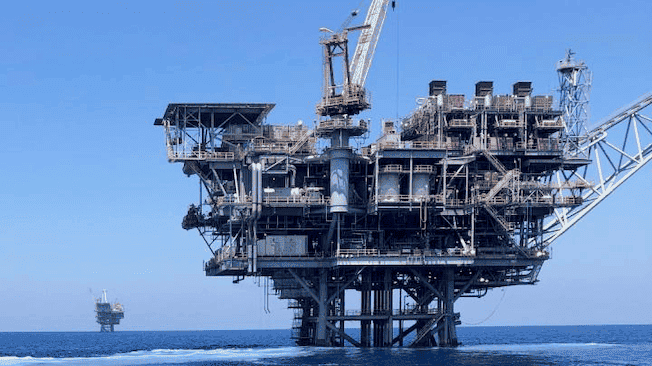
On March 17, a consortium of the Azerbaijani state oil company SOCAR, the British energy giant BP, and Israel’s NewMed Energy signed an agreement to explore for oil and natural gas in Block 1, located more than 100 miles off the coast of northern Israel. The block is adjacent to where the exclusive economic zones of Cyprus, Israel, and Lebanon meet.
Apart from marking a restart for energy exploration in this area, the agreement is also notable for BP’s successful entry into the Israeli sector. Previously, plans for BP and the Abu Dhabi National Oil Company (ADNOC) to buy 50 percent of NewMed for $2 billion collapsed in October 2023. The latest consortium has roughly equal shares, but the operator will be SOCAR, which recently bought part ownership of Israel’s already producing Tamar field.
Awarding the license to explore does not necessarily mean that gas (or, less likely, oil) will be found. The consortium now has three years to conduct seismic tests that may or may not indicate commercially viable deposits. Observers are optimistic because the area is comparatively close to Israel’s two main producing fuels, Leviathan and Tamar.
Even so, bringing a deep-water offshore field into production typically takes up to five years. In the case of Leviathan and Tamar, more than 100 miles of pipeline had to be laid on the seabed and connected to processing terminals off Israel’s central and southern coasts. A smaller discovery could be exploited using a floating production storage and offloading vessel (FPSO), as seen at the Karish North field located adjacent to the maritime border with Lebanon but closer to the coast. In that project, the FPSO Energean Power processes gas on board before piping it ashore.
In international and regional terms, Israel’s found deposits and potential discoveries are small, though they have made the country energy independent. The world’s major natural gas players remain Iran and Russia, with Qatar a distant third. The portion of Israel’s gas available for export mainly goes to neighboring Egypt.
Broader commercial limitations aside, the East Mediterranean provides a useful example of the realpolitik-based compromises that countries are willing to make when it comes to energy. Muslim-majority Azerbaijan provides around 40 percent of Israel’s oil imports, delivered by tanker after being pumped across Turkey, which has a publicly hostile view of Israel. Indeed, Baku has often found itself mediating Israeli-Turkish relations during crisis points over the years.
Israeli gas is also being considered as a potential solution to Syria’s power shortage, a technically feasible though diplomatically unlikely option. Yet portions of the Arab Gas Pipeline route that would be needed for this purpose are currently flowing in the other direction, sending gas to Egypt via Jordan, so the parties would need to resolve various technical and commercial issues before supplies could reach Syria.
Qatari gas may be an option as well. There are no extant pipeline routes from there, so Doha’s assumed but mostly unmentioned approach would be to ship gas to Egypt by tanker, replacing a similar volume of gas that Cairo currently receives from Israel but which would now be heading (very quietly) north to Syria. The sensitivity of this is huge, but the proposal is hardly fanciful. For the moment, however, it is only theoretical because of ongoing Houthi attacks actions along the Red Sea route that Qatar’s tankers would use. In any case, despite Israel’s low oil and gas ranking in the Middle East, its growing position in the East Mediterranean could make it a crucial energy player in the coming months.
Simon Henderson is the Baker Senior Fellow and director of the Bernstein Program on Gulf and Energy Policy at The Washington Institute.