



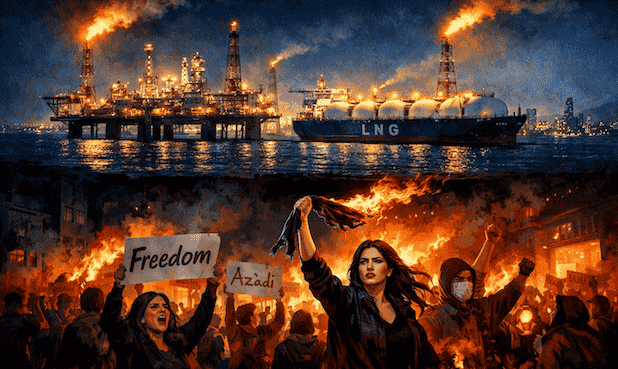
Western realism masks a deeper cynicism: deference to gas flows has prolonged Iran’s illegitimate theocracy.
When Zbigniew Brzezinski addressed Moscow’s Diplomatic Academy in 1989, he delivered a warning Western policymakers preferred to ignore. Stalinism, he argued, was not a betrayal of Leninism but its logical continuation. The implication was stark: systems founded on ideological coercion cannot be repaired into legitimacy. They must be repudiated at the root.
Iran is approaching that moment.
Since the “Woman, Life, Freedom” uprising of 2022—and with renewed force in recent months—Iranians have crossed a decisive threshold. The slogans are no longer reformist. “Death to the dictator” names the Supreme Leader directly. Clerical authority is mocked rather than petitioned. Statues of Ruhollah Khomeini are defaced. Pre-1979 flags reappear. This is not incremental dissent; it is a popular rejection of velayat-e faqih, the regime’s founding claim to rule.
Brzezinski would have recognized the sequence. In the Soviet Union, glasnost—the exposure of ideological falsehoods—preceded collapse. What prolonged decay was perestroika: the illusion that technical reform could substitute for moral rupture. Iran now risks a similar fate if the outside world colludes in managed continuity rather than confronting systemic illegitimacy.
Yet Western governments continue to treat the Islamic Republic as a permanent interlocutor. Embassies remain open. Diplomatic language preserves the fiction of normal statehood. This posture is defended as realism. In fact, it reflects something else entirely.
The real constraint on Western policy is not Iranian stability but the duplicity created by illegitimate gas flows.
Iran itself is not the anchor of this dependence. Despite enormous reserves, it remains marginal to global LNG supply. The leverage lies next door, in Qatar, which supplies about 20% of global LNG and plans to expand North Dome liquefaction capacity from 77 million tons per year today to roughly 142 million by 2030. Europe’s post-Russia energy strategy is now structurally tied to this expansion. Any political rupture affecting the shared North Dome/South Pars reservoir—whether through regime collapse or renegotiation of upstream governance—would introduce arbitration risk, market volatility, and short-term price spikes.
That dependence explains the diplomatic fiction surrounding Tehran. It is not confidence in the Iranian regime that preserves engagement, but fear of unsettling gas flows whose legitimacy is quietly assumed rather than examined. Cynicism replaces strategy. Clientélisme passes for prudence.
Qatar, a patron of Islamist movements from Hamas to the Muslim Brotherhood, lectures the West on “stability” while exporting ideological disorder across the region. Its influence is transactional, not strategic. Gas contracts buy silence. Repression is deplored rhetorically and tolerated in practice. Iranian society is praised symbolically—and abandoned materially.
History offers a familiar warning. During the Cold War, Soviet gas pipelines were defended in Europe as unavoidable commercial necessities. Ronald Reagan rejected that logic, understanding that energy dependence inevitably distorts political judgment. Brzezinski shared that clarity. Trading moral coherence for energy comfort does not buy stability; it merely postpones reckoning at higher cost.
A serious Western strategy would invert today’s priorities. It would acknowledge that Iran’s regime has already lost legitimacy—and that prolonging it increases, rather than reduces, long-term instability. The task is not to manage the mullahs but to prepare an exit from the system they represent.
That means ending the diplomatic pretense. Engagement should be shifted to conditional, external frameworks. Persian-language media should carry a clear message: post-theocracy is not chaos, but national renewal rooted in Iran’s own history of statehood and law. Sanctions relief must be phased, conditional, and reversible—tied to verifiable milestones, not promises.
Energy should be part of this strategy, not its hostage. A post-theocratic Iran would urgently seek Western capital and technology to modernize its gas sector. Transparent contracts and international participation would expand supply over time, weakening monopolistic leverage and lowering prices. Short-term volatility would give way to long-term abundance.
History suggests otherwise. When legitimacy collapses, realism that ignores it is not realism at all. It becomes delay—paid for in lives.