



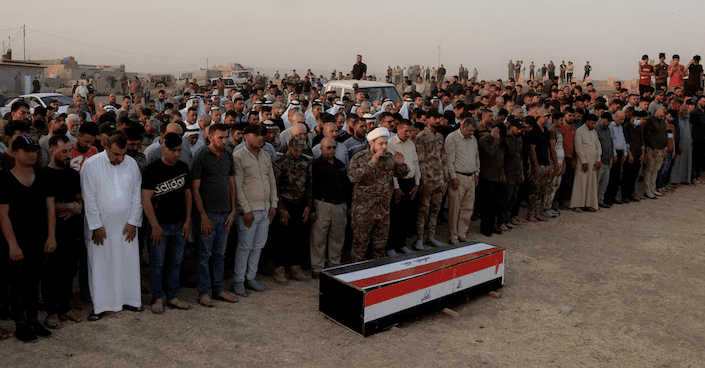
Iraqi mourners attend the funeral of a Hashd al-Shaabi fighter Monday following U.S. airstrikes on the Syrian-Iraqi border.
On Sunday night, the Biden administration announced that U.S. airstrikes had targeted facilities on either side of the Iraq-Syria border linked to militias that have Iranian ties. U.S. officials said that the strikes were reprisals for an uptick in drone attacks targeting U.S. personnel in the region. Kataib Sayyid al-Shuhada, one of the Iranian-backed factions hit by the United States, confirmed four of its fighters had been killed in the strike.
On Monday evening, the violence continued. U.S. officials confirmed that multiple rockets had targeted a facility housing U.S. troops near al-Omar oil field in northeast Syria, and that the United States had responded with artillery fire targeted at positions where the rockets were launched.
The current round of fighting is part of a long-simmering phase of hostilities between U.S. forces and proxies linked to Tehran. Some lawmakers in Washington are starting to question the sustained presence of American troops in Syria and Iraq, as well as the United States’ right to carry out airstrikes on positions within these countries. But the Biden administration, like its predecessor, argues that the threat these militias pose to U.S. troops merits such action.
Tensions are spiking just as the European-led diplomatic effort to bring both countries back into the nuclear deal appears to be faltering. Six rounds of negotiations have yet to yield an agreement that could see the United States offer sanctions relief to Tehran in exchange for the Iranian regime scaling back its uranium enrichment activities. Those activities were accelerated after the Trump administration’s decision to break the deal and launch a “maximum pressure” campaign on Iran. As a result, Tehran is far closer to having the necessary material to produce a nuclear weapon than it was while the deal was intact.
In a recent interview with the New York Times in Paris, Secretary of State Antony Blinken said the Biden administration was “getting closer” to walking away from the talks. “If this continues, if they continue to spin more sophisticated centrifuges at higher and higher levels, we will get to a point where it will be very difficult as a practical matter” to restore the framework of the original nuclear deal, he said.
Robert Malley, the U.S. special envoy for Iran, offered a slightly more optimistic view. “We’re somewhere between the very hard and the possible,” he told NPR on Friday. “We still think it’s doable. There’s no reason we shouldn’t be able to reach a deal. But it depends also on what positions Iran is going to take.”
So far, the Iranian position has been a recalcitrant one. Tehran wants the Biden administration to lift all the sanctions imposed on it by President Donald Trump — something the White House is unwilling to do. It has also begun limiting access to inspectors from the International Atomic Energy Agency, the U.N. nuclear watchdog, to the country’s major facilities. Iranian authorities allowed a deal with the IAEA to continue monitoring its nuclear activity to lapse last week; on Monday, the country’s Foreign Ministry said it had yet to make a decision on whether to give the IAEA access to the surveillance cameras installed as part of its monitoring operations.
An upcoming changing of the guard in Tehran also may muddy the waters. “The victory this month in Iran of Ebrahim Raisi, a hard-line cleric who opposes negotiations with the United States, has added to the sense of urgency hovering over the talks,” my colleagues explained. “Raisi, who replaces President Hassan Rouhani, a political moderate, will assume office in August.”
Malley and other U.S. officials contend that the identity of the country’s president is immaterial to the progress of current talks, not least because Iran’s elected leadership is kept on a tight leash by the regime’s clerical leadership, led by the aging supreme leader, Ayatollah Ali Khamenei.
Some analysts suggest that Raisi’s ascension could even be a boon for diplomacy. “Iranian negotiators, despite not having shown much flexibility thus far, nonetheless appear keen to finalize the road map for restoring the nuclear deal before Rouhani leaves office,” wrote Ali Vaez and Dina Esfandiary of the International Crisis Group. “That’s encouraging. It would provide Raisi with the best of all worlds: He comes in with a clean slate, blaming Rouhani for the road map’s shortcomings while reaping the economic dividends of sanctions relief.”
But even if a deal can be reached, it probably will be rather limited. There’s little sign that the Biden administration and its European partners will be able to achieve their larger goal of expanding the scope of dialogue with Iran beyond its nuclear program and to a wider set of concerns, including Tehran’s support for the proxy factions exchanging fire with U.S. forces.
“Raisi’s selection signals that Iran will resist the Biden administration’s desire to negotiate a follow-on agreement that also addresses Tehran’s missile program and regional ambitions,” wrote Karim Sadjadpour, a senior fellow at the Carnegie Endowment for International Peace. “This could create a conundrum for Biden: If the U.S. tries to coerce Iran with new sanctions, Tehran could respond by resuming its nuclear activities and attacking—via its proxies—U.S. interests and allies in the Middle East, mindful that the Biden administration seeks to reduce America’s regional presence.”