



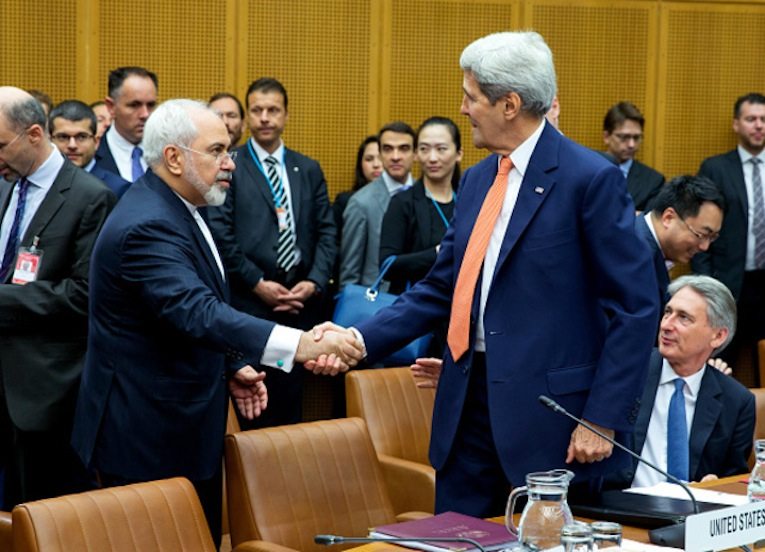
As the White House campaign to persuade Congress about the wisdom of its Iran nuclear deal moves into its second week, important components of the complex agreement are emerging that will be shrouded from the public and in some cases from the U.S. government itself.
The existence of these secret clauses and interpretations could undermine the public’s trust in the Barack Obama administration’s presentations about the nuclear pact. Already Republicans and other critics of the deal have seized on the side agreements between Iran and the International Atomic Energy Agency as a weakness in the deal closed last week in Vienna.
The controversy began on Wednesday when Secretary of State John Kerry told House lawmakers behind closed doors that he neither possessed nor had read a copy of two secret side deals between the IAEA and Iran, according to Representative Mike Pompeo, a Republican member of the House Intelligence Committee who was inside the session. Congress hasn’t seen those side agreements either.
“Kerry told me directly that he has not read the secret side deals,” Pompeo told us in an interview. “He told us the State Department does not have possession of these documents.”
In other cases, secret understandings were provided to legislators. Congress on Monday was given a set of non-public interpretations of the Iran deal, according to House and Senate staffers who have seen the documents. These were part of 18 documents the White House provided to Congress as required under legislation passed this spring that gives Congress 60 days to review the Iran deal.
Of the 18 documents, six are classified or confidential, the staffers told us. These include secret letters of understanding between the U.S. and France, Germany and the U.K. that spell out some of the more ambiguous parts of the agreement, and classified explanations of the Iran deal’s provisions that commit other countries to provide Iran with research and development assistance on its nuclear program. There is also a draft of the U.S. statement to be made public on the day the Iran agreement formally goes into effect.
Those are the secret understandings Congress and the administration have put on paper. But in the case of the side agreements with the IAEA, Congress and the executive branch may not have all the facts. In Wednesday’s closed session, Kerry sparred with Pompeo, who last weekend traveled with Republican Senator Tom Cotton to Vienna last weekend to meet with IAEA officials. Those agency representatives told the lawmakers the that two secret side deals covered how the IAEA would be able to inspect the Parchin military complex and how the IAEA and Iran would resolve concerns about the possible military dimensions of Iran’s nuclear program.
The briefing for lawmakers was classified, but the Kerry-Pompeo exchange was not. Pompeo pressed Kerry on the details of the side agreements between the IAEA and Iran. Kerry acknowledged he didn’t know all of the specifics.
A statement distributed by the State Department on Friday disputed the characterization that the agreements between Iran and the IAEA were “secret.” Instead, it described them as “technical arrangements” and said U.S. experts were “comfortable with the contents,” which the State Department would brief to Congress if asked.
“It is standard practice for the IAEA and member states to treat bilateral documents as ‘safeguards confidential,’ ” the State Department statement said. “This is a principal the United States has championed throughout the IAEA’s existence to protect both proprietary and proliferation sensitive information. We must be able to ensure that information given to the IAEA does not leak out and become a how to guide for producing nuclear materials that can be used in nuclear weapons, and that countries know their patented or proprietary information won’t be stolen because they are released in IAEA documents.”
But while these agreements may be standard operating procedure in the case of other IAEA nuclear inspections, with Iran it’s potentially more serious. On Thursday, during an open session before the Senate Foreign Relations Committee, Republican Senator James Risch said his understanding was that one of the IAEA-Iran side agreements would allow Iran to take its own environmental samples at Parchin. Speaking around the specifics, Senator Bob Corker, the Republican chairman of the committee, compared this arrangement to the NFL allowing athletes suspected of taking steroids to mail in their own urine samples.
Kerry and others have told Congress that the agreement about Parchin and the understandings about IAEA inspections in general are largely technical and do not weaken a strong agreement. Needless to say, Pompeo disagrees. “Kerry gave no indications they are seeking these documents and there is no indication he is the least bit worried he doesn’t have access to this. The Ayatollah knows what’s in the deal but we don’t,” he told us, referring to Iranian Supreme Leader Ali Khamenei.
For the Obama administration, not having copies of the side agreements between Iran and the IAEA is convenient. The law requires it to give Congress all the documents it possesses and only those documents. If the side agreements are outside the reach of Kerry, they are outside the reach of Congress and the American people.
On the other hand, that fact undermines Obama’s argument that the overall deal can be verified and is transparent. Already Iranian leaders have publicly spoken about the Iran deal in terms vastly different from their American counterparts. The existence of secret understandings of that deal will only exacerbate this tension over time.