



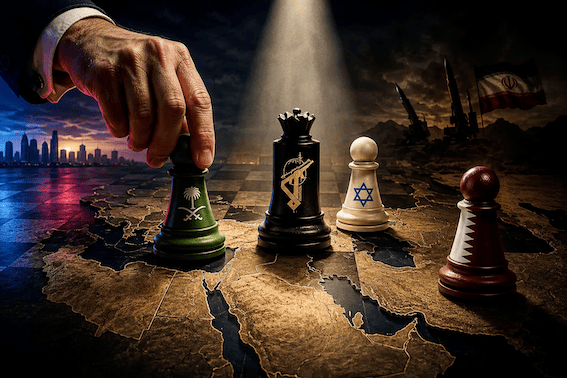
Donald Trump’s latest messaging on the Middle East, in demanding an immediate price on key players (not the least the Saudis and Qatar) to normalise with Israel, should not be dismissed as rhetorical excess. It looks more like a strategic gambit: bring the region’s main players into the open, force them to choose sides, and create the conditions for a decisive blow against Iran’s Revolutionary Guard.
That is the real logic behind the pressure campaign. The old Middle East formula—Arab hedging, Israeli isolation, and Iranian expansion—has run its course. If the U.S. is preparing to confront the Islamic Republic again, then the regional order will have to be clarified first. Ambiguity, in this view, is no longer a virtue. It is a liability.
Saudi Arabia is the key test case. Riyadh has long sought to preserve room for maneuver, keeping channels open to Washington, Tehran and, quietly, Jerusalem. But Trump’s message suggests that the era of strategic balance may be ending. The Saudis may soon have to decide whether they want to remain cautious spectators or step into the open and align more explicitly with Israel.
That would be a major shift. A public Saudi alignment with Israel would do more than alter diplomatic optics. It would strengthen a regional front against Iran, increase pressure on the Islamic Republic and signal that the Arab world’s most influential monarchy has chosen the post-Iran future rather than the old balancing act.
Qatar is part of this equation as well. Doha has built its foreign policy on flexibility, mediation and selective ambiguity. But in a more polarized region, that posture may become harder to sustain. If Washington concludes that Gulf states have benefited from American protection while avoiding the discipline of alignment, they may find themselves exposed to the consequences of a renewed conflict.
Trump’s approach is blunt, but not incoherent. He appears to believe that a stronger peace requires a stronger deterrent first. A serious strike on the IRGC would not be an end in itself. It would be the means by which the regional board is reset, the balance shifts, and the Arabs are forced to make clearer choices.
The Abraham Accords were never just about symbolism. They were part of an effort to build a new regional architecture around deterrence, normalization and a shared interest in containing Iran. If that architecture is to survive, it may need to be reinforced by force before it can be expanded by diplomacy.
The deeper question is whether Riyadh is prepared for that moment. The Saudi crown prince understands the stakes: stability with a weakened Iran could open the door to a more durable regional settlement, but only if they are willing to move openly now and absorb the political cost. That is the gamble Trump seems to be making. He is not promising serenity. He is trying to create a new order from a more forceful one.
If it works, the result could be an immediate shift of balance toward uniting anti IRGC alliance, which ultimately leads to a permanent victory and enduring peace. If it fails, the region will be left with a harsher confrontation. But either way, the message is clear: the days of letting everyone hedge while Washington carries the burden are ending.