



Follow the black trail.
Key dates summing up the capture and cartelisation process:
- The Zahrani refining capacity reached 17,500 bpd until the refinery was shut down in 1989 (“the Lebanese war and the failure to operate the refinery led to its suspension in 1992” as per govt website)1. It used to produce LPG, gasoline, kerosene, gas oil and fuel oil.
- The Tripoli refinery also shut down sometime between 1989 and 1992. The refinery’s maximal storage capacity was 34,500 bpd of crude oil but did not exceed 30,000 barrels a day. Before its breakdown, the refining capacity was virtually operating 21,000 bpd. The main refined products were fuel oil (50%), gas oil (22%) and gasoline (21%). “The studies made in this regard showed that from an economic point of view, it’s useless to rehabilitate the refinery of Tripoli in its current capacity because the local market need exceeds 140,000 barrels a day”)
- In 1990, in the last few months of fighting, the Higher Customs Council granted official status to private oil terminals that had mushroomed along the coast, thereby ostensibly legalizing the private importers using these ports (Picard 2000, 303)
- August 1991 when the Lebanese Parliament passed an amnesty law for all politically motivated crimes and other crimes committed before 28 March 1991. Effectively allowing warlords to assume government roles conduct their private business irrespective of how they acquired those.
- Ministry of Industry and Oil -MIO- (merged into the MOEWR) effectively abandoned its obligations to implement laws and had no immediate intention of pursuing the state’s claim to control the oil sector and to put in place a Special Agency that existed only on paper. “After two more years of muddling through, the MIO in August 1994 began issuing temporary licenses to twenty-two private importers, provided they could show that they possessed adequate installations and expertise” (AN 7 July 1994).
- Linking importing licenses to having access to coastal facilities practically established legal ground for a cartel of the now legally entitled owners of coastal facilities that were built illegally under the various militias rule during the civil war and that had started privately importing petroleum products with the help of established international trading companies like BB Energy.
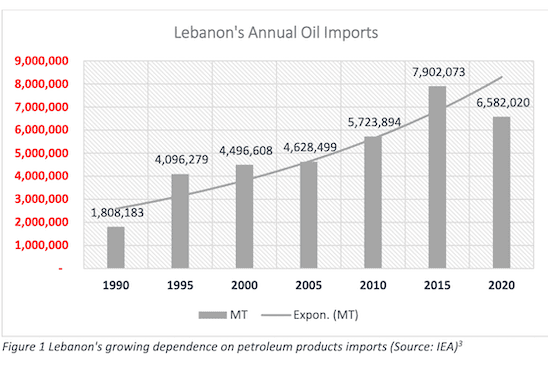
The legally empowered petroleum products cartel caused the dismantlement of a strategic state monopoly. This exposed the energy imports dependent country to a permanent drain of foreign currency reserves that was allowed by the artificial pegging of the Lebanese Pound. The financial engineering (Ponzi) schemes implemented since 2016 consisted in a desperate further attempt to attract foreign currency into the banking sector in order to maintain the economy on artificial life support. The policy effectively dollarized purchasing power of consumers which permitted a five folds jump in gasoline consumption2.
Rather than profiting the State, the dismantlement of both refineries, and the strengthening of the cartel, ensured that supply and distribution business profited the cartel itself. The incestual relationship between the cartel (led in the backstage by BB Energy) and the PEP’s linked distribution companies (e.g. the Jumblatt/Bassatne joint venture Cogico which was strengthened following BBE’s acquisition of Mr. Bahige Abou Hamzeh’s shares in Cogico), in addition to the captive oil and LPG storage terminals (the state owned Zahrani site is controlled by Speaker Mr. Nabih Berri’s cronies or appointees) has prevented any meaningful competition in the sector, primary source of enrichment of the political elite.
It is in that broad context that one must read the so called Sonatrach contract signed initially in 2005: a quid pro quo between a corrupt oil cartel and BBE who was feeding it with products. BB Energy (lately joined to take turns by Teddy Rahme’s ZR) secured itself a 15 years contract to supply EDL with products at abnormally high margins (while they were tendering FO in Malta at 4.5$ per MT4) positioning as a subcontractor to Sonatrach Petroleum Corporation BVI. The contract generated BB Energy and its silent partners estimated profit margins of around 30$ per Metric Ton for the supply of Fuel Oil and Gasoil to EDL. It was thereafter impossible for the abdicating authorities to either determine the true origin of shipments supplied under this contract, nor control the quality along the supply route (the profit margins can reach well above 50-100$/MT under such fraudulent practises).
For to have accepted such high premium during 15 years in a row, members of government must have benefited from premium retrocession out of the realised profits. Four key “godfathers” of the historical cartel are known to be involved (these are officials involved and responsible for 4 consecutive renewals of the contract and by way of obstruction from launching a new tender4). This contract generated Sonatrach an “umbrella fee” reported to be equal to US$3.5/MT and it’s likely that the former Sonatrach Petroleum Corporation management (whose former group CEO Mr. Ouldkaddour following extradition from the UAE5 was sentenced and imprisoned in Algeria on embezzlement charges) was also benefiting from this odd arrangement. Rumours indicate 5$ per MT was being paid to each “godfather”. Such profit shares could have easily been distributed back to the PEP’s by way of additional gasoline of diesel quantities supplied in lieu of payment to the companies affiliated to the PEP’s, in the absence of any customs control. “Most important, direct state controls on the quality and quantity of oil imports were not applied, both because the ministry’s laboratories in Zahrani remained understaffed and lacked adequate funding and because the MIO’s Special Agency, legally mandated to oversee such tasks, was never established”6. The purpose of these ill-gotten profits would have been to pay the chain of corruption permitting it.
It seems that amidst such negligence in controlling fuel quality, it was finally the damage caused to the new diesel generators on board the power ships that led to uncovering the fraud on fuel oil quality (ship to ship transfers after loading in Malta, blending on-spec products with highly compromised and toxic products) as an additional source of profits that may even have had over years significantly added to the contractual premiums.
It is estimated that EDL imported more than 30 million tonnes of Fuel Oil and Gasoil from the Sonatrach contract effective owners (BBE, ZR), and that at least US$1 to US$5 billions were generated by the cartel (depending on the extent of product fraud practise) with active role of at least:
Mr. Walid Jumblatt, Mr. Fuad Siniora (Prime Minister in 2005), Mr. Nabih Berri (Speaker), Mr. Ali Hassan Khalil (Minister of Finance) and Mr. Ziad Al-Zein (Associate General Manager of Zahrani facilities). Notable was the collaboration of former Minister of Energy Mr. Mohammed Fneish (who allowed the initial contract) and Mr Gebran Bassil (who was fully aware of the subcontracting structure when he admittedly even mediated between BBE and ZR to share roles as contract owners).
1 https://en.dgo.gov.lb/category/3
2 Gasoline consumption, thousand barrels per day, 1980 – 2018: 11 thousand barrels per day in 1988 to 49.01 thousand barrels per day in 2017 (Source: https://www.theglobaleconomy.com/Lebanon/gasoline_consumption/ )
3 IEA World Energy Balances 2022 https://www.iea.org/data-and-statistics/data-product/world-energy-statistics-and-balances 4 https://parlament.mt/media/90400/dok-27-l12.pdf
4 How was Sonatrach’s contract extended 4 times in the Cabinet? Dramatizing public procurement in the time of quotas Emad Sayegh – Legal Agenda 10-11-2020
5 https://www.reuters.com/world/middle-east/former-head-algerias-sonatrach-face-trial-over-corruption-2021-08-04/
6 Spoils of Truce: Corruption and State-Building in Postwar Lebanon By Reinoud Leenders