



Metransparent Exclusive
For six years, Lebanese depositors have been waiting.
Waiting for a financial recovery plan.
Waiting for Parliament.
Waiting for the government.
Waiting for the IMF.
Waiting for the banks.
Waiting for someone, anyone, to decide what should happen to their trapped deposits.
If there is one thing the Lebanese state has demonstrated remarkable consistency in, it is its inability to make decisions. This is a country where a water pipe can take years to fix, an electricity plan can consume decades of debate, and a financial recovery plan can remain trapped in committee rooms longer than depositors have been trapped in their banks.
At some point, depositors must ask themselves a simple question:
Would you rather bet on the Lebanese government finding a solution, or bet on tangible private-sector assets that already exist?
For many, the answer may be obvious.
The Last Escape Route for Lollars?
One of the few remaining avenues for depositors to convert trapped bank dollars into real assets is through the Lebanese stock market, particularly through shares of Solidere.
This opportunity may not remain open forever. Market participants increasingly expect that the Central Bank will eventually move toward pricing Solidere shares in real dollars rather than bank trapped lollars. If that happens, the ability to use lollars to acquire ownership in one of Lebanon’s most valuable real-estate companies could disappear.
For depositors still sitting inside the banking system, the clock may be ticking.
What Exactly Is Solidere?
Strip away the politics and emotions surrounding the company, and what remains is a straightforward question of assets.
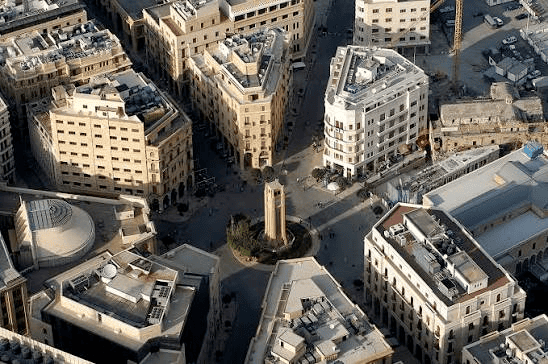
Solidere owns some of the most valuable real estate in downtown Beirut.
The company controls approximately 1.25 million square meters of development rights and land in downtown Beirut. At an estimated value of roughly $2,200 per square meter, that land alone is worth approximately $2.75 billion.
In addition, Solidere owns roughly 190,000 square meters of developed property including Beirut Souks. At an average valuation of $7,500 per square meter, these assets represent more than $1.4 billion in additional value.
The company also owns 43% of Solidere International, which has prime projects and investments in Saudi Arabia and Ajman.
Added to the assets outlined above, Solidere owns several other valuable holdings, including a 50% stake in Zaitunay Bay and the Yacht Club, as well as a substantial cash balance.
Altogether, the company reports approximately $4.9 billion in assets.
Most importantly, unlike many Lebanese institutions, it carries virtually no debt.
In an era where balance sheets matter, zero debt is not a trivial detail.
The Numbers Don’t Add Up
Solidere currently has approximately 165 million shares outstanding, consisting of 100 million Class A shares and 65 million Class B shares.
The company has been buying back its own shares over the past several years and has accumulated approximately 6.5 million shares to date. In addition, Solidere International is expected to repurchase roughly 4% of its shares at a price of $120 per share. This indicates that Solidere International’s management considers the shares undervalued, while the transaction will also provide Solidere with a meaningful liquidity inflow.
Based on the company’s assets, analysts estimate a net asset value of approximately $30 per share in real dollars.
Yet the shares continue to trade at around 70-75 lollars, which translates into roughly $11 in real-dollar terms at prevailing market rates.
For non-financial readers, this means investors are buying assets worth roughly $30 for around $11.
That is a discount of approximately 63%.
History Has Already Provided the Answer
The most compelling argument is not theoretical. It is historical.
At the beginning of the crisis, some depositors used trapped bank dollars to purchase Solidere shares when the stock traded at roughly $5 in real-dollar equivalent terms.
Today, those shares are worth approximately $11 in real dollars.
Meanwhile, depositors who left their funds trapped in the banking system have spent six years listening to promises, recovery plans, draft recovery plans, amendments to recovery plans, and discussions about discussions of recovery plans.
One group owns appreciating assets. The other owns hope
Likewise, depositors who used lollars to purchase real estate during the early years of the crisis generally emerged in a far stronger position than those who continued waiting for a government solution.
In Lebanon, history repeatedly suggests that betting on private assets is often safer than betting on public promises.
The Liquidity Problem Ahead
There is another issue that investors should consider.
Today, approximately $70 billion of trapped bank deposits (Lollars) can theoretically participate in assets priced in lollars.
If markets move toward real-dollar settlement, that pool shrinks dramatically.
The amount of actual dollar liquidity circulating within the banking sector is estimated to be closer to $3 billion.
A market fed by $70 billion of trapped deposits behaves very differently from a market fed by only $3 billion of actual dollars.
Trading volumes would likely decline. Liquidity could become scarcer.
The opportunity for depositors to convert trapped balances into productive assets may narrow significantly.
On the other hand, a transition to real-dollar pricing could also encourage some of the billions of dollars currently hidden in homes and safes to return to the market. Many Lebanese distrust the banking system but are willing to invest directly in assets they control.
A Choice Between Two Forms of Faith
Ultimately, this debate is not really about Solidere.
It is about where depositors place their faith.
On one side stands the Lebanese state: six years into a banking collapse, still unable to agree on who bears the losses, how deposits should be repaid, what a recovery plan should look like, or when any solution might arrive.
On the other side stand tangible assets: land, buildings, development rights, and ownership stakes in projects that already exist.
One requires faith in politicians. The other requires faith in assets.
The first has produced six years of waiting. The second has already produced results for many who acted early.
Waiting for Godot
Every depositor must make their own decision.
But they should do so with open eyes.
The opportunity to exchange lollars for real assets may not remain available forever. If Solidere eventually moves to trade exclusively in real dollars, the door could narrow significantly for those still trapped inside the banking system.
At that point, the only remaining strategy may be to continue waiting for a comprehensive financial solution.
Perhaps it will come next year. Or the year after. Or after the next government. Or after the next parliamentary committee.
Or after the committee formed to review the recommendations of the previous committee.
In Lebanon, that is always possible.
So is waiting for Godot.
The difference is that Godot is fictional. The land in downtown Beirut is not.