



This is the moment to break Iran’s resistance, force an agreement on American and Israeli terms, and finish the war on the ground of our choosing. We do that by seizing and squeezing Iran’s chokepoint
The U.S.-Israeli war against Iran has already achieved extraordinary military results. The regime’s supreme leader is dead. Its nuclear infrastructure is damaged. Its missile production has been severely degraded. Its command structure is fractured. Across every major military objective, decisive progress has been made.
And yet, Iran has found a way to fight back. How? By closing the Strait of Hormuz, and shifting the battlefield from military targets to the global economy.
Roughly 20 percent of the world’s oil and a significant share of liquefied natural gas pass through that narrow waterway. Iran brought traffic to a near standstill not with formal naval blockade, but via selective drone strikes on tankers, the threat of mines and anti-ship missiles, and the resulting collapse of insurance coverage. Tanker movement has dropped by more than 90 percent. Brent crude has surged to as much as $120 a barrel. One of the largest disruptions to global energy supplies since the 1970s is now underway.
This was a predictable move. Iran has threatened to close the Strait for decades, and the logic was always clear: If the regime is struck hard enough, it will use its geographic position to inflict economic pain on the entire world. The question was never whether Iran would try. The question is what we should do about it.
When military commanders assess a situation, they examine three things: the environment, the enemy’s capabilities, and their own.
First, the environment. The Strait of Hormuz is narrow, crowded, and now likely partially mined, especially in areas near the Gulf States. That means tankers are pushed into a tighter navigational lane closer to the Iranian side, within easier range of missiles, drones, and fast attack craft.
Second, the enemy. Iran can employ a layered mix of threats along nearly 100 miles of coastline: naval mines, explosive boats, cruise and coastal anti‑ship missiles, ballistic missiles, and unmanned aerial systems launched from the shore and from depth inside its territory. Even if many of these systems are degraded, enough will remain to keep any transit under constant threat.
Third, our own capabilities. The ships that transit the Strait are enormous commercial vessels with civilian crews. The fundamental question is not only whether the United States and its allies can reduce the threat they face, but whether shipping companies will accept the risk, and whether captains and crews will be willing to sail. One strike is enough to stop traffic. The crews will refuse to board. The insurers will hesitate or withdraw. The companies will refuse the liability. This risk alone has been sufficient to halt the flow.
When you face this level of operational complexity, you do not solve it by chasing every weapon system. You change the enemy’s calculation. You must take from Iran something it cannot afford to lose.
The first and most obvious target that meets that standard is Kharg Island.
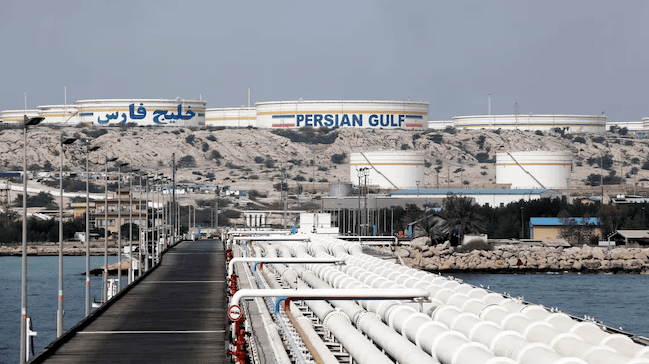
Kharg Island is a small strip of land in the northern Persian Gulf, roughly comparable in size to lower Manhattan, sitting about 25 kilometers off Iran’s coast and several hundred kilometers northwest of the Strait of Hormuz. The main terminal for close to 90 percent of Iran’s crude oil exports, Kharg Island is the economic backbone of the regime. It is also, critically, the primary source of hard‑currency revenue for the military and security services, which control and sell a significant share of those exports.
Disrupting energy operations on Kharg Island is regarded by analysts as a doomsday scenario for Iran’s economy, with far‑reaching consequences. Iran’s economy depends in practice on two main sectors: oil and gas. Disruption would trigger a chain reaction throughout the energy system, creating acute shortages of gasoline and diesel inside a country that sits on some of the largest hydrocarbon reserves in the world. Iran would also lose billions of dollars a month in oil income. Without the flow of dollars and yuan, the central bank would struggle to defend the rial, driving hyperinflation and eroding the savings of an entire society.
Economic pressure on this scale would dramatically increase the likelihood of popular unrest. Iran’s population has repeatedly demonstrated its willingness to take to the streets. The demonstrations of January 2026 were one of the most significant since the 1979 revolution. A regime that cannot pay its security forces or fuel its own economy faces a fundamentally different internal reality. Its ability to support proxies and sleeper cells throughout the Middle East, Europe, and the U.S. would also be compromised.
The U.S. has already struck dozens of military targets on Kharg Island while deliberately sparing the oil infrastructure. President Trump has warned that those oil installations will be next if Iran continues to interfere with shipping. But warnings alone will not reopen the Strait. Iran’s leaders have already decided that the global economic pain they are inflicting by closing Hormuz outweighs the risk that Kharg’s facilities might be damaged.
The operational logic therefore points toward seizure, not destruction.
If you bomb Kharg’s oil infrastructure, you destroy an asset that would take years to rebuild and eliminate a potential source of leverage. But if you seize the island, you control it. Iran cannot export a single barrel without your permission. You’re able to tell Tehran: Open the Strait and we discuss terms. Keep it closed and your oil revenue drops to zero.
When a regime loses both its external leverage over the global economy and its internal ability to buy time with money and fuel, its options narrow. The same choke point Iran is using to pressure the world can become the instrument that pressures the regime.
How, though, would this operation work in practice? An amphibious assault on a defended shore is one of the most demanding operations in modern warfare. Militaries study landings like Normandy for a reason: They require precise coordination across sea, air, and land domains, and they leave the first waves of troops exposed if combat power does not quickly build ashore. Success depends on integrating helicopters and fixed‑wing aircraft, landing craft, ground forces, intelligence, and constant protection against missile and drone attacks.
Kharg Island, however, presents unique conditions. It is a small, isolated objective, far from Iran’s main population centers, ringed by waters the United States already dominates from the air and sea. American forces can approach from multiple directions and bring significant combat power to bear in the opening hours. The primary danger does not come from the relatively limited Iranian forces on the island itself, but from long‑range missiles, drones, and other strike systems positioned deeper inside Iran.
And yes, there are risks. Any operation to seize Kharg would require thousands of troops, sustained air and naval support, and detailed intelligence, and it would carry a real and expected cost in human life. Iran would also target every reachable energy facility across the Gulf, a campaign already underway.
But the conditions in this case tilt the balance in favor of action. The U.S. has overwhelming air superiority. Maritime advantage around the island is significant but partial. Small assault craft can be airlifted to neighboring countries and reach Kharg directly. Bringing larger warships into position, however, would require transiting the Strait of Hormuz itself, which is possible but carries risks. In military terms, this is a difficult operation, but it is not an impossible one.
President Trump has set up the U.S. for this option. By signaling willingness to explore a diplomatic agreement with Iran, he has shown both the American people and the international community that he is prepared to compromise if Iran meets core demands. At the same time, he has set clear conditions: the transfer of enriched uranium, the reopening of the Strait of Hormuz, and effective guarantees against renewed nuclear and regional aggression.
In giving Iran days, not months, to meet these conditions, he buys time for U.S. forces and their allies to prepare and finalize operational plans. That time is not a concession. It is an investment in readiness, and it strengthens the president’s position domestically and internationally for whatever comes next. If Iran accepts the terms, the objectives are achieved without seizing Kharg. If Iran refuses, the president will have both the legitimacy and the capability to act.
The question, then, is not whether a diplomatic formula can be imagined. It is whether this regime will agree to conditions it will portray at home as surrender. Everything we know about Tehran’s behavior suggests that is unlikely.
As long as Iran controls the Strait of Hormuz, the regime retains a veto over the global economy. As long as the world’s energy supply remains hostage to Iranian weapons deployed along a hundred miles of coastline, the destruction of nuclear and missile sites will be overshadowed by an economic crisis that erodes the will to finish the job.
Kharg Island is the key that resolves this equation. It accelerates the economic and political pressure that may finally produce the internal change the Iranian people have sought for decades. And it sends a message air strikes alone cannot deliver: The U.S. is committed to a decisive outcome, and it is not going home without one.
On the strategic chessboard of this war, Kharg Island is the next piece. It may be the move that decides the conflict. If it is going to be made, it must be made now.