



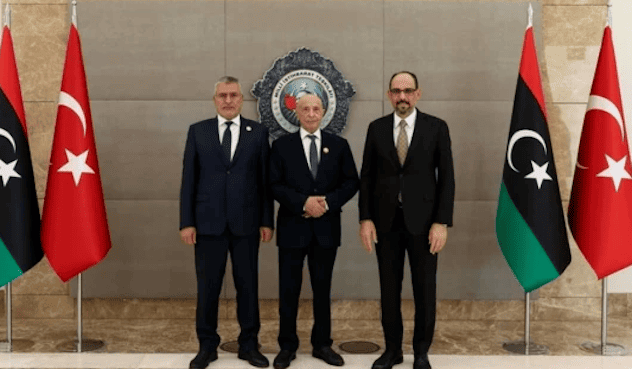
*Türkiye has brought the heads of Libya’s two rival legislative institutions to the same table for the first time in Ankara, securing agreement to revive negotiations over electoral laws. The encounter gives Ankara a potentially important role alongside the UN process, but the real test will be whether another Libyan political agreement can finally be translated into elections and institutional unity.*
Türkiye has taken a potentially significant step into Libya’s long-running political deadlock, bringing House of Representatives Speaker Aguila Saleh and High Council of State President Mohammed Takala together for talks hosted by National Intelligence Organization, or MİT, chief İbrahim Kalın.
The Sept. 10 meeting was notable not simply because senior Libyan figures visited Ankara, but because the leaders of the two institutions at the heart of Libya’s constitutional and electoral dispute appeared together under Turkish auspices. Their discussions covered political and military unity, the consolidation of divided state institutions, elections and continued Libya-Türkiye cooperation.
More concretely, Saleh and Takala agreed to reactivate the joint 6+6 Committee, established by the House of Representatives and High Council of State to formulate the laws governing presidential and parliamentary elections. Türkiye offered to host the committee in the coming days so that it could complete outstanding work on the electoral legislation.
That makes the Ankara encounter potentially more consequential than another exercise in diplomatic symbolism. Libya has experienced numerous agreements, conferences and roadmaps since the fall of Muammar Gaddafi in 2011. The recurring problem has been less the absence of political formulas than the inability to implement them.
Ankara and the UN track converge
The timing is particularly important. On Aug. 30, participants in a UN-facilitated “Smaller Convening” reached an agreement addressing two obstacles that have repeatedly blocked elections: reconstituting the board of the High National Elections Commission and resolving outstanding constitutional and legal problems affecting presidential and parliamentary elections. The agreement envisages national elections within a period not exceeding 24 months.
The UN Security Council welcomed the agreement on Sept. 8 and called for progress toward unifying Libya’s institutions, including its military and security structures and executive authority. Two days later, Saleh and Takala were meeting in Ankara.
The sequence matters because Ankara, at least at this stage, does not appear to be constructing a rival process. Instead, the Turkish initiative could complement the UN roadmap by bringing together two institutions whose cooperation is indispensable if electoral arrangements are to acquire sufficient legal and political legitimacy.
Saleh and Takala themselves stressed after their meeting that the political process should remain within Libya’s Constitutional Declaration, legal framework and existing political agreement, while respecting the competencies of the two councils.
The immediate test will therefore be the proposed 6+6 meeting in Türkiye. If it produces workable compromises on electoral legislation, Ankara would have helped convert political dialogue into a tangible step toward elections. If disagreements return once the technical details are discussed, the meeting could prove to be another temporary convergence in Libya’s prolonged transition.
Türkiye broadens its Libya strategy
There is also a larger Turkish calculation. Ankara’s intervention in support of the Tripoli-based government in 2019-2020 helped stop Khalifa Haftar’s offensive against the capital. It consequently became one of western Libya’s most important military and political partners, but was simultaneously regarded with deep suspicion in the east.
Türkiye has gradually tried to overcome that division by expanding contacts with eastern Libyan institutions and personalities while preserving its strong relationships in Tripoli. Hosting Saleh alongside Takala demonstrates how far that adjustment has progressed.
This creates an unusual diplomatic asset. Ankara now has channels into competing Libyan power centers and could increasingly present itself as a facilitator rather than simply the external sponsor of one camp.
Its interests, however, remain substantial. Libya occupies an important place in Türkiye’s security strategy, commercial ambitions and energy policy, while the 2019 Türkiye-Libya maritime jurisdiction agreement remains a cornerstone of Ankara’s Eastern Mediterranean position. A unified and stable Libya would provide a more predictable foundation for those interests.
That is both Türkiye’s advantage and the potential limitation of its mediation. Ankara has influence because it is deeply invested in Libya, but precisely because it has important strategic interests, other actors will judge whether its diplomacy can accommodate competing Libyan constituencies rather than merely consolidate earlier Turkish gains.
Elections are the real measure
The UN roadmap rests on three connected pillars: a politically viable electoral framework, unification of institutions through a single government, and structured dialogue addressing governance, security, economic and reconciliation questions.
The Ankara meeting touches directly on the first two.
Yet Libya’s experience counsels caution. Elections originally planned for December 2021 collapsed amid disagreements over electoral rules, presidential candidates and constitutional authority. Since then, transitional arrangements have repeatedly become political destinations rather than bridges toward permanent institutions.
That is why the significance of Kalın’s initiative cannot ultimately be measured by the meeting itself. It will be measured by what follows.
If Türkiye can bring the 6+6 Committee back to serious negotiations, help Saleh and Takala maintain their dialogue and coordinate its initiative with UN Special Representative Hanna Tetteh’s roadmap, Ankara could acquire a considerably larger diplomatic role in Libya’s next phase.
For now, Türkiye has accomplished the easier but still important part: getting two essential Libyan institutions around the same table. The harder task begins with transforming their agreement on political unity and elections into rules they are prepared to implement, and finally giving Libyans the opportunity to decide who should govern them.
*Yusuf Kanlı is a veteran journalist and editor with nearly 50 years of experience. A former editor-in-chief of Turkish Daily News, Hurriyet Daily News, he writes on geopolitics and press freedom. He is also the author of The Anatolian Fire, on Eurasian myths and legends