



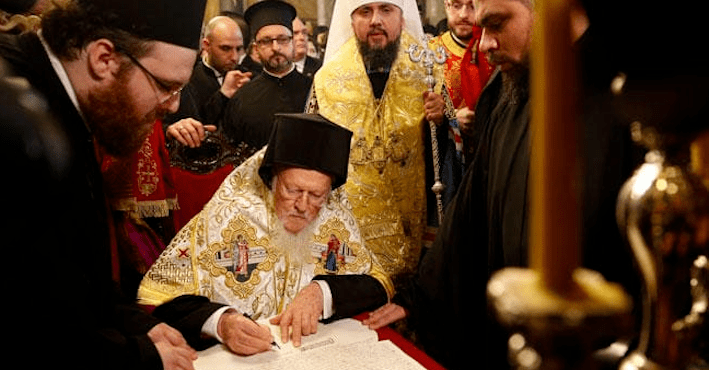
(photo caption: Ecumenical Patriarch Bartholomew of Constantinople signed a decree on January 5, 2019, granting autocephaly, or independence, to the Orthodox Church in Ukraine, ending more than 330 years of Russian religious control in Ukraine. The ceremony in Istanbul, which is considered the spiritual headquarters of Orthodox Christianity, was attended by Ukrainian President Petro Poroshenko.)
*
ROME – Wars always have wildly unforeseen consequences, eviscerating a status quo and violently shaping new realities. While most pundits are pondering the geopolitical, diplomatic and military fallout from Russia’s invasion of Ukraine, Putin’s war also seems destined to have important consequences on the religious scene.
Right now what those consequences may be seems impossible to descry, but it’s certainly worth contemplating the possibilities.
To begin with, there are at least three clearly religious dimensions to this conflict that, so far, have largely been overlooked in most analysis.
First, the war may affect relationships among the world’s Orthodox churches.
There are almost 300 million Orthodox Christians in the world, divided among 15 autocephalous churches and a variety of other branches, with roughly 100 million in Russia and 40 million in Ukraine.
The Russian Orthodox Church regards Ukraine as the cradle of its faith and its “canonical territory,” but on the ground Orthodox believers in Ukraine are divided into three separate churches, with only one being directly dependent on Moscow.
One effect of the war thus could be to produce a new sense of common cause among the Orthodox in Ukraine, weakening Moscow’s hold and producing a strong new counterpoint in the Orthodox world. At the beginning of the war, the Moscow branch of the Orthodox church in Ukraine issued strong statements condemning the invasion, though that content has since been scrubbed from its website.
In addition, a contest has been unfolding for some time for leadership in the Orthodox world between Moscow and the Patriarchate of Constantinople, led by Patriarch Bartholomew I. Broadly speaking, Constantinople is considered the more progressive and pro-Western point of reference – Bartholomew, for instance, is an ecumenical figure who’s engaged in multiple partnerships with Pope Francis – while Moscow is seen as more conservative and confrontational.
In general, Constantinople has the stronger claim to preeminence, rooted in the traditional conception of Constantinople as the “first among equals” in the Orthodox tradition. Moscow, however, has the numbers, the money and the backing of the Russian state.
Should Orthodox opinion around the world sour on the Russians, one net effect could be to strengthen Constantinople’s hand.
Religious historian Diana Butler Bass puts it this way:
“The conflict in Ukraine is all about religion and what kind of Orthodoxy will shape Eastern Europe and other Orthodox communities around the world (especially in Africa),” she writes. “This is a crusade, recapturing the Holy Land of Russian Orthodoxy and defeating the westernized (and decadent) heretics who do not bend the knee to Moscow’s spiritual authority.”
“If you don’t get that, you don’t get it. Who is going to control the geographical home, the ‘Jerusalem,’ of the Russian church? Moscow? Or Constantinople? And, what does claiming that territory mean for Orthodoxy around the world? Will global Orthodoxy lean toward a more pluralistic and open future, or will it be part of an authoritarian neo-Christendom triumvirate?”
Second, the war in Ukraine may also have important consequences for Catholic-Orthodox relations, especially as it concerns the fate of the Greek Catholic Church in Ukraine, the largest of the world’s 23 eastern churches in communion with Rome.
The Greek Catholics in Ukraine have long played an outsized role in national affairs, producing generations of scholars and activists working toward the goal of a unified and independent Christian community in the country. Greek Catholics are generally strongly pro-Western and resistant to Moscow, playing important roles in Ukraine’s various pro-independence uprisings, and for precisely this reason are likely to be at great risk as the Russian offensive continues to roll out.
Stretching back to Paul VI, the Vatican’s broad policy vis-à-vis Russian Orthodoxy has been détente, going to great lengths to avoid confrontation. The soft glove approach was confirmed under Pope John Paul II and his long-cherished dream of a Christianity that would “breathe with both lungs,” East and West. The Polish pope was a relentless opponent of Communism and helped trigger the collapse of the Soviet empire, but he tended to deference and tact when it came to the Russian Orthodox.
All that was frustrating for many Catholics during the Cold War, and it remains so today, given that Pope Francis still has not even publicly named Russia as the aggressor, nor has he condemned Putin’s actions like many other global leaders have done.
The current conflict may have the potential to change that calculus. Granted, Friday’s virtually unprecedented drop-in at Russia’s Embassy to the Holy See wasn’t accompanied by any public criticism of Moscow, but let’s face it – a pope doesn’t go storming down the Via della Conciliazione to a foreign embassy because he’s happy.
Perhaps the fallout from the war will be to shape a new Vatican brand of ecumenism, one that’s a bit more robust in its capacity to push back.
Third, the current crisis could also impact conservative Catholic and Christian circles in the west, who have come to see Putin as an ally in the struggle against Islamic radicalism, especially in terms of protecting persecuted Christians in the Middle East, and in favor of promoting traditional Christian values as a bulwark against secularism.
If some of those conservative Catholics and Christians sour on Putin, it could trigger a quest for other ways to advance their aims.
It’s also worth noting, by the way, that Putin’s pretense of being a great Defender of the Faith on the global scene isn’t entirely bluster. At critical moments in the Middle East, Putin has used Russian power in ways that actually have benefited Christian populations, most notably in the struggle against ISIS in Syria and Iraq.
Under the law of unintended consequences, a weakened and distracted Putin could end up exposing those Christians to greater danger, a possibility that forward-thinking Western leaders would do well to anticipate, because otherwise, Putin would be free to propagandize about their failure.
In sum: On the other side of the war, the global religious landscape is destined to look different. What those differences will be, however, will be determined by the choices religious leaders make right now.
Follow John Allen on Twitter: @JohnLAllenJr