



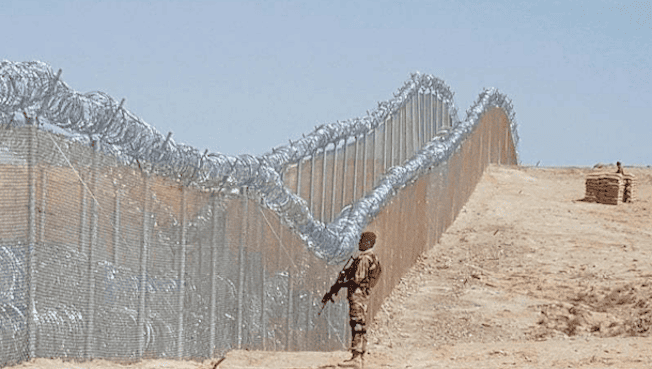
(An army soldier stands guard along the newly fenced part of the Pak-Afghan border)
A reported explosion in Dera Ismail Khan is part of a broader escalation that has already drawn Pakistan into retaliatory strikes inside Afghanistan. The immediate danger is not that Türkiye and Saudi Arabia will be pulled automatically into Pakistan’s counterterrorism campaign, but that an expanding insurgency could turn into another interstate conflict. How the three allies respond will determine whether the Mecca Pact develops into a credible security mechanism or remains largely a declaration of political solidarity.
The reported explosion in Dera Ismail Khan last saturday, which killed 13 and injured 20, should be understood not as an isolated terrorist incident but as another warning from a rapidly deteriorating security environment along Pakistan’s western frontier. Yet the precise circumstances matter. At the time the original report was published, the target, casualty toll and perpetrator had not been independently established. Earlier attacks in the district were also being recirculated, creating a risk that casualties from separate incidents might be conflated. The first analytical requirement is therefore restraint: the wider crisis is undeniable, but the latest incident should not be used to support conclusions that the available evidence cannot yet sustain.
What is already established is serious enough. A Sept. 18 assault on a police facility in Kohat killed at least 24 people. Pakistan then conducted air strikes in Afghanistan’s Paktika and Kunar provinces, saying that 28 militants had been killed. Afghan authorities accused Islamabad of killing civilians, and the United Nations confirmed the deaths of a man, a woman and a girl. Kabul summoned Pakistan’s chargé d’affaires and promised an appropriate response. The strikes ended almost three months of relative calm between two neighbours whose confrontation earlier in 2026 had already claimed hundreds of lives.
The emerging sequence is therefore more consequential than any single bomb. Militants attack inside Pakistan; Islamabad attributes the operation to networks sheltering in Afghanistan; Pakistan strikes across the frontier; Kabul describes the action as aggression; and Afghan forces or affiliated groups retaliate. Every repetition narrows the political space for restraint.
The insurgency could become an interstate war
Pakistan’s immediate problem is a widening constellation of insurgent organisations rather than one easily identifiable enemy. The Tehreek-e-Taliban Pakistan remains the most prominent threat, but the Kohat attack was claimed by Shura Ittehad-ul-Mujahideen, led by Hafiz Gul Bahadur. Analysts describe Bahadur’s organisation as an umbrella bringing together several militant components, with historical connections to al-Qaeda. Pakistan’s security crisis also extends beyond Khyber Pakhtunkhwa to separatist violence in Balochistan.
This fragmentation complicates both attribution and retaliation. The Afghan Taliban and the TTP are not the same organisation, even though they possess ideological, personal and operational connections. Kabul denies sheltering anti-Pakistan militants and argues that Islamabad is externalising a domestic problem. Pakistan, by contrast, maintains that the scale and sophistication of the attacks would be impossible without sanctuaries and logistical networks on Afghan territory.
Both propositions can contain elements of truth. Militants may exploit Afghanistan while also benefiting from governance failures, local grievances and political alienation inside Pakistan. Cross-border strikes may eliminate commanders or infrastructure, but they cannot substitute for police reform, local intelligence, civilian administration and political engagement in Pakistan’s frontier districts.
The greatest danger is that Islamabad increasingly treats the Afghan Taliban government as an active belligerent rather than an authority unable—or unwilling—to suppress the TTP. Once that threshold is crossed, an insurgency becomes an interstate conflict. Civilian deaths accelerate that transformation by increasing public pressure on Kabul to retaliate and making quiet cooperation with Pakistan politically toxic.
Does the Mecca Pact apply?
The Mecca Joint Defence Agreement, signed by Türkiye, Saudi Arabia and Pakistan on Aug. 7, declares that an armed attack against one member will be regarded as an attack against all. It envisages high-level political and military mechanisms, joint exercises, air-defence cooperation, intelligence coordination and joint development in drones, autonomous systems, electronic warfare and artificial intelligence.
The declaration resembles NATO’s collective-defence principle politically, but the resemblance should not be exaggerated. Publicly available information does not indicate an integrated command, standing forces, permanent headquarters or a detailed procedure for threat assessment and activation. Nor has it been explained whether the agreement covers terrorism, insurgencies, proxy attacks and disputed cross-border operations in the same way as conventional aggression by another state.
Dera Ismail Khan exposes this ambiguity. A bombing inside Pakistan cannot automatically activate collective defence. The allies would first have to determine who conducted it, whether the perpetrators received external direction and whether the incident constituted an armed attack under the agreement. Automatic activation without reliable attribution could allow a militant organisation to manipulate the alliance into confronting Afghanistan—or another regional power—through a false-flag or deliberately ambiguous operation.
Conversely, refusing to offer Pakistan any meaningful assistance would damage the pact’s credibility. Saudi Arabia has already faced Houthi attacks, yet Pakistan said on Sept. 10 that no military response under the pact was being discussed. The three members have preferred diplomatic support, including recognition of Riyadh’s right to defend itself, over immediate collective military action.
A similar response to Pakistan would confirm that the agreement is not an automatic war guarantee. Its real utility may instead lie in graduated assistance: intelligence sharing, surveillance, border-security technology, training, diplomatic mediation and economic support.
Türkiye’s opportunity—and its limits
Türkiye possesses an unusual advantage: channels to Pakistan’s civilian and military leadership as well as access to the Taliban authorities in Kabul and Kandahar. Ankara can therefore help create an incident-verification mechanism through which Pakistan submits specific evidence about militant movements or camps and Kabul is given a limited period to investigate or act before Pakistan resorts to force.
Such a mechanism could include a secure intelligence channel, liaison officers, geolocated evidence, procedures for investigating major attacks and emergency military communications intended to prevent border clashes. Saudi Arabia or Qatar could participate as political guarantors, while technical support might be sought from the United Nations.
Türkiye could also provide counterterrorism technologies, including drones, electro-optical surveillance, communications monitoring and training in protecting police compounds. But Ankara should avoid becoming a party to Pakistani operations inside Afghanistan. Direct Turkish combat involvement would damage its access to Kabul, expose Turkish personnel to militant retaliation and transform a potentially valuable mediator into another belligerent.
There is also a NATO dimension. Ankara must prevent the Mecca Pact from creating open-ended obligations that could embroil Türkiye in a South Asian conflict without parliamentary scrutiny, a clearly defined mandate or coordination with existing alliances. Türkiye can support Pakistan’s security without endorsing every Pakistani assessment of responsibility.
Saudi leverage cannot purchase obedience
Saudi Arabia’s role is different. Riyadh possesses financial resources, longstanding ties with Pakistan and religious and political influence in Afghanistan. It could finance border-monitoring equipment, humanitarian projects, rehabilitation programmes and economic incentives tied to verifiable Afghan action against militant networks.
But Saudi money cannot compel the Taliban to wage an unrestricted campaign against ideologically related groups. Kabul may calculate that confronting the TTP would fracture its own coalition, generate internal defections or produce a new jihadist challenge. Financial incentives must therefore be attached to limited, measurable commitments—restrictions on militant movement, closure of identified facilities, detention of particular commanders and participation in a verification process.
Saudi Arabia must also avoid converting assistance into unconditional financing for either side. Supporting Pakistani escalation could deepen the war, while unmonitored funds directed to Kabul would offer little assurance that militant operations would cease.
Wider regional consequences
A prolonged Pakistan-Afghanistan confrontation would create opportunities for several external actors. India would monitor any diversion of Pakistani troops and intelligence resources from the eastern frontier, while Islamabad would become even more sensitive to alleged Indian involvement in Balochistan or Afghanistan. Iran would fear militant movement across another unstable border and would watch whether the Mecca Pact develops into a wider Sunni security bloc. China, with investments in the China-Pakistan Economic Corridor and an interest in preventing jihadist infiltration into Xinjiang, would favour stability but resist arrangements that diminish its influence.
The economic consequences for Pakistan could also be severe. Persistent attacks raise insurance and transport costs, discourage foreign investment and weaken confidence in infrastructure projects. Large military operations would place additional pressure on public finances, while border closures would disrupt legal trade and livelihoods. New refugee movements or mass deportations would add a humanitarian crisis to an already combustible security confrontation.
The incident therefore presents the Mecca Pact with a defining choice. It can imitate the rhetoric of a military alliance without developing the procedures necessary to manage ambiguous threats. Or it can become a practical security framework capable of distinguishing terrorism from state aggression, verifying attribution and delivering assistance short of war.
The pact does not need Turkish aircraft or Saudi-funded troops entering Afghanistan to prove its relevance. It needs an agreed definition of aggression, an intelligence-fusion mechanism, a consultation procedure and a ladder of possible responses. Its first success would not be a collective military operation. It would be preventing Pakistan’s insurgency from becoming another regional war.
*A former editor-in-chief of Turkish Daily News, Hurriyet Daily News, Yusus Kanli writes on geopolitics and press freedom. He is also the author of The Anatolian Fire, on Eurasian myths and legends.