



Shaffaf Exclusive
Lebanon’s reconstruction will require millions of tonnes of cement. It will also require something considerably harder to manufacture: confidence that the billions of dollars expected to flow into reconstruction will not become a new source of financing for Hezbollah and the networks surrounding it.
An investigation into Lebanon’s cement market raises precisely that concern.
The issue is no longer simply the price of cement, the shortage of supply or the familiar Lebanese argument over quarries. It is the emergence of a secondary market in cement quotas—and, more importantly, the way some of those quotas are apparently being settled through Lebanon’s foreign-exchange dealers.
A Market Lebanon Should Not Need
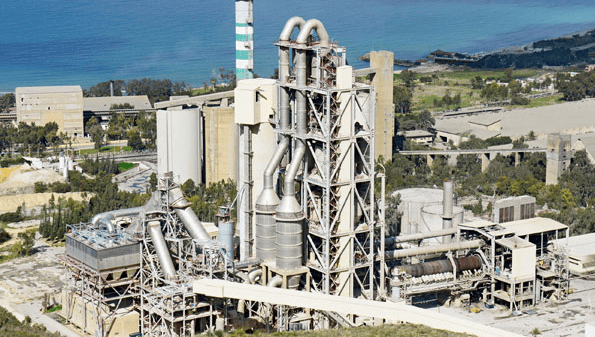
Lebanon has three major cement producers and historically possessed more than enough productive capacity to satisfy domestic demand.
Yet shortages caused prices to surge in 2026. The Ministry of Industry eventually intervened. On July 1, Minister of Industry Joe Issa El Khoury issued Decision 52/1, setting the maximum ex-factory price of black cement at $96 per tonne before VAT. At the same time, Circular 53/1 opened the market to cement imports subject to prior approval by the ministry.
The ministry explicitly connected the increase in demand to preparations for Lebanon’s reconstruction.
That should have brought greater transparency to the market.
Instead, another market appears to have developed alongside the official one.
The Cement Is Not the Only Thing Being Sold
Interviews and information gathered during this investigation indicate that access to cement is being distributed through quotas.
Those quotas have value.
If a person has the right to collect 1,000 tonnes from a factory at the official price while buyers outside the factory are prepared to pay substantially more, the piece of paper—or authorization, allocation or relationship—that provides access to those tonnes has effectively become a financial asset.
This investigation found something more troubling.
Foreign-exchange dealers identified and interviewed during this investigation were not simply being used to settle payments. They were being given cement quotas to sell.
That raises an obvious question: why would a cement producer—or individuals associated with it—use Lebanon’s foreign-exchange network to distribute cement?
FX dealers trade currencies. They do not normally sell cement.
So why were cement quotas ending up in their hands?
And, more importantly, what purpose does the FX network serve that an ordinary, transparent sale of cement does not?
In other words, the transaction does not resemble an ordinary purchase of cement.
There is the visible transaction: cement leaves a factory at the official price.
And then there is the second transaction: the value of securing access to the cement is settled elsewhere, through an FX dealer.
There may, of course, be an innocent explanation. Perhaps Lebanon’s currency dealers have suddenly discovered an unexpected talent for selling cement.
But there is another, more troubling possibility.
Who is actually buying the cement—and does the company know where those tonnes ultimately end up?
If the real buyer cannot, or does not want to, purchase directly from the producer, an FX dealer inserted between the two parties provides something potentially more valuable than a payment service: distance.
The quota goes to the dealer. The dealer sells it on. The cement moves. But the original buyer may never appear where one would normally expect to find them—on the transaction with the company.
So the question is no longer merely why an FX dealer is selling cement.
It is whether the FX dealer is there to sell the cement—or to obscure who is really buying it.
Follow the Dollars, Not the Cement Trucks
A price ceiling can regulate an invoice. It cannot regulate an invisible premium.
Suppose cement officially leaves a factory at $96 per tonne. If access to that cement is scarce enough that the market will ultimately pay $150, $180 or $200, somebody controls an extremely valuable spread.
The critical question therefore becomes not simply who bought the cement?
It is:
Who received the quota, who paid for it, who received that payment and where did the dollars ultimately go?
The use of FX dealers makes that question particularly important in Lebanon.
Foreign-exchange houses and informal dealers can settle dollar transactions independently of the conventional banking system. Payments can therefore potentially be separated from the underlying commercial invoice.
This investigation does not establish that every cement quota is handled this way, nor does it establish that the cement company who is behind this scheme has authorized sanctions evasion. But it found instances in which people associated with this particular company and involved in sales providing quotas to FX dealers.
That deserves investigation by Lebanese regulators—and by any international institution intending to finance Lebanon’s reconstruction.
Why Washington Should Care
This is not happening in a vacuum.
The United States has dramatically intensified its focus on Hezbollah’s access to Lebanon’s informal financial economy.
In February, the U.S. Treasury sanctioned individuals and entities it said were exploiting Lebanon’s informal financial sector to generate revenue for Hezbollah. In March, Treasury targeted a separate network that it said had diverted more than $100 million through economic projects and companies associated with Hezbollah financiers.
That March action contained an especially relevant warning for Lebanon’s reconstruction.
According to the U.S. Treasury, Hezbollah-linked financier Alaa Hamieh had used his former position at the Investment Development Authority of Lebanon in connection with funds from an Iraq-Lebanon trade arrangement intended to support reconstruction. Treasury alleged that Hamieh received millions of dollars for Hezbollah-associated projects.
The concern, therefore, is no longer theoretical: Washington has explicitly identified reconstruction and commercial contracting as potential channels through which Hezbollah-linked networks can generate or divert money.
In June, Treasury expanded its designations further, targeting what it described as Hezbollah-associated businessmen and networks that execute contracts and operate companies generating revenue for the organization.
And in August, Treasury sanctioned another network that it said moved cash between Lebanon, Turkey, the UAE and Iran outside the formal financial system, providing Hezbollah with foreign currency while evading sanctions.
The pattern identified by Washington is strikingly consistent: commercial activity, intermediaries, informal financial channels and transactions whose real economic beneficiary may be obscured.
Cement quotas settled through FX dealers therefore deserve far more attention than they are currently receiving.
Reconstruction Is the Prize
The stakes will increase dramatically once reconstruction accelerates.
Cement is not a peripheral commodity in reconstruction. It is one of its fundamental inputs.
Roads require it. Bridges require it. Apartment blocks require it. Schools, hospitals and public infrastructure require it.
Control access to cement and you acquire leverage over reconstruction.
And if access to cement itself becomes monetised through privately distributed quotas, the person controlling those quotas does not necessarily need to own a construction company or even appear on the final invoice to benefit.
That is precisely why international donors need to look beyond traditional procurement controls.
Auditing which contractor won a tender is not enough.
They need to audit the entire supply chain.
Who supplied the cement?
Who received the original allocation?
At what price?
Was the quantity consistent with the project?
Was any intermediary involved?
Did an FX dealer settle any portion of the transaction?
Who was the beneficial recipient of those dollars?
Were any of the parties sanctioned, owned or controlled by sanctioned persons, or acting on their behalf?
These questions should be answered before billions of reconstruction dollars arrive, not several years afterwards in another forensic audit.
The FX Dealer Is the Red Flag
There may be legitimate explanations for individual payments involving an exchange house. Lebanon remains heavily dollarised and its banking system has still not recovered from the financial collapse.
But the settlement of the economic value of a cement quota through an FX dealer is different from somebody simply exchanging Lebanese pounds for dollars to purchase construction materials.
If the FX transaction is settling a payment to the person who controls access to the quota, then regulators need to establish exactly what is being purchased.
That distinction could determine whether Lebanon is looking at an unusual but legal distribution arrangement or an attempt to circumvent regulated cement prices and sanctions exposure—or something considerably more serious.
Rebuilding Lebanon Without Rebuilding Hezbollah
Washington’s concern about reconstruction is becoming increasingly explicit.
Bipartisan legislation introduced in the U.S. Senate in August seeks, among other things, to support infrastructure recovery administered through the Lebanese state rather than Hezbollah and calls for continuing oversight of stabilization funding.
The logic is simple.
If the international community spends billions rebuilding areas devastated by war while the supply chains feeding that reconstruction simultaneously replenish the financial networks of the organization it is trying to disarm, reconstruction policy will defeat sanctions policy.
Cement is therefore not just cement anymore.
Lebanon’s government should require the three cement producers to disclose their complete allocation systems: every quota recipient, quantity, invoice, beneficial owner and authorized intermediary. Large allocations should be traceable from factory gate to final construction project.
FX dealers should be required to identify transactions connected to cement allocations and disclose the ultimate payer and beneficiary to the relevant Lebanese authorities if this is to be legalised.
International reconstruction institutions should go further. Contractors receiving donor money should be required to provide a complete chain of payment for strategic construction inputs, including cement and steel, with enhanced screening of intermediaries.
Because the most important transaction may not be the one appearing on the invoice.
It may be the payment made quietly somewhere else.
Lebanon has already learned what happens when billions of dollars circulate through an economy without sufficient transparency.
Reconstruction should not become the sequel.
*