



Let us be clear, the greatest fallacy is that Hezbollah objects to talks with Israel. What it really opposes is the Lebanese government conducting the talks. Hezbollah needs to be the interlocutor in order to maintain its control over the country. The militant group’s declared aim is the liberation of Jerusalem but its real one is the continued occupation of Lebanon. The formula is that Iran negotiates with the US over the region, while its Islamic Revolutionary Guard Corps proxies each remain in charge of the territory they control.
In fact, Hezbollah itself engaged in talks with Israel to coordinate the Israeli withdrawal from south Lebanon in 2000. This was facilitated by two Swedish mediators. In his recently published memoirs, Magnus Ranstorp described how he was contacted by former Israeli Prime Minister Ehud Barak and his advisers and asked to mediate with Hezbollah. Ranstorp had written articles describing how Hezbollah could transform itself into a political party after an Israeli withdrawal and had given presentations at a conference in the UK where he predicted that Hezbollah would not continue the war if Israel withdrew.
The fact that Israel withdrew on May 25, 2000 — “without even a slap on anyone’s face,” as it was then described — was thanks to the efforts of Ranstorp and another Swedish researcher, Magnus Norell. The withdrawal was coordinated through indirect talks between Hezbollah and Israel. Talks are talks, whether direct or indirect; what matters is who talks about what.
Maybe one day historians will judge it a mistake for Israel to have empowered Hezbollah and not to have dealt with the Lebanese state. In any case, Israel is making the same mistake now by negotiating with Hamas instead of the Palestine Liberation Organization.
The current bold move by the Lebanese state to initiate direct talks with Israel under US auspices breaks many taboos and challenges Hezbollah’s authority.
To understand the significance of this, one has to go back to the last time such direct talks happened, also with US backing, in 1983, which led to what became known as the May 17 Agreement for Israel to withdraw from south Lebanon after its invasion the previous year — an incursion that resulted in the PLO being driven out of the country. This led to violent opposition by Syria and the Shiite Amal movement under the leadership of Nabih Berri, now the Lebanese parliamentary speaker, and other elements that were later to emerge as Hezbollah.
The violence included attacks on both the French and US embassies in Beirut in April and a truck bomb blast at a US barracks in October that killed 241 troops. In September 1982, President Bachir Gemayel was assassinated. All this was followed by the occupation of Beirut by Shiite and Druze militias on Feb. 6, 1984. A few months later, the US withdrew.
Now, 42 years after what amounted to a takeover, Hezbollah is being challenged openly, with the Lebanese government initiating direct talks with Israel. The last time the group was challenged was when its status as a resistance movement was questioned following the Israeli withdrawal in 2000. This eventually led to a series of assassinations from 2004, a war with Israel in 2006 that helped restore its resistance credentials, an occupation of the capital, government paralysis, a 2011 coup — and so on until Hezbollah achieved almost total control of the country.
Intense debate surrounds the subject of peace talks with Israel and why they should or should not happen. Many hint at previous violence or the threat of civil war if full internal consensus is not achieved for the talks. This is an indirect way of giving Hezbollah the power of veto, though it did not require such a consensus to drag the country into war after war.
Another myth is that the Lebanese delegation to the talks should include a comprehensive representation of all the political parties. This is another attempt to give Hezbollah the power to paralyze the Lebanese team. In 1983, the Lebanese negotiating team was composed of professionals who consulted with various parties between sessions of talks. This empowered the negotiators in relation to their Israeli counterparts because they asked for the best concessions, so as to be able to sell it internally to the various parties.
There is the argument that any talk of peace with Israel is impossible given the current government and its wars in Gaza, Lebanon and Iran. In fact, it could be argued that relations between Israel and the Arab world have never been better. There are treaties with Egypt and Jordan and the Abraham Accords with the UAE and four other states.
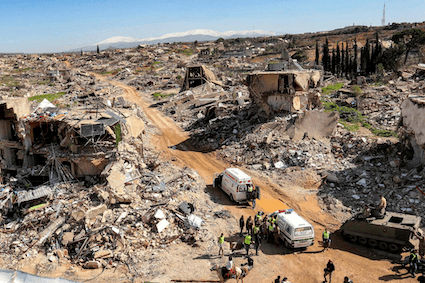
There is a convoluted story that normalization will be imposed on Lebanon and that this will create a rift with regional countries, since it abandons the Palestinian cause and will result in Israeli hegemony and economic control. These are exaggerations, however, and ignore the Lebanese government’s objectives in these talks, which are to achieve Israel’s withdrawal to the 1949 armistice line and to resolve border issues, allowing people to go back to their villages in the south and begin rebuilding their lives. Such an achievement would be a threat to Hezbollah’s power over the community, which is where the real internal political battle will take place.
Finally, there are the claims that the Lebanese state is too weak, that it is going to the talks empty-handed, with no leverage, and will be forced to make concessions. This is all the more reason why these talks should happen now, while there is US and Arab support. The main threat remains from Hezbollah, but it will be at its weakest militarily and politically if the talks can deliver a return for the people of south Lebanon and allow them to live in peace for the first time in more than half a century.
- Nadim Shehadi is an economist and political adviser. X: @Confusezeus