



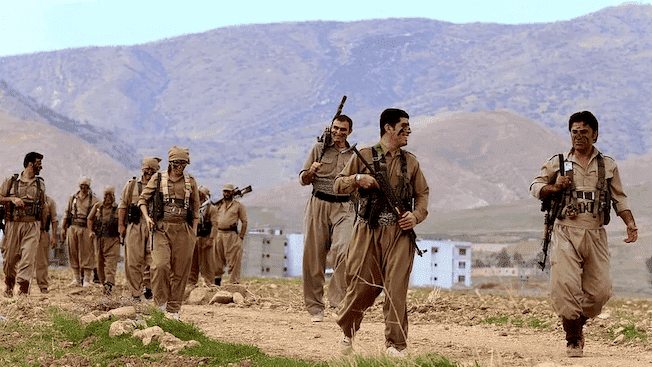
The Mujahedeen-e Khalq (MeK) tried to attack the Headquarters of the Iranian Supreme Leader (Beit-e Rahbari) located in the Motahari Complex in Tehran on Monday 23 February but were not successful in their operation. The MeK released a statement that up to a hundred of its fighters were killed, wounded or arrested by the protection force of the Motahari Complex. The MeK most likely tried to show to the US and Israel that it was still a force that had to be reckoned with, but ultimately failed to do so.
One and a half week before the attack on Iran five Kurdish-Iranian organisations established the Coalition of Political Forces in Iranian Kurdistan. The five are: the Kurdistan Free Life Party (PJAK), the Kurdistan Democratic Party of Iran (PDKI), the Komala Organization of Kurdistan and the Khabat Organization of Iranian Kurdistan and the Kurdistan Freedom Party (PAK).
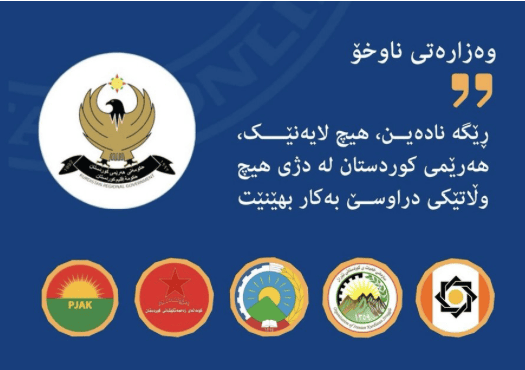
Some of these groups were already crossing into Iran since January when resistance to the Islamic Republic’s forces became serious. Since mid-January reports were coming in that IRGC and its internal suppression force, the Basij, were ordered to attack majority Kurdish cities and villages in north-western Iran as if there was an uprising.
The lethal force used by the IRGC led to armed resistance and Kurdish fighters came in from Iraqi Kurdistan to support their fellow Kurds inside Iran to resist the brutal violence imposed on them by the IRGC. In some smaller towns in western Iranian provinces like Ilam city, centers became places of urban warfare, where both sides used deadly force. Repression, using deadly force, of the demonstrations against the Islamic Republic started there on January 7, a day early to most other places in Iran.
As communications were disconnected, and still are disrupted, in provinces like Kermanshah, Lorestan, Kurdistan, Ilam and West-Azerbaijan with a majority of Kurdish people, the exact scope of the violence and devastation done to mainly Iranian Kurdish cities and villages is still unknown, but it is known that a high percentage of casualties of the repression in January were in the western part of Iran.
Abdanan Resistance
The majority Kurdish city Abdanan in the province of Ilam was harshly attacked by IRGC troops in February. Large groups of mourners who were commemorating the 40th day of the death of some of the protestors, were attacked by IRGC members in heavy armored personnel carriers shooting with shotguns.
Abdanan was attacked in a revenge strike because it was able to withstand attacks by IRGC troops in early January. Kurdish fighters had entered from Iraq and helped to defend the city center against IRGC troops. To take their revenge IRGC troops started firing on unarmed people visiting a cemetery, leading to a new outbreak of fighting. Armed fighters stormed IRGC and Basij positions in Abdanan which led to many casualties on the side of the IRGC and Basij.
IRGC expects incursion from Iraqi Kurdistan
Now that the Islamic Republic is at its weakest since its establishment, there are fears in Tehran that separatist groups will try to start an uprising to cut out territories for themselves. Rumors are also being fed that the US and its allies might support separatist groups in the Kurdish territories and Sistan and Balochistan.
For some time, the IRGC expects that Kurdish separatists and other Kurdish groups might enter the Kurdish areas of Iran. To prepare for an incursion the IRGC started to build a 600 kilometer security wall to repel smugglers and Kurdish fighters. Part of the security wall has been build inside the Kurdish autonomous region inside Iraq.
Security Wall in north-west Iran
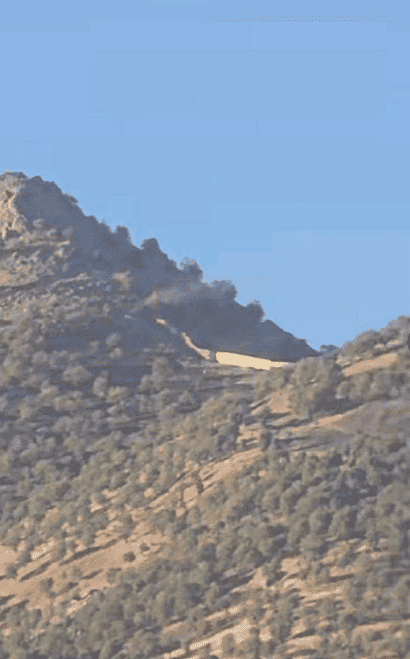
The IRGC has lost control of the smuggler groups since at least 2022. At an emergency security meeting between the top of the Islamic Republic’s intelligence community and the Supreme Leader in late 2022, which was during the Mahsa Amini protests, the commander of the IRGC border guards reported that large amounts of small fire arms, ammunition and explosives being smuggled into Iran from Kurdish Iraq.
In recent weeks the US has relocated troops from the Qasrak base in northeastern Syria (al-Hasakah governorate) to Erbil, including Special Forces. Some Special Forces, including Green Berets, have already been stationed in the Erbil at al-Harir Air Base for some time. Also, the US recently deployed 1,900 soldiers of the 10th Mountain Division’s 2nd Brigade Combat Team to Iraqi Kurdistan, giving the US an experienced military ground unit near Iran’s border. Together, both the Green Berets and the 10th Mountain Division, are excellent units to support operations of Kurdish groups in the mountainous area in north-west Iran.
It is well possible that these US military units in Iraqi Kurdistan might set up a bridgehead inside the Iranian Kurdish provinces to support operations inside Iran, to take out high value targets and degrade the capabilities of regular IRGC ground forces in the area.
When thinks go wrong Iranian leadership wants to settle in NW Iran
One of the options discussed within the leadership of the Islamic Republic and IRGC when things go really bad is to create a mini (or breakaway) Islamic Republic in the province of East Azerbaijan and adjacent provinces. The logic behind this was that some of the most influential members of the leadership of the Islamic Republic are ethnic Azeri, including Supreme Leader Ali Khamenei and President Masoud Pezeshkian.
The mountainous areas in north-west Iran have many underground bases and silos. The Tabriz underground missile silo complex was heavily bombed in June 2025. When the IRGC-Aerospace Forces (IRGC-ASF) ordered the Tabriz base to go on full alert in January 2026 missile technicians went on strike. Since the suppression of the protestors and especially since the Israeli-US bombing campaign started many defections have been reported from the area around Tabriz.
Also, reported are many defections from IRGC units in other north-western provinces of Iran. Reports said that many IRGC military members cross the borders into Iraq, Armenia and Azerbaijan. After the first bombing raids on the Beit-e Rahbari there were reports that the Supreme Leader was perfectly healthy and taken by his security detail overland to the Tabriz area. Many were making jokes about that, but in light of the options the leadership of the Islamic Republic were discussing this makes sense.
During the 2022-2023 Mahsa Amini protests the IRGC leadership was also making plans to evacuate their families and top ranking officials. Their plans were to cross the borders with Georgia and Armenia to end up in a large IRGC owned compound in Armenia. One of the main problems that western intelligence analysts, saw at that time, was that a rogue and vengeful IRGC general might be trying to flee with enriched uranium or a dirty bomb and take it with him to a South Caucasus hideout and transport to a European city and explode.
IRGC tries to block land incursion
As US forces and most likely Israeli Special Forces are preparing for land operations in north west Iran, IRGC ground forces are entering the conflict more visibly, by executing drone strikes against Iranian Kurdish positions in Iraqi Kurdistan.
Since the start of the US and Israeli bombing campaign the IRGC Quds Force (IRGC-QF) has instructed its proxies in Iraq to fire at Erbil and for at least the last few days the al-Harir Air Base has come under heavy missile and drone attacks.
Both Iran and Israel have deep ties to Iraqi Kurdistan. The Peshmerga of the Kurdistan Democratic Party (KDP) of Masoud Barzani were trained by Israel. While the Patriotic Union of Kurdistan (PUK) of Bafel Talabani is known to have a longstanding relationship with the Islamic Republic. Yesterday President Trump talked with the two main Iraqi Kurdish politicians, Masoud Barzani and Bafel Talabani, about the operations in Iran.
What might be the goal of an incursion into NW Iran
As a land incursion in north-west Iran is becoming more probable there will be multiple goals to be achieved. An incursion will cut off the opportunity for the leadership of the Islamic Republic to create a small breakaway empire in East Azerbaijan and adjacent provinces. It will also cut off an overland escape route for IRGC leadership to the South Caucasus. It will put extra pressure on Tehran and will create an armed force that is needed to finally topple the Islamic Republic.