



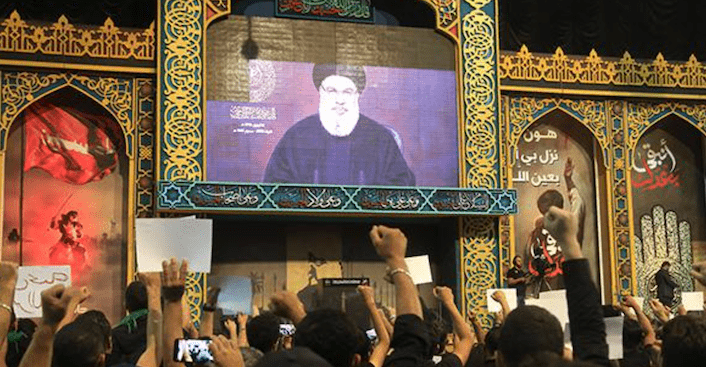
Hezbollah may accept a new government, but would be as pleased if the country’s social and political order crumbled.
In October 2019, the party’s secretary general, Hassan Nasrallah, along with his communal ally Nabih Berri, mobilized to neutralize the street protests and shield the government of Saad al-Hariri. In that way they sought to preserve the broad equilibrium in place that had sustained the political class, and with it the Lebanese political order in which Hezbollah has anchored its domestic hegemony.
That plan momentarily suffered a setback when Hariri resigned. His move caught Hezbollah off guard, giving a fleeting victory to the so-called “revolution.” To fill the void, the political class brought into office the toothless and calamitous government of Hassan Diab. Within a matter of weeks, the politicians and their allies had undermined the government’s economic program, which sought to place the burden of Lebanon’s financial losses on the banking sector, and by extension on the politicians with banking interests.
Hezbollah watched all this with equanimity. If Diab succeeded, he would stabilize a country that the party dominated. If the government failed, this would lead to the further destruction of a political order whose demise Hezbollah had always welcomed. It was Nasrallah, after all, who had said in an interview with the Emirati newspaper Al-Khaleej in March 1986: “We do not believe in a nation whose borders are 10,452 square kilometers in Lebanon; our project foresees Lebanon as part of a political map of an Islamic world in which specificities would cease to exist, but in which the rights, freedoms, and dignity of minorities are guaranteed.”
Some might argue that Nasrallah’s attitude has changed since that time. Really? When has the Hezbollah leader ever shown that he believes that Lebanon and its system of sectarian consensus are legitimate? When has he done anything but push to transform the country into an outpost of Iran’s expansionist project in the region—a project that sees Lebanon as part of a political map of an Islamic world dominated by Tehran? If Nasrallah has proven anything, it is the consistency of his thinking. Everything we see today suggests that if the Lebanese system disintegrates, Hezbollah would welcome it.
This explains the party’s ambiguous attitude toward an agreement on a government. Hezbollah does not appear to oppose a government, and has backed the initiative of Speaker of Parliament Nabih Berri in this regard, but nor has it done anything to ensure a successful outcome. Some have argued that the party is unwilling to harm its relationship with Michel Aoun and Gebran Bassil by forcing both men to make concessions in their months-long standoff with Hariri. Nonsense. Bassil is too much in need of Hezbollah’s backing for his own presidential bid to risk a falling out with the party.
More likely, Hezbollah sees that it can only gain from a clash between the leading Maronite and Sunni representatives. That dispute, which has drifted onto the terrain of constitutional prerogatives, has only highlighted that the consensus over the Lebanese political system is unraveling. If this drift leads toward a reconsideration of the current post-Taif constitution and, therefore, an overhaul of the sectarian social contract, Hezbollah would be in a good position to demand a larger share in the system for the Shi‘a community. This could translate into even greater power than the party has today.
Moreover, an accord over Iran’s nuclear program would release Iranian funding for Tehran’s regional proxies. This would allow Hezbollah to partly fill Lebanon’s financial and economic vacuum. The party could use this as leverage to impose a more overtly pro-Iran order and then secure it with constitutional changes it desires.
Aoun, Bassil, and Hariri are so focused on their quarrels that they cannot see that Hezbollah, by allowing the system’s failure, is fulfilling a long-term ambition to reshape Lebanon. The crumbling of the economy could mean that the financial and economic sectors in which the Christians and Sunnis have played a major role could take a decisive hit, not to mention the communal emigration that has accompanied it. It would also indicate that the Lebanese army, the one institution still enjoying national credibility and dominated by the Sunnis and Maronites, may become weaker. That suits Hezbollah, as does the push by the dupes at right-wing U.S. think tanks to defund the army, on the crude assumption this will weaken the party.
A new Lebanon is emerging on the debris of the old, and Hezbollah wants to fashion the country in its own image. Three words are notably absent today: “International Monetary Fund.” Lebanon will not soon resort to the IMF’s conditions and reform its public finances to secure a bailout. Hezbollah does not want Lebanon to submit to an institution in which Western states have a major say. In this the party will have the backing of a contemptible Lebanese political class that refuses to make any concessions that diminish its power.
That leaves the Lebanese people. Do they want their country to turn into a permanent base for an authoritarian, clerical regime in Tehran, alienating the West and much of the Arab world? Are they prepared to give up on their system of sectarian compromise and power-sharing for an order permanently dominated by Hezbollah? It has been a year and a half that the Lebanese realized that their politicians had robbed them of everything, in many cases denying their children a future. Yet the society has remained silent. A people that won’t fight for their children’s future is not likely to do so for their country.