



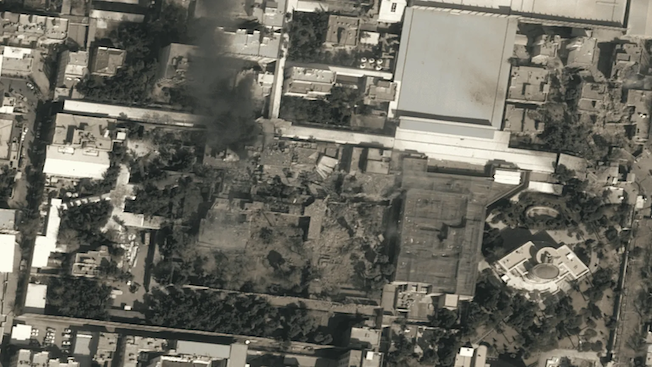
(Satellite image showing damage to the compound of Iranian Supreme Leader Ayatollah Ali Khamenei in Tehran)
As Israeli-American strikes on Iran trigger regional retaliation, Türkiye faces a dangerous strategic dilemma between principled diplomacy, security concerns and domestic transparency.
The latest Israeli-American military operation against Iran, and Tehran’s retaliatory strikes across the region, have pushed the Middle East toward a dangerous threshold. This is not simply another flare-up between rivals. It is a structural escalation that threatens to reshape regional security dynamics in unpredictable ways.
Let us begin with clarity. Iran is not Türkiye’s best friend. A nuclear-capable Iran would undoubtedly pose a serious threat to Türkiye and the entire region. Yet intellectual honesty requires acknowledging that Israel’s undeclared nuclear arsenal is also a destabilizing factor. Nuclear asymmetry does not generate sustainable security; it entrenches imbalance and perpetual mistrust. A region in which one state’s nuclear capability is tolerated while another’s is treated as an existential crime cannot produce lasting stability. It produces strategic hypocrisy.
In this already volatile neighborhood, Israel, as a democratic state, should have remained Türkiye’s natural strategic partner. For years it was exactly that. Close security coordination, intelligence cooperation and expanding trade ties reflected a pragmatic and mutually beneficial alignment. Yet over time that strategic logic eroded. The domestic political priorities of Ankara and the rigid Netanyahu doctrine in Tel Aviv steadily narrowed the space for rational engagement. Expansionist reflexes, hardline security maximalism and diminishing sensitivity to proportionality gradually replaced long-term strategic thinking, making constructive partnership increasingly difficult.
More troubling from Ankara’s perspective is the emerging alignment between Israel, the Greek Cypriot administration and Greece. Energy partnerships, military exercises and trilateral defense coordination have increasingly taken on a political character that appears directed against Türkiye’s interests in the Eastern Mediterranean. What began as energy cooperation has evolved into a geopolitical bloc that many in Ankara perceive as an exclusionary axis. Whether one calls it containment or coordination, the result is the same: strategic polarization.
When Israel deepens military cooperation with Athens and the Greek Cypriot administration while tensions with Türkiye remain high, it inevitably fuels the perception of a hostile alignment forming in the Eastern Mediterranean. This dynamic does not enhance regional security. It multiplies fault lines.
A sustainable regional order cannot be built on selective alliances designed to sideline or encircle a major regional actor. If strategic blocs harden further, the Eastern Mediterranean risks becoming yet another theater of confrontation rather than cooperation.
Destabilization and double standards
Iran has long relied on proxy networks as instruments of influence, contributing significantly to instability across the region. However, in recent years it is Israel that has directly struck multiple neighboring states and steadily widened the scope of confrontation. Military operations extending beyond immediate borders, combined with rhetoric rooted in historical and theological narratives of a “promised land,” have amplified regional anxieties. As strategic actions increasingly intersect with ideological undertones, the perception of Israel as an unpredictable and assertive actor has gained ground. This growing image, whether fully justified or not, is reshaping threat assessments across the Eastern Mediterranean and the broader Middle East.
Even President Recep Tayyip Erdoğan has publicly acknowledged that Türkiye might be on Israel’s potential target list. That statement alone underscores the seriousness of the moment.
Meanwhile, Washington’s approach continues to prioritize Israeli security as the central organizing principle of regional policy. Under President Donald Trump, this reflex has deepened. Selective interpretations of international law undermine credibility and weaken the very order they claim to defend.
Paper tigers and real risks
Recent events have exposed the limitations of Russia and China. Both project global confidence and cultivate strategic partnerships, yet when real escalation erupts their role appears cautious and constrained. A friend in need is a friend indeed. So far, their support seems strongest in times of stability, not in moments of acute crisis.
The absence of credible deterrence makes life more difficult for all nations, especially middle powers such as Türkiye. A functioning balance of power has historically acted as a brake on unilateral adventurism. When that balance weakens, the temptation to act without constraint grows. In that sense, Russia and China remain important not because they are flawless actors, but because their presence in the global system provides at least a theoretical counterweight to unchecked American and Israeli military dominance. Without some form of strategic equilibrium, the rule of the powerful becomes normalized.
The inconsistency of great power backing becomes even clearer when contrasted with other actions by the United States under President Donald Trump. Earlier this year, Washington carried out a large-scale military operation in Venezuela that resulted in the capture of President Nicolás Maduro and his abduction out of his country without United Nations authorization. Many legal experts described the move as a violation of sovereignty and a dangerous precedent involving the forcible removal of a sitting head of state. Despite rhetorical objections from parts of the Global South, there was no decisive counterbalance from those who speak of multipolar order.
This pattern reflects a broader shift toward power politics. When force becomes the primary instrument of policy, international law is reduced to selective interpretation. Venezuela one month, Iran the next. The message is unmistakable.
The Israeli-American assault and Iran’s counterstrikes now carry the risk of evolving into a broader regional war. Energy corridors, maritime routes and fragile states could all be pulled into the vortex, deepening instability that the same global actors claim they seek to prevent.
Mediation, silence and transparency
Türkiye’s offer to mediate is diplomatically valuable. But mediation without clear moral positioning risks ambiguity. Silence in the face of aggression can be interpreted as calculation rather than principle.
Equally troubling is the instinct to limit media scrutiny under the disinformation law. Managing perception may provide temporary comfort, but it cannot shield society from strategic consequences. In moments of heightened danger, transparency strengthens national resilience.
The region does not need another prolonged war. It needs strategic sobriety, balanced diplomacy and the courage to confront uncomfortable truths, at home and abroad.