



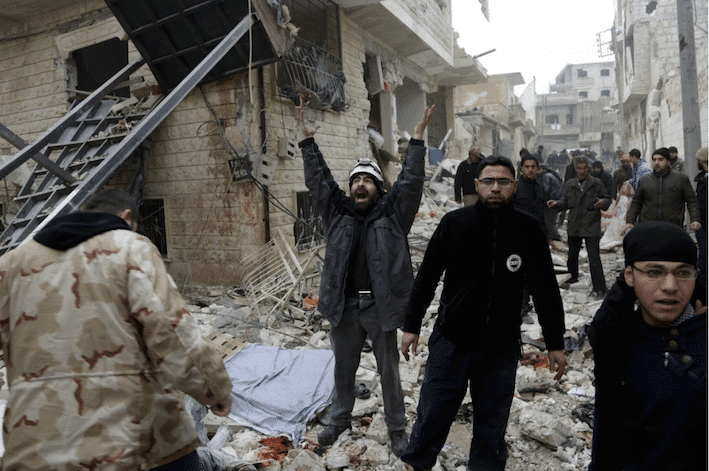
According to analysts and officials here, the Russian government believes it has won those dividends at a relatively low cost to the country’s budget, with minimal loss of soldiers’ lives and with largely supportive public opinion.
“The operation is considered here to be quite successful,” said Evgeny Buzhinsky, a retired lieutenant general and senior vice president of the Russian Center for Policy Studies in Moscow. It could probably continue for one year or longer, he said, “but it will depend on the success on the ground.”
Whether the benefits of Russia’s gambit to put soldiers on the ground in Syria will continue long term remains to be seen. President Obama warned last year that Russia was entering a “quagmire” reminiscent of the Soviet invasion of Afghanistan, and it is unclear when Moscow could declare victory and whether it has an exit strategy.
But as Assad’s forces push forward and as diplomatic talks in Geneva broke off in recriminations Wednesday after just two days, there is little pressure right now on the Kremlin to pull back.
“Putin can afford to play geopolitical chess in the Middle East because it does not cost much,” said Konstantin von Eggert, an independent political analyst based in Moscow.
Entering the conflict in Syria has allowed Putin to combat what he sees as a U.S. policy of regime change, show off his military muscle and reassure allies in the region that Moscow is a loyal partner, von Eggert said.
But Russia’s endgame remains unclear, he and others said.
“No one asks what Putin is doing in Ukraine because it’s obvious,” he said. “In the Middle East, not so much.”
There have been some clear costs to Russia’s campaign, including the October bombing of a charter jet filled with Russian vacationers returning from Egypt that left 224 dead. The Sinai Peninsula affiliate of the Islamic State claimed responsibility for the attack.
There was also the downing of a Russian strike fighter by Turkish F-16s in November that resulted in the death of one pilot. A Russian marine was subsequently killed during a rescue attempt, probably by U.S.-backed rebels. And on Wednesday, Russia’s Defense Ministry announced that a military adviser was killed by mortar fire earlier in the week. It blamed the Islamic State.
Yet those incidents have not prompted the kind of round-the-clock television coverage drawn by the conflict in Ukraine, in which Russia has denied having a formal role.
“This is a limited war that doesn’t really have an effect in Russia,” said Maxim Shevchenko, a Russian journalist who has supported the Russian intervention in Syria and traveled after New Year’s Day to the country, where he embedded with Hezbollah fighters.
“There is no stream of coffins,” he said. “There is nothing comparable even to Donetsk,” he added, referring to Russian deaths in eastern Ukraine, including some believed to be active servicemen.
Russian officials, including Putin and Foreign Minister Sergei Lavrov, also have batted away accusations that Russian bombers have focused their firepower on more moderate opponents of the Assad regime instead of the Islamic State.
The Russian intervention has upended the Obama administration’s version of a negotiated settlement to the war, including an abdication by Assad. The opposition was hesitant to join talks this week in Geneva because of perceived backtracking from the United States on Assad’s future.
In many ways, Putin’s intervention may be more important as a diplomatic tool than on the battlefield. Analysts in Moscow said Assad has retaken only about 2 percent of the country’s territory in the four months since the Russian intervention.
“The Russian intervention already accomplished the biggest thing it could, which was ensuring the cohesion and stability of the Syrian regime,” said Steven Simon, a senior fellow at the Middle East Institute, who was the senior director for the Middle East and North Africa at the National Security Council from 2011 to 2012.
Although questions remain about the potential of the Syrian army and its ability to take back land, the intervention has had an outsize influence on negotiations.
“The Washington officials who work on this issue are scarcely oblivious to the impact of Russia’s intervention on the course of the war,” he said. “I think they understand at this point that the options and the ambitions of the opposition . . . are necessarily truncated.”
Alexander Aksenyonok, a veteran Soviet diplomat and former charge d’affaires at the Soviet Embassy in Syria, said that he thought Russia’s focus would shift toward diplomacy in the coming months.
But the military operation has played an important role, and will continue to do so, he said.
“I think that if this military pressure had not been applied, we would not be seeing the diplomatic activity we are seeing now,” he said. “When I say that Russia has gained more than it has lost, I have this in mind, too.”