



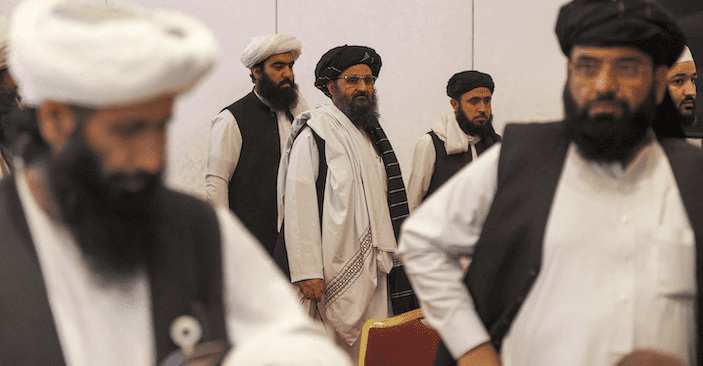
Mullah Abdul Ghani Baradar (center) in Qatar’s capital Doha on July 18, 2021.
Islamabad has long fostered the fighters but Doha has recently sheltered prominent members of the group. Will its deeper pockets make a difference?
By Bobby Ghosh and Hussein Ibish
As the Taliban settle into their second stint as Afghanistan’s rulers, any hope of avoiding a reprise of their first period of rule may rest on a competition for influence in Kabul between Pakistan and Qatar. The outcome will determine what role the wider world, and especially the West, can play in the country after the withdrawal of American forces.
Most Afghans — as well as foreign governments, aid agencies, donors and investors — will be rooting for Doha over Islamabad. Memories of how the previous Taliban administration performed under Pakistani tutelage allow for no optimism about how things will play out this time. The Qataris are a relatively unknown quantity in South Asia, but they could hardly do worse.
Who wins will be determined in large part by another contest, within the Taliban. Although the group is headed by a supreme leader, Habitullah Akhundzada, it is not a monolith. Qatar is aligned with the political faction led by Mullah Abdul Ghani Baradar, while Pakistan is backing the military wing, marshalled by the likes of Mohammad Yaqoob, the son of former supreme leader, Mullah Omar, and Sirajuddin Haqqani, head of the dreaded Haqqani Network, designated a terrorist group by the U.S.
On the surface, things are looking good for the Qataris. Baradar, who has lived in Doha for the past three years, has arrived in Kabul and is expected to head the new government. The Biden administration seems to have determined that it can do business with him: Central Intelligence Agency Director William Burns held secret talks with Baradar on Monday.
This will alarm the Pakistanis, who are thought to be in bad odor with Baradar. They first gave him shelter after the U.S.-led defeat of the Taliban, then arrested him in 2010. He was reportedly tortured in captivity. The Qataris, on the other hand, have been treating him as Afghanistan’s leader-in-waiting, and have built strong ties to others in his faction.
But even if Baradar heads the government, the real power in the Taliban lies in Akhundzada’s “shura,” or council, where Yaqoob and Haqqani wield considerable sway. From 1996 to 2001, when the Taliban last ruled, decisions made in Kabul were routinely overruled by the high council in Kandahar, the group’s spiritual base and home of its supreme leader.
If Pakistan’s proteges emerge as the dominant clique, Islamabad will likely be their principal go-between with the world. We’ve seen that movie before, and it ends badly. The last time around, rather than encourage the Taliban to develop a modern, inclusive state, Pakistan indulged their obscurantist ideology, defended their reactionary worldview and excused their atavistic domestic agenda.
Western governments, and especially the U.S., paid handsomely for Pakistan’s services as the designated Taliban-whisperer, but this only enriched and empowered the military and intelligence establishment in Islamabad, and did nothing to alleviate the plight of the Afghan people or abate the terrorist threat emanating from their country.
After the fall of the Taliban in 2001, Pakistan provided the safe havens for them to regroup, rearm and return to the fray. Over the past 20 years, governments in Islamabad have made little effort to ameliorate the attitude of their guests. Now that they’re back in power, it is hard to imagine Pakistan will temper their tendencies.
Can Qatar do better? Over the past decade, the tiny emirate has emerged as an effective interlocutor between the West and the Taliban. By brokering peace negotiations in Doha, the Qataris paved the way for the American withdrawal and the insurgents’ return to power.
Their bid for influence in Kabul will depend on Baradar being grateful for services rendered — and wanting still more. If the Taliban want international recognition for their government, the Qatari auspices will be more effective than that of Pakistan, which is itself regarded with suspicion by the West.
And if they want money — aid or investment — Doha has much deeper pockets than Islamabad. This will be especially important in the first months of the new administration, when Western governments and donors will hold back funding while they take the measure of the new dispensation. Even if they remain suspicious of the Taliban, those inclined to keep assisting the Afghan population will feel more comfortable using Qatar as a conduit than relying on Pakistan.
But don’t rule out the Taliban’s old patrons just yet. For one thing, the Pakistanis have a major advantage in proximity. The two countries share a 1,650-mile land border, whereas Qatar and Afghanistan are separated by the landmass of Iran and the Persian Gulf. Pakistanis and Afghans also share ethnic and cultural ties that the Qataris can’t hope to match.
More important, the Pakistani state has a history with new rulers in Kabul that goes back to the Taliban’s birth, midwifed by Islamabad’s intelligence services, in the early 1990s. Some of those ties were frayed when the government of General Pervez Musharraf enabled the U.S.-led 2001 invasion of Afghanistan, but the group could not have survived without continued, covert Pakistani backing. Baradar may have suffered at the hands of his jailors, but many in the military wing, leaders and fighters alike, will feel they owe their recent hosts a debt of gratitude.
And finally, Pakistan also has much more at stake. For Doha, a friendly government in Kabul would be a very good outcome; for Islamabad, it is an existential imperative because Pakistani military doctrine has long held that Afghanistan provides the country with “strategic depth” in its rivalry with India.
So, count on Pakistan to fight much harder than Qatar for influence in Afghanistan. This contest could yet get very dirty.