



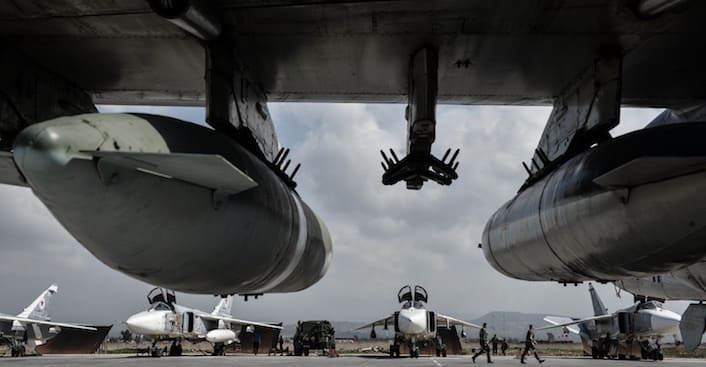
Russia said that it shot down seven of the 13 drones and used electronic countermeasures to safely bring down the other six. It said no serious damage was caused.
The drone attack, however, came less than a week after two Russian servicemen were killed in a sustained mortar assault on the same base, which appears to have caused some damage to Russian military assets.

The Russian Defense Ministry denied a report in the Russian Kommersant publication that seven warplanes were put out of action in the mortar attack, including two of its premier Su-35 fighter jets and four Su-24 attack aircraft, losses that would represent the worst single day for the Russian air force in decades. A Russian journalist posted photographs of damage that suggested at least some planes had been hit.
Taken together, the drone and mortar attacks appear to represent the most concerted assault on the Russian headquarters in Syria since the military intervention in September 2015, which has broadly succeeded in its goal of shoring up President Bashar al-Assad’s fight to suppress the seven-year-old rebellion against his rule. Russian news outlets have also reported two smaller drone attacks against Russian outposts in the provinces of Homs and Latakia, as well as another attack against Hmeimim, all in the past two weeks.
The Hmeimim base, the heart of Russia’s military operations in Syria, is deep in Syrian-government-held territory and until now had seemed immune to attack, said Maxim Suchkov of the Russian International Affairs Council, who also writes for the publication Al-Monitor.
“They thought the base was secure, but now it seems it is vulnerable,” he said. Among the questions being asked in Moscow, he said, are whether the Russian military had adequately secured the base and whether it had failed to detect the acquisition of new technology by its adversaries.
[A Putin-Assad embrace launches Russia’s new peace bid for Syria]
The attacks also raise questions about the sustainability of Russia’s gains in Syria, said Jennifer Cafarella of the Washington-based Institute for the Study of War. In December, Putin visited the Hmeimim base and said Russia would start to wind its presence down because the war in Syria is essentially over.
The events of recent days are a demonstration “that whoever conducted these attacks can still penetrate regime areas and impose costs on the Russians,” she said. “The gains the regime has made are not secure and are at high risk of being temporary.”
[U.S. moves toward open-ended presence in Syria after Islamic State is routed]
Perhaps the biggest question of all, however, is who was responsible. What makes the attacks especially unusual is that there has been no claim, triggering a frenzy of speculation in the Russian and Syrian news media over who may have carried them out.
Russia’s Defense Ministry on Tuesday appeared to accuse the United States of supplying the technology for the drone attack, saying the assault required a higher level of expertise than any armed group in Syria is known to possess. Compounding the suspicions, the ministry said in a statement on its Facebook page that a U.S. Poseidon reconnaissance aircraft was in the skies above the area for four hours during the drone assault.
Pentagon spokesman Eric Pahon said the allegation was “absolutely false.” The Islamic State has often used armed drones against U.S.-allied forces in eastern Syria and Iraq without “significant impact,” he said, adding that small drones are readily available commercially.
But the nearest Islamic State positions are hundreds of miles from the western coastal province where Hmeimim is located, making the group one of the more unlikely culprits.
[A boost for Assad as the Syrian army makes gains against ISIS]
Most of the Islamic State drones used against U.S. allies, moreover, had a range of no more than one to two kilometers, according to an analysis by the defense consultancy IHS Markit group. The Russian Defense Ministry statement said the drones used in the Hmeimim attack came from between 50 and 100 kilometers away, making them far more sophisticated and expanding the pool of potential suspects, the IHS analysis said.
One of the myriad Syrian opposition groups is the most probable suspect, Suchkov said. According to a report Wednesday in the Russian Defense Ministry’s official Krasnaya Zvezda newspaper, the drones were launched from a village controlled by the “moderate opposition” called Muazzara in southern Idlib province. Russia has sent a letter to Turkish authorities urging them to comply with Turkey’s obligations in the area under ceasefire agreements with Russia, the report said.
But that nonetheless leaves a question mark over which of the many groups was involved. because rebel groups typically claim all their operations. “If it was the opposition, they tend to put everything online and boast about it,” Suchkov said.
Among the theories circulating widely is that disgruntled Alawites from Assad’s own minority sect were responsible. A statement about the attacks on the base, which is in a predominantly Alawite area, was posted online in the name of a shadowy group called the Free Alawite Movement. It warned Alawites who support the Syrian regime that the attacks proved Assad’s hold on power is not secure, but did not explicitly claim that it carried out the attacks. A number of Alawite opposition members said they did not think the group is real and speculated that foreign intelligence agencies are seeking to create the impression of strife among regime loyalists.
Another claim made in Syrian opposition news outlets is that an Iranian-backed militia fighting on behalf of the regime and located in the government-controlled hills nearby was responsible. According to that theory, Iran wants to thwart Russia’s efforts to impose a peace settlement on Syria that would undermine Iranian interests.
“There are so many theories,” Suchkov said. “But it’s a mystery at the moment.”
Suzan Haidamous and Louisa Loveluck in Beirut, Heba Habib in Stockholm and Zakaria Zakaria in Istanbul contributed to this report.