



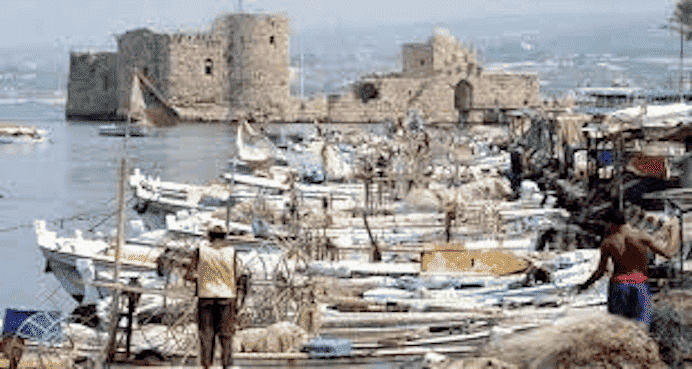
I, recently, returned to Saida, that predominantly sunni city south of Beirut — sentimental to me and politically charged for Lebanon. My own memories there are personal: I was once lost as a child in its streets until an elderly man sat me on a stairway and waited patiently for my mother to reappear. Cities can wound and protect in the same moment; Saida is doing it again to the southern shia refugees fleeing the war.
Today, Saida is the latest recipient of Lebanon’s internal displacement — not just Syrian and Palestinian refugees, but Lebanese economic refugees from Nabatieh and the broader Shia south. This southward-to-northward flow inside the South is political in ways that statistics rarely capture. When businesses shuttered in Nabatieh — under the combined weight of economic collapse due to war they did not disappear. They relocated to Saida. Whole trading networks and wholesale markets shifted. Daily laborers followed. A new economic geography formed without a government plan, without a development strategy, and without even the pretense of policy.
In a normal country, such a demographic and economic shift would be studied, legislated, and managed. In Lebanon, it’s absorbed — by whichever city happens to have cheaper rent and a bit of space and Saida has a warm heart.
Politics of Oversupply
The influx of workers into Saida created a textbook oversupply of labor, pushing down daily wages. When I asked workers why they stayed, they replied with a political truth disguised as an economic one: “Saida is cheap.” Cheap cities become poverty traps when movement upward or outward is blocked. Lebanon’s blocked mobility is not just physical but political — dictated by war, frozen deposits, territorial patronage, and the strength (or weakness) of local political parties.
Saida did not ask to become a hub for displaced southern labor, but it became one anyway. In doing so, it now occupies a new position in Lebanon’s fractured political economy: a buffer city between the Shia interior and the Sunni coast, absorbing the economic shock of a region without receiving the political compensation that would accompany such a role in a functioning state.
Crypto as Sanctions Infrastructure
The second-hand car yards that migrated from the southern city of Nabatieh to Saida reveal another political layer. Many now prefer payment in cryptocurrency. When sanctions complicate imports and regional finance, traders seek instruments that bypass banks altogether. Crypto’s rise in poorer Lebanese towns is not a tech story; it is a sanctions story, a sector predominantly controlled by Hezbollah the second hand car yards have moved to the digital age.
The irony is glaring: Lebanon’s wealthier, more developed districts now trade in cash — physical, monitored, traditional — while its poorer, peripheral economies transact in borderless digital currencies. The periphery has become more globalized than the center. The formal sector has become more primitive than the informal one.
Whether car yards are linked to Hezbollah-import networks or simply part of a broader southern merchant ecosystem is almost a secondary question. The political reality is that non-state actors and sanctions-era traders have built parallel financial channels where the Lebanese state has collapsed.
Two Cities Merged, Zero Planning
Refugee labor — both Lebanese Palestinian and Syrian — stresses Saida’s social services, yet the city absorbs it. Many work in Saida by day and sleep in the South by night, creating a circular economy without local taxation and without national subsidy. In effect, Saida is subsidizing an internal refugee crisis using municipal capacity and private resilience alone.
Meanwhile, Nabatieh’s economy has merged into Saida, creating a single metropolitan market without municipal coordination and without central government strategy. Prices fell for consumers — sometimes by half compared to Beirut — because political vacuum breeds competitive markets at the bottom, even as it destroys wages at the top.
This is Lebanon’s newest political paradox: the poorer the city, the cheaper the food, the lower the wages, the more cryptocurrency transactions, and the more invisible the state.
The Politics of a Sentimental City
As I walked through Saida, I realized the city had become a mirror for Lebanon itself. A place where care comes from strangers, not institutions. Where trauma is absorbed locally because national politics refuses to intervene. Where an old man once made sure a lost child was found — something the Lebanese state has never done for its own citizens.
Cities, like nations, are political organisms. And Saida now holds two cities inside it — its own, and the displaced one from the South — merged without strategy, managed without planning, and held together not by policy but by improvisation.