




On the surface, they looked like demonstrations from the Arab Spring more than a decade ago. Since late September 2025, thousands of young Moroccans have been protesting in the streets against poor government administration, corruption and high unemployment.[1] The protests were organized on the social media platform Discord by an anonymous collective called GenZ212 (212 is Morocco’s dialing area code).[2] While there has been violence, repression and even some deaths, the protests do not seem to be spiraling out of control, and generally have not called for the overthrow of the state or the country’s king. The clashes are a real political and security challenge for the state but seem relatively manageable by one of the better run regimes in the region.
The Arab Spring, which saw protests break out from North Africa to the Arabian Gulf, generally failed.[3] They led to the fall of several dictators (in Tunisia, Egypt, Yemen, and Sudan) but in no country – with the partial exception of Syria – do they seem to have led to a radical change. In most situations, one strongman was eventually replaced by another, even if there may have been a brief pseudo-democratic interregnum.
The majority of the conditions and dissatisfactions which led to those Middle East youth revolts are still in place. If anything, the desire for domestic change has been replaced by the desire to flee. According to the August 2024 Arab Barometer, 35 percent of Moroccans (the numbers are higher in Tunisia and Jordan) would like to emigrate.[4] Among Moroccan youth between the ages of 18 to 29, that number of potential migrants rises to 55 percent.[5]
If turmoil in Morocco is driven by socio-economic issues, elsewhere in Africa open war provides an additional incentive for migration.[6] There are currently war or warlike conditions, often (but not everywhere) driven by Jihadist insurgencies, in Mali, Burkina Faso, Niger, Nigeria, Cameroon, Sudan, and Somalia (which have combined population 415 million). One could add volatile Ethiopia, Libya and South Sudan (combined population 154 million) into that mix. The situation in Nigeria, Africa’s most populous country, is particularly worrying, with a mixture of Jihadist insurgency, rampant banditry and crime, corruption, and ethnic and sectarian tension.[7]
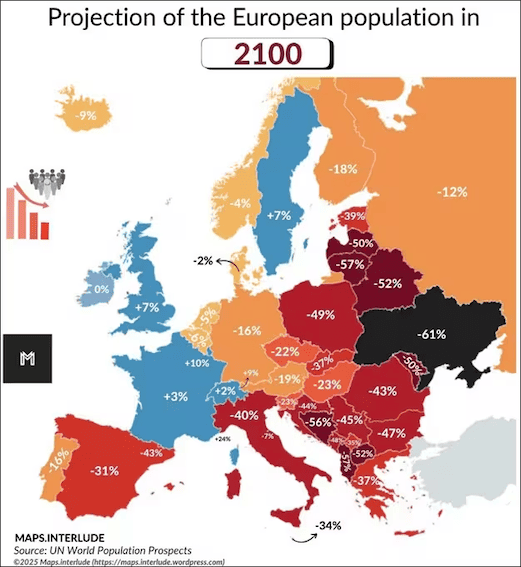
If Africa is teeming with turmoil and with life (with extremely high population growth rates), Europe, especially the continent’s southern flank seems to be quietly imploding into advanced senescence. The continent as a whole is expected, according to UN statistics, to lose 20 percent of its current population by 2100. But numbers vary wildly. The UN projections include major declines in Poland, Ukraine, and most of the Balkans.
Particularly hard hit is Europe’s southern flank, where Spain (projected to decline by 31 percent), Greece (a 37 percent decline) and Italy (by a whopping 40 percent) are closest to the African rim of the Mediterranean Sea. Those percentages would mean that there would be 14.8 million less Spaniards, 3.7 million fewer Greeks, and 23.8 million fewer Italians in only 75 years. All of these projections are, of course, without factoring in the potential entrance of millions of new migrants into these countries.
Obviously, a rapid increase in the fertility rate of these countries would grow the population and reverse these trends. But that is certainly not happening – fertility rates are declining globally – and most European countries, with a few exceptions, do not seem to be prioritizing this path.
Spain’s central bank projects that the country “needs” an eye-watering 25 million migrants between now and 2053 to maintain the current pension system and labor market.[8] Spain’s current population is 49 million (and its youth unemployment rate, the worst in Europe, is 24.5 percent) so importing 25 million people would make Spanish citizens a minority in their own country within one generation should this actually happen. Spain already has growing immigrant populations, drawn from Latin America, North Africa, and Sub-Saharan Africa. Immigration, especially illegal immigration from Africa, is a controversial political subject in Spain as it is elsewhere in Europe.[9] Foreigners make 19 percent of the current Spanish population (and 31 percent of its prison population).[10] The largest number of foreigners in Spain are from Morocco, followed by Colombia and Venezuela.[11] And rather than covering up budget deficits, immigrants in Spain are currently wildly overrepresented as consumers of government welfare and social assistance.[12]
What will actually happen in the next generation in Europe? No one actually knows. Sentiment against unlimited immigration is generally spiking across the continent with the rise of right-wing populist parties. Left-wing governments (like the one in Spain) tend to be much more welcoming of illegal, uncontrolled migration than right of center governments (such as the one in Italy). Spain’s leftist rulers not only have maintained relatively open borders, they have also been forward leaning in giving citizenship (and, of course, voting rights) to foreigners. The country’s ruling leftist coalition seems increasingly unpopular, mostly because of corruption.
Is a Spain where most of the population is, within recent memory, from somewhere else, still Spain? One could perhaps make that case if all of the new immigrant population was being drawn from Latin America with its historic language, cultural, and religious ties to the Iberian Peninsula. Will an immigrant population made up of Latin Americans, North African Muslims, and Sub-Saharan Africans really pay the pensions of old people with whom they differ radically in terms of culture, race, and religion? That is a social engineering experiment never attempted before.
Perhaps the newcomers might prefer to advocate for euthanizing an elderly population with whom they share few cultural or emotional ties. And Spain, like Portugal and unlike Central and Eastern Europe, actually has an overseas population reservoir of former imperial possessions from which, at least in part, to seek to supplement its declining population. The “kinship gap” would likely be wider elsewhere in Europe.
We – the whole world, as far as population decline is concerned – are in uncharted territory. The interaction and ultimate impact of “older” countries with rapidly declining populations and neighboring countries declining less rapidly with younger populations that seek to flee to the West are still poorly understood. Many focus, understandably so, on economic issues such as pensions, taxes and work force participation. But human beings are not blank slates. The ultimate impact of socio-cultural and political issues on questions of identity is less studied.[13] Can nation states reject the political and economic pressure of wholesale demographic reconfiguration or is it, already, too late?
Countries adapt and evolve due to changing circumstances all the time, of course, but I, for one, would be disheartened to see a Spain or an Italy that was no longer Spain or Italy. How does one even measure the quality or value of “Spanishness” or “Italianity” as a material good? Does anybody know what time it is? Does anybody really care?[14]
*Alberto M. Fernandez is Vice President of MEMRI.
[1] Apnews.com/article/morocco-gen-z-protests-king-explainer-106e99e49835fca17da9d1ee411b78f5, October 4, 2025.
[2] Moroccoworldnews.com/2025/10/261927/an-sos-from-genz212-moroccos-youth-will-not-hang-up, October 4, 2025.
[3] Washingtonpost.com/world/interactive/2021/arab-spring-10-year-anniversary-lost-decade, January 24, 2021.
[4] Arabbarometer.org/report/migration-attitudes-in-the-middle-east-and-north-africa, August 15, 2024.
[5] Arabbarometer.org/media-news/arab-barometer-reveal-findings-from-major-morocco-survey, June 7, 2024.
[6] Afrobarometer.org/articles/international-migrants-day-almost-half-of-africans-have-considered-emigrating-afrobarometer-survey-shows, December 18, 2024.
[7] See MEMRI Daily Brief No. 838, Nigeria: Africa’s War Within A War, August 25, 2025.
[8] Cope.es/programas/mediodia-cope/audios/espana-enfrenta-futuro-demografico-necesita-25-millones-inmigrantes-sostener-pensiones-20251002_3225227.html, October 2, 2025.
[9] Gaceta.es/espana/informes-de-la-fiscalia-certifican-que-solo-el-47-de-los-considerados-menas-son-menores-mientras-pp-y-psoe-se-niegan-a-hacerles-pruebas-de-edad-como-pide-vox-20251002-1328, October 2, 2025.
[10] Derechopenitenciario.com/noticia/la-cifra-de-presos-extranjeros-en-espana-desciende-un-35-en-15-anos, accessed October 6, 2025.
[11] Es.statista.com/estadisticas/472512/poblacion-extranjera-de-espana-por-nacionalidad, accessed October 6, 2025.
[12] Eleconomista.es/economia/noticias/13576964/10/25/los-inmigrantes-acaparan-hasta-el-50-de-las-rentas-minimas-autonomicas.html, April 10, 2025.
[13] Elespanol.com/el-cultural/letras/20170104/significa-espanol/183482542_0.html, January 4, 2017.
[14] Youtube.com/watch?v=9FzCWLOHUes, June 6, 2019.