



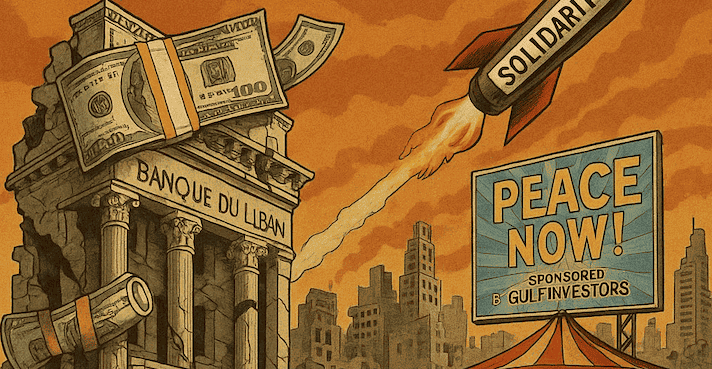
Six years into a financial free-fall worthy of a Greek tragedy, this country has turned collapse into kabuki theater—complete with port explosions, fuel-smuggling joyrides, and artisanal rockets for added spectacle. As Syria and the Gulf roll out red carpets for peace deals, Lebanon can’t even coax its own leaders to say the word without breaking into a panic. Forget a roadmap to recovery; here, “national strategy” means procrastination with fireworks—and an encore is always just around the corner.
If there’s one thing Lebanon excels at, it’s doing everything wrong with impeccable flair. Six years into a financial collapse that would make Enron look like a bookkeeping error, the country has managed to turn state failure into an art form—like Chagall, if he’d painted with flaming tires and ‘Monopoly’ banknotes.
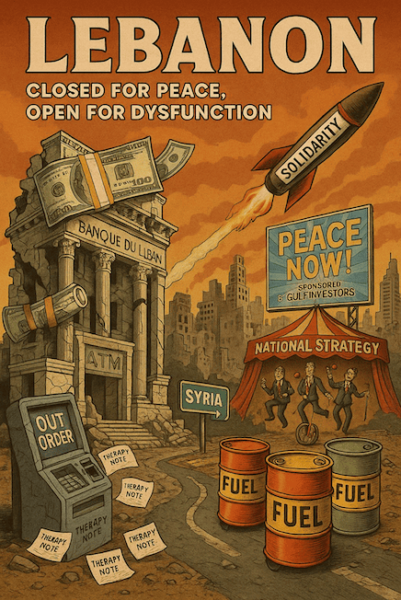
Now, you’d think that after half a decade of economic misery, political paralysis, and currency so unstable it needs therapy, Lebanon might catch a break. You know—maybe a miracle. Or at least a functioning ATM. But no. When Lebanon goes down, it does it in style, with multiple plotlines, foreign guest stars, and a recurring cast of local villains who make the Sopranos look like amateur hour. Still, official Lebanon stubbornly snubs the regional peace process that is unfolding in broad daylight!
Let’s roll the history tape on the series of disasters that have both compounded & somewhat surpassed the country’s mere debt burden.
Back in 2020, while the economy was crumbling and the banks were practicing new ways to say “No, you can’t have it,” Beirut decided to add some spice—a casual Port Explosion, courtesy of 2,750 tons of poorly stored ammonium nitrate. Who did it? No one. Everyone. “Circumstances.” Also, the cast included Hezbollah, Syria, Iran, Israel’s ever-busy drone squad, and possibly The Beach Boys in retrospective. But certainly not anyone you can see or could sue. By that point, the Lebanese people had already survived the 2019 protests, a nationwide pot-banging session that taught citizens two important things: 1) the revolution is loud, and 2) no one in government gives a damn (or gives back the money).
Then came the Great Fuel Giveaway of 2021-2022, in which the Central Bank —whose economic strategy seemed to be “what if we just bled what’s left of your reserves?”—decided to subsidize gasoline. Result? Smugglers joy-rode $15 billion worth of fuel across the border into Syria, proving once and for all that the fastest thing in Lebanon isn’t internet speed—it’s the blackmarket. Depositors, meanwhile, learned a new form of metaphysics: their savings simultaneously existed and didn’t, like Trump’s friendship with world leaders, Tesla’s carmaker, and Jeffrey Epstein.
And just when the country hit rock bottom, someone handed Hezbollah a shovel. In October 2023, in a brilliant display of tactical irrelevance, the Iran-backed militia decided to “stand in solidarity” with Hamas by lobbing artisanal rockets at Israel. The logic? If your house is on fire, why not also punch a tiger? Tourism fled. Remittances shrunk. Forex houses flourished and even Al-Qard Al-Hasan—the shadowy bank with no need for KYC—got its own bang, literally. And Lebanon became a destination only for washed up diplomats of the Hochstein and Le Drian type, and the occasional foreign correspondent looking for danger with good cuisine. Try the hummus a la shrapnel and the tabbouleh au canon.
Now comes the kicker: Syria—yes, that Syria, the post-apocalyptic theme park once known as a country—has decided it wants peace. Their new leader, a former ISIS franchisee turned Gulf- friendly pitchman, looked into a camera and said, “We seek peace with our Israeli neighbors.” And suddenly, Gulf money flowed in like it was Black Friday at a Dubai real estate expo. No constitution or laws? No investor protections or safeguards? No functioning courts or justice for that matter? No problem! As long as you say “peace,” you get beachfront property, a few billion in fresh cash from Qatar, and probably a private plane named after you.
And Lebanon?
Lebanon, the country that invented hospitality, accounting fraud, and dramatic acceptance speeches for best supporting role in the motion picture “how to screw your own country”, can’t even say the word peace without needing a drink and the bogus threat of civil war. Despite having more to gain than anyone—tourism, trade, international funding, maybe even streetlights—its leaders prefer to tiptoe around Hezbollah like it’s an angry uncle at a family reunion.
What passes for a national strategy these days is basically procrastination with fireworks.
So, here’s a thought: instead of perfecting the art of delay, why not try the ancient Lebanese tradition of deal-making? The kind where you take the bad, mix it with a bit of charm, and sell it as a win. Make peace with all neighbors. Get investments from anywhere. Maybe even unlock deposits whose expiry dates are overdue. Because if we don’t, the country that once sold the world the art of “skiing & swimming in a 2-hour interval” will become nothing more than a cautionary tale told at Davos’ cocktail parties—right between salty canapés and tradable carbon credits.