



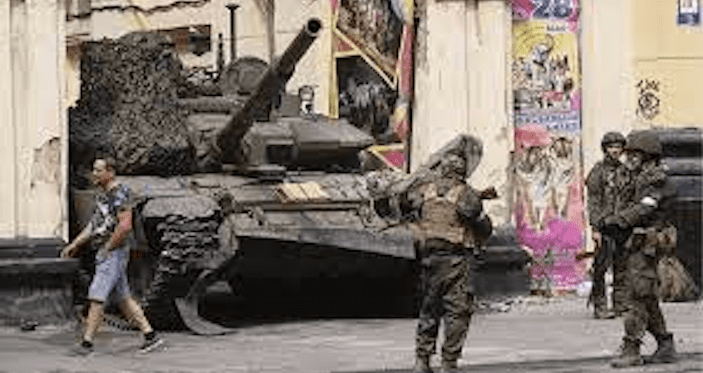
The Wagner mercenary boss was counting on solidarity from senior army officers, and since he came close to reaching Moscow without encountering any particular resistance, he might not have been completely mistaken.
One of the most shocking aspects of the weekend’s mutiny by Yevgeny Prigozhin’s Wagner private military company is that the Russian armed forces appear to have done next to nothing to stop the Wagner troops as they moved first from field camps in Ukraine to the southern Russian city of Rostov-on-Don, where they seized key military headquarters, and then on almost to Moscow.
In theory, those headquarters—as the main command center for Russia’s operations in Ukraine—should have been one of the most high-security sites in the country. Yet Prigozhin was able to breeze in with his gang of mercenaries in tow and effectively take two senior generals hostage: First Deputy Head of the General Staff Main Directorate Vladimir Alekseyev and Deputy Defense Minister Yunus-bek Yevkurov.
Even after a criminal case was initiated against Prigozhin on suspicion of inciting armed insurrection and Putin addressed the nation, calling Prigozhin’s actions a “stab in the back,” there was still no resistance. It seems that the maverick Wagner boss may not be mistaken in his belief that there are plenty of people within the armed forces and security services who secretly sympathize with his cause.
In his voice notes explaining the mutiny, Prigozhin clearly stated that he was going to “have it out with [Defense Minister Sergei] Shoigu,” not taking a stand against the armed forces. On the contrary, he said that his “march for justice” was also being carried out in their name.
The Russian armed forces are not monolithic, but consist of a multitude of rival groups competing for positions and sources of income. Far from everyone within the military leadership is loyal to Shoigu and General Staff Chief Valery Gerasimov personally: as a rule, that’s only those who have been promoted through the ranks with their help, or who have been awarded lucrative Defense Ministry–linked contracts. In recent months, Prigozhin has been trying to win over another group of generals: those whose careers took off under the reformist respective predecessors of Shoigu and Gerasimov—Anatoly Serdyukov and Nikolai Makarov—and stalled after their departure.
Long before the mutiny, Prigozhin had said openly that he would like to see Shoigu replaced with Mikhail Mizintsev, and Gerasimov with Sergei Surovikin. Mizintsev, dubbed the “Butcher of Mariupol” by Western media for his supervision of the devastating siege of the Ukrainian city, was one of the most promising generals during the Serdyukov-Makarov military reforms in 2008–2012. In 2012, he was made head of the Central Command Post of the General Staff, an office that had just been established in order to streamline the archaic chain of command in the Russian armed forces.
Shoigu, who was appointed defense minister soon after, preserved the new institution and Mizintsev at its head, but never favored the general. After taking Mariupol, Mizintsev was first demoted and then apparently discharged from the army, after which he became a deputy commander of Wagner. There is no doubt that Mizintsev has retained his influence among those officers who rose up through the ranks under his command, and it’s possible that Mizintsev’s reputation among those officers played a role in Wagner’s ability to occupy the Rostov military headquarters without any bloodshed.
Surovikin also prospered under the Serdyukov-Makarov leadership. Back then, he was appointed head of another newly created institution: the military police. As in Mizintsev’s case, Shoigu confirmed the appointment, but limited the powers of the new establishment. Still, Surovikin managed to build a strong reputation—first in Syria and then as the commander of operations in Ukraine last October—before being replaced with Gerasimov in January. Prigozhin and his war blogger followers have frequently praised Surovikin, who remains a key figure within the top brass who is not part of Shoigu and Gerasimov’s inner circle. Of all those in the military leadership, Surovikin enjoys the most authority among rank-and-file officers.
The examples of Mizintsev and Surovikin confirm that the main group that Prigozhin was counting on to remain neutral or offer silent support was senior officers who made their careers under the reforms enacted by Serdyukov and Makarov. Interestingly, the establishment of Wagner and Prigozhin’s appointment as its head also date back to this time.
Under those reforms, 80 percent of colonels and 70 percent of majors were discharged from the armed forces, creating plenty of opportunities for more junior officers to rise up through the ranks. These (now senior) officers do not owe their careers to Shoigu or Gerasimov, and may be more inclined to agree with Prigozhin’s criticism of the military leadership in the belief that if Shoigu had continued those reforms, the Russian armed forces would be performing better in Ukraine. While the officers are not prepared to express their frustration openly, when speaking anonymously they are vocal in their criticism of both the Defense Ministry and Putin.
Following the failure of his mutiny, it’s unlikely Prigozhin will get his wish of Mizintsev being appointed defense minister. But he may be satisfied with Alexei Dyumin, a former military intelligence officer, Putin bodyguard, and deputy defense minister who was put in charge of the Defense Ministry’s Special Operations Forces in 2014.
This is the elite division credited in Russia for the successful annexation of Crimea in the spring of 2014. Since 2016, Dyumin has been the governor of the Tula region, home to key defense industry enterprises. His name frequently features in discussions about potential successors to Putin.
In interviews, Prigozhin has been effusive in his praise of Dyumin’s command of the annexation operation. The Insider has reported that the two men share some business interests, and last fall Meduza cited sources as saying that Dyumin had his own reasons to criticize the Defense Ministry under his former boss Shoigu, since the two men had apparently not gotten on, resulting in Dyumin being posted to Tula.
Dyumin did not join the many other regional governors rallying around the Kremlin on June 24 with public expressions of support for the president and condemnation of Prigozhin. Then, shortly after the news broke that Prigozhin had agreed to stand down, apparently under the terms of a deal brokered by Belarusian President Alexander Lukashenko, it was reported that it was in fact Dyumin who had negotiated terms with Prigozhin. The governor’s press service was quick to deny the reports, but Putin’s spokesman declined to comment on the rumor.
Taking all of the above into account, it’s entirely possible that by the start of his “march for justice,” Prigozhin believed he would find solidarity among many officers in the armed forces, and that if his uprising was successful, they would be joined by certain groups within the ruling elite, such as generals with no direct ties to Shoigu, or former members of Putin’s security detail seeking to boost their status within the system.
Prigozhin wasn’t wrong on the first count, and most of the armed forces made no attempt to stop him advancing on Moscow. But his hopes for support from elite groups who would also like to see a Defense Ministry reshuffle appear to have been dashed. Putin threw his unequivocal backing behind the armed forces, cutting off any ways for other bodies of authority to express solidarity with Wagner.
Still, Prigozhin’s mutiny revealed the scale of the crisis within the Russian armed forces, which are disillusioned by constant failures and tired of war, and within the military and security elites more broadly.
When senior and mid-ranking officers effectively respond to an armed mutiny with a “go slow” strike, there can be little doubt that the Wagner boss will not be the last challenger to square off against Shoigu and his allies and seek to capitalize on the unspoken but growing resentment within the Russian armed forces.
*Mikhail Komin is a political scientist and researcher majoring in data governance. He is a visiting fellow at European council on foreign relations (ECFR).
- Mikhail Komin