



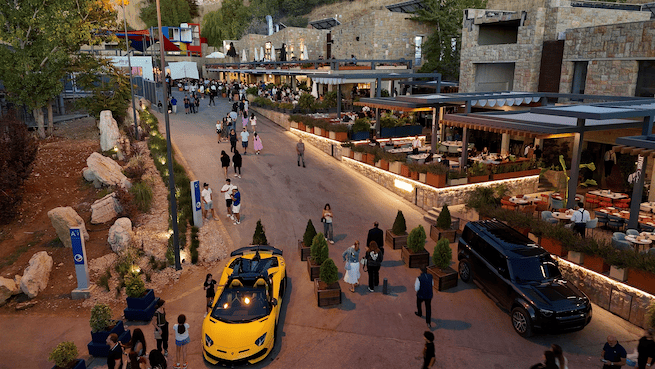
Every August, for perhaps two or three glorious, ridiculous and occasionally traffic-choked weeks, Faqra becomes Lebanon’s answer to Saint-Tropez.
The comparison is imperfect. Saint-Tropez has yachts. Faqra has ATVs driven by teenagers who appear to believe they have diplomatic immunity. Saint-Tropez has orderly parking. Faqra occasionally requires the patience of a Buddhist monk simply to travel from one dinner to another. But both share the essential ingredients: beautiful surroundings, expensive houses, beautiful people, people trying very hard to look beautiful, restaurants packed until midnight, sunset parties, concerts, rosé, gossip and an extraordinary concentration of wealth in a very small geographical area.
For those few weeks in August, Faqra is not merely a mountain resort. It is a country within a country.
And increasingly, it tells us something important about what Lebanon has become.
I spend much of my time as a writer looking for Lebanon’s cash economy. I follow money changers, remittance companies, crypto shops, traders and the strange financial ecosystem that emerged from the wreckage of the banking crisis.
Then I arrive in Faqra in August and realise that perhaps I have been working too hard.
The cash economy is staring me directly in the face, probably from behind very expensive sunglasses, saying: “Darling, I’m right here.”
Look at the property market.
Villas and plots that once circulated among a relatively established group of Lebanese families are changing hands at extraordinary prices. The demographics of the buyers are changing too. New fortunes have emerged during Lebanon’s crisis, particularly in sectors operating outside the traditional banking system and in businesses connected to the enormous dollarised cash economy that developed after 2019.
And in Lebanon, “cash buyer” can be remarkably literal.
There are property transactions where the expression cash purchase does not mean that somebody wired the money without requiring a mortgage. It can mean dollars physically arriving. Suitcases are no longer simply something you bring to your summer house; sometimes they appear to be part of the financing package.
Faqra has therefore become an accidental economic indicator.
If you want to understand who has money in Lebanon today, watch who is buying the villas.
The old wealth remains, of course. But alongside it is the nouveau riche of crisis-era Lebanon: entrepreneurs, traders, financiers and people who prospered in the parallel economy that replaced the formal one. Some fortunes are perfectly legitimate, others invite more interesting questions. What matters economically is that wealth has shifted, and Faqra is one of the places where that shift becomes visible.
Prices rise because people are prepared to pay them. Restaurants fill because people can afford them. Events multiply because there is demand. Villas are renovated, gardens manicured and parties organised because private money continues to function in a country where the state so often does not.
It is perhaps Lebanon’s oldest paradox: almost everything privately managed seems capable of becoming spectacular, while basic public infrastructure can turn a ten-minute journey into an existential crisis.
Which brings us to Faqra traffic.
One can admire what the resort has become while begging its management to discover traffic management.
Please.
You have created Lebanon’s Saint-Tropez. Now perhaps create a roundabout.
There comes a point when spending an hour travelling between two places that are practically visible from each other stops being glamorous. Eventually people will simply stay home. And while we are organising things, perhaps somebody could explain to the children that an ATV is a motor vehicle rather than an accessory supplied with the family chalet. Some of them navigate Faqra as though auditioning for Fast & Furious: Keserwan edition.
But behind the humour lies a much more serious picture.
Because Faqra also represents one side of the extraordinary contradiction that is Lebanon today.
Drive south and you encounter another Lebanon: communities that have endured war, displacement, destruction and repeated confrontation between Hezbollah and Israel. Families have lost homes, businesses and loved ones. Entire areas have lived with insecurity and the knowledge that another escalation can transform their lives overnight.
There is nothing amusing about that Lebanon.
And there is something deeply uncomfortable about moving between these two realities in the same tiny country: from destruction and anxiety in the south to sunset drinks, concerts and overflowing restaurants in the mountains.
Instagram never allows us to forget the contradiction.
Every summer, the familiar moral argument appears. How can Lebanon party while people elsewhere in Lebanon are suffering? How can somebody post champagne from Faqra while families in the south are living through destruction?
It is an understandable emotional reaction. But it is also too simple.
The people sitting at those tables are not necessarily indifferent to what is happening 100 kilometres away. Many support charities, scholarships, families and humanitarian organisations. Many employ hundreds or thousands of Lebanese. Many run businesses that suffered badly during war and instability. Some have themselves lost property. Others have watched businesses they spent decades building lose customers, investment and market share because Lebanon once again became associated internationally with conflict.
Many of these people built successful businesses abroad and continue investing their money in Lebanon despite receiving remarkably little in return from the Lebanese state.
Electricity? Find your own generator or solar panels.
Water? Solve it yourself.
Security? Hire it.
Healthcare? Pay privately.
Education? Pay privately.
Retirement savings? Ask your bank where they went.
Roads? Good luck.
And yet they come back.
They buy houses. They employ people. They open restaurants. They invest. They bring their children. They spend their dollars in Lebanon when almost any rational financial adviser might tell them to put those dollars somewhere else.
And for two weeks in August, they ask Lebanon for one thing in return: allow us to live.
That does not mean ignoring the suffering of the south. Quite the opposite. Lebanon should be capable of mourning one part of itself without demanding that the rest of the country stop living.
There is also a difficult political reality beneath this debate. Many Lebanese feel powerless over the military decisions that repeatedly determine whether their country moves toward stability or another confrontation with Israel. Whatever one’s politics, ordinary citizens cannot personally disarm Hezbollah, negotiate borders or prevent rockets and airstrikes. Those are matters for the Lebanese state, its institutions and diplomacy.
President Joseph Aoun’s challenge is precisely to strengthen the authority of the state and prevent the fate of conflict-affected areas from becoming the fate of the entire country.
Meanwhile, people still have businesses to run, children to educate, weddings to celebrate and lives to live.
Normality itself becomes an act of resilience.
Perhaps that is what critics of Lebanon’s party culture sometimes misunderstand. Lebanese people are not partying because they do not know their country is suffering. They are partying because they know perfectly well.
They have been knowing for decades.
Civil war. Assassinations. Bombings. Economic collapse. Frozen bank deposits. Political paralysis. Port explosion. Currency collapse. Emigration. War.
How many summers must a population postpone before it is morally permitted to order another bottle of rosé?
And there is something particularly Lebanese about the person posting solemnly on Instagram that “while we party, people are suffering in the south”, shortly before you discover them at the next table in Faqra.
Apparently solidarity and sunset cocktails are not mutually exclusive after all.
The point should not be to mock compassion. Lebanon desperately needs more of it. The suffering of civilians in the south deserves empathy, assistance and national solidarity. No family should be treated as collateral damage in somebody else’s geopolitical struggle.
But compassion should not become a demand for collective misery.
A functioning country does not honour its wounded by creating more wounded. It rebuilds. It works. It invests. It creates jobs. It fills restaurants. It sends children to university. It attracts tourists. It celebrates weddings. It produces music. It opens businesses.
It chooses life.
And this is why Faqra fascinates me.
For a few weeks every summer, it offers a glimpse of the Lebanon that many Lebanese desperately want: prosperous, slightly outrageous, entrepreneurial, cosmopolitan and alive.
It also exposes the uncomfortable new economics of the country. The villas changing hands for ever-higher prices reveal where wealth has moved since the banking collapse. The suitcases of dollars reveal how deeply cash has replaced banks. The new buyers reveal the emergence of a different economic elite.
Lebanon’s financial crisis did not eliminate wealth.
It redistributed it.
And nowhere is that redistribution easier to observe than in Faqra in August.
So yes, investigate the money. Ask who became rich, how they became rich and where the dollars came from. As someone who spends her life digging into Lebanon’s cash economy, I certainly intend to.
But do not condemn people simply for enjoying the country they are simultaneously trying to keep alive.
Lebanon already has enough forces pulling it toward despair.
If Faqra represents the Lebanon determined to eat, drink, invest, dance, build and carry on, then let Faqra become bigger and better every year.
Just one request.
Organise the traffic.
And please tell your children to stop trying to kill us with their ATVs.
Choosing life should not require surviving the drive to dinner.