


Shaffaf Exclusive-
Until last night, Marine Le Pen appeared almost certain to become France’s next president, largely because Jean-Luc Mélenchon seems incapable of winning over a majority of French voters. Polls reportedly show 71% rejecting Mélenchon, with abstention potentially reaching 38% in a Le Pen–Mélenchon runoff.
Le Pen is polling at 35%, against Mélenchon’s 20%. Former prime minister Édouard Philippe stands at 12%, Socialist candidate Raphaël Glucksmann at 10%, and Cannes mayor David Lisnard, a promising liberal conservative, at another 10%. Former interior minister Bruno Retailleau has 4%, while Dominique de Villepin trails at around 2%.
Senate President Gérard Larcher, who reportedly had ambitions to emerge as a moderate right-wing candidate, is now out of the picture. He had hoped to capitalise on a possible presidential resignation following Macron’s defeat in parliamentary elections, using the interim presidency as a platform for a presidential bid.
Why does Le Pen appear so difficult to beat?
Mélenchon may mobilise protesters, voters of Arab origin and remnants of the anti-Israel left, but precisely that support could alienate the broader electorate. The violence accompanying protest movements has also fuelled a quiet backlash against both protesters and Mélenchon.
Arab commentators and media outlets, including Al Jazeera and France 24, may overstate Mélenchon’s momentum, mistaking street mobilisation for electoral strength.
Another development deserves attention: the apparent cultural and political shift reflected in Pope Leo’s visit to France, reportedly drawing 800,000 people into Paris streets. The sight of Parisians kneeling in the streets for confession, alongside the growing popularity of small crosses worn by young people—many of them not practising Christians—may signal a deeper reaction in French society.
This does not necessarily mean France has become racist or anti-Muslim. Rather, growing frustration over the economy, insecurity, unbridled immigration and what many see as the indifference of Macron and Paris’s political establishment is reshaping the electorate.
François Hollande’s surprise return
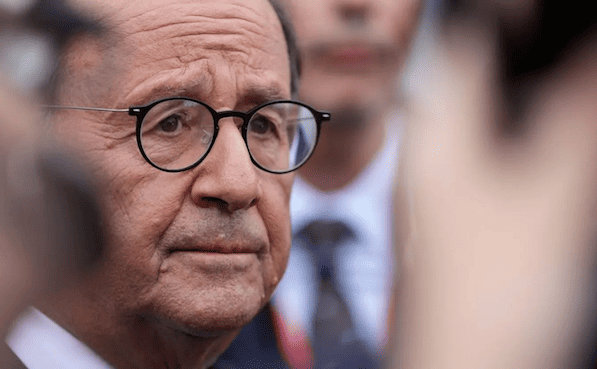
Then, suddenly, François Hollande comes in.
Until last night, Le Pen’s victory in five months seemed the most plausible outcome. But the former president appeared on LCI Channel and delivered a remarkably convincing performance, presenting himself as a potential alternative—and perhaps a political saviour.
The new François Hollande (like Le Beaujolais nouveau!) emerged as a reassuring figure, contrasting with Le Pen, whose presidency remains untested. As a former Socialist Party leader, he could reclaim Socialist voters drifting toward Mélenchon and Glucksmann.
More importantly, Hollande positioned himself as a candidate capable of rebuilding the so-called Republican front—the cross-party alliance of left and right that has historically blocked the Le Pen family from the presidency since Jacques Chirac’s era. Voters who might support Le Pen primarily to prevent a Mélenchon victory could conceivably rally behind Hollande instead.
Even Trump might not oppose him.
Despite their ideological differences, Hollande left office deeply resentful of Barack Obama, whom he felt had abandoned France over Syria. After Assad’s chemical weapons attacks in 2012, French fighters were reportedly ready to strike Damascus, but Obama backed away, citing the need for congressional approval. Britain followed suit.
Hollande had been more assertive than Obama in seeking Assad’s removal. He also ordered French intervention in Mali to prevent its collapse into extremist hands and cancelled the sale of a helicopter carrier to Russia following its aggression in Ukraine. His positions on Ukraine and NATO were markedly more aligned with the Atlantic alliance than those of either Le Pen or Mélenchon.
On Arab affairs, Hollande would also bring familiarity with regional issues and potentially greater alignment with Arab and Gulf interests.
What happens next?
Hollande has not formally declared his candidacy but has invited the French to rally behind him. He has until January to persuade public opinion, the Socialist Party and potentially conservative voters. Polls will quickly reveal whether his gamble has traction.
If successful, he could emerge as Le Pen’s opponent in the second round. If he fails, it may become difficult for any other candidate to prevent her from reaching the presidency.
His challenge would then be formidable: reclaiming working-class voters in cities and suburbs increasingly drawn to Le Pen, overcoming public disappointment with the Socialists, and persuading conservative voters to support a candidate who is socialist in name, if not necessarily in practice—much like Tony Blair.
He would also need substantial financial backing from business leaders, a clearer stance on immigration, unemployment, drugs and organised crime, and alliances with the conservative right.
Can François Hollande defeat Marine Le Pen?
Possibly—but narrowly, and with considerable difficulty.
Hollande has chosen his moment well. Just as the presidential race appeared settled in Le Pen’s favour, he has presented himself as a credible alternative capable of uniting left and right.
The betting is now wide open.